The Smallest Number That Can Make or Break Your Trade
Here's a scenario: you open your first EUR/USD trade. The price moves from 1.1050 to 1.1060. That's a tiny change — just 0.0010. But depending on your position size, that microscopic move could mean $1, $10, or even $100 in your pocket.
That tiny unit of movement? It's called a pip — and it's the heartbeat of every forex trade you'll ever make.
If you don't understand pips, you can't calculate your profit, set your stop loss, or manage your risk. So let's make sure you understand them — completely.
What Exactly is a Pip?
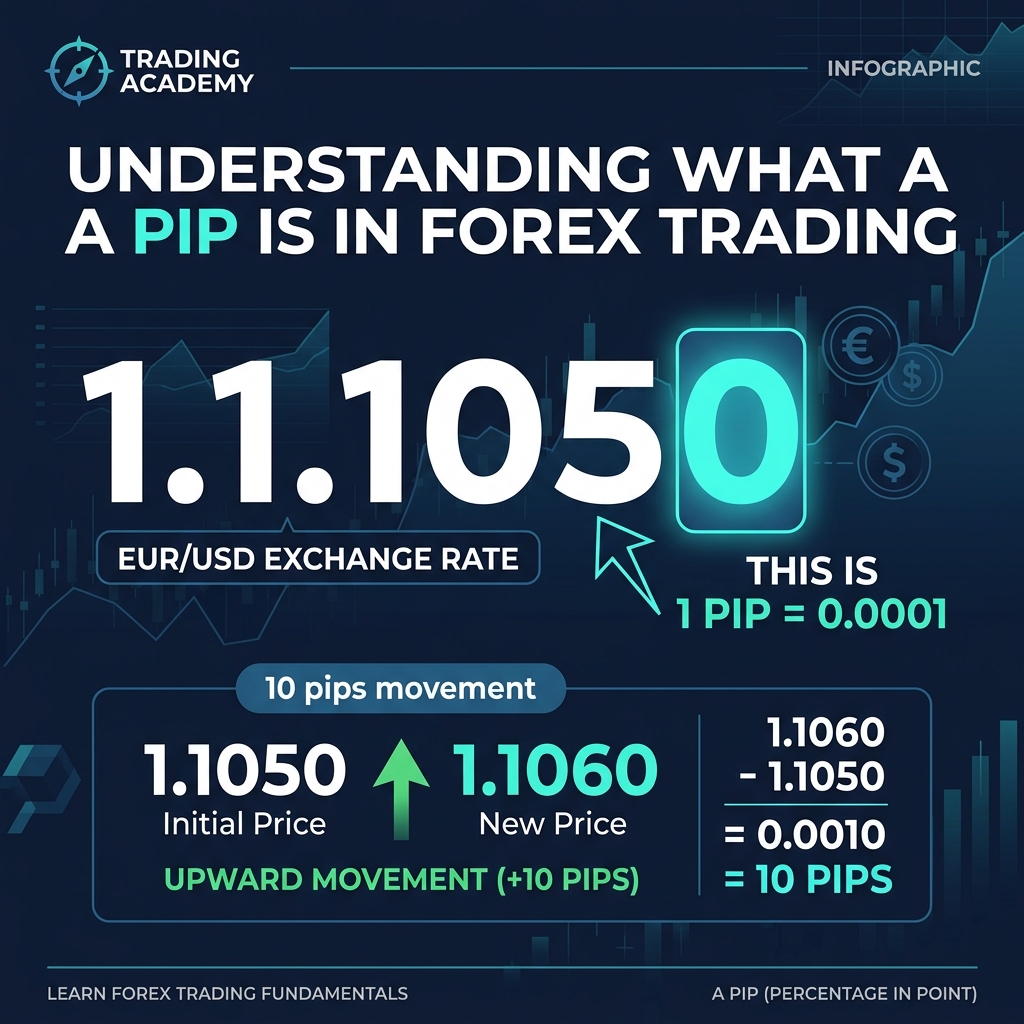
Pip stands for "Percentage in Point" (or "Price Interest Point" — traders love their acronyms). It's the smallest standard unit of price movement in a currency pair.
For most currency pairs, a pip is the fourth decimal place:
EUR/USD moves from 1.1050 to 1.1060 = 10 pips
That's it. One pip = 0.0001. Simple.
The Japanese Yen Exception
There's one important exception. Currency pairs involving the Japanese Yen (JPY) are quoted to only two decimal places. So for yen pairs:
USD/JPY moves from 149.50 to 149.60 = 10 pips
For JPY pairs, one pip = 0.01 instead of 0.0001.
What About Pipettes?
You might notice that some brokers show five decimal places (or three for JPY pairs). That extra digit is called a pipette — it's 1/10th of a pip.
Example: EUR/USD at 1.10503 — the "3" is a pipette. Most traders ignore pipettes for general calculations, but they show up on your platform. Don't let them confuse you.
How to Calculate Pip Value
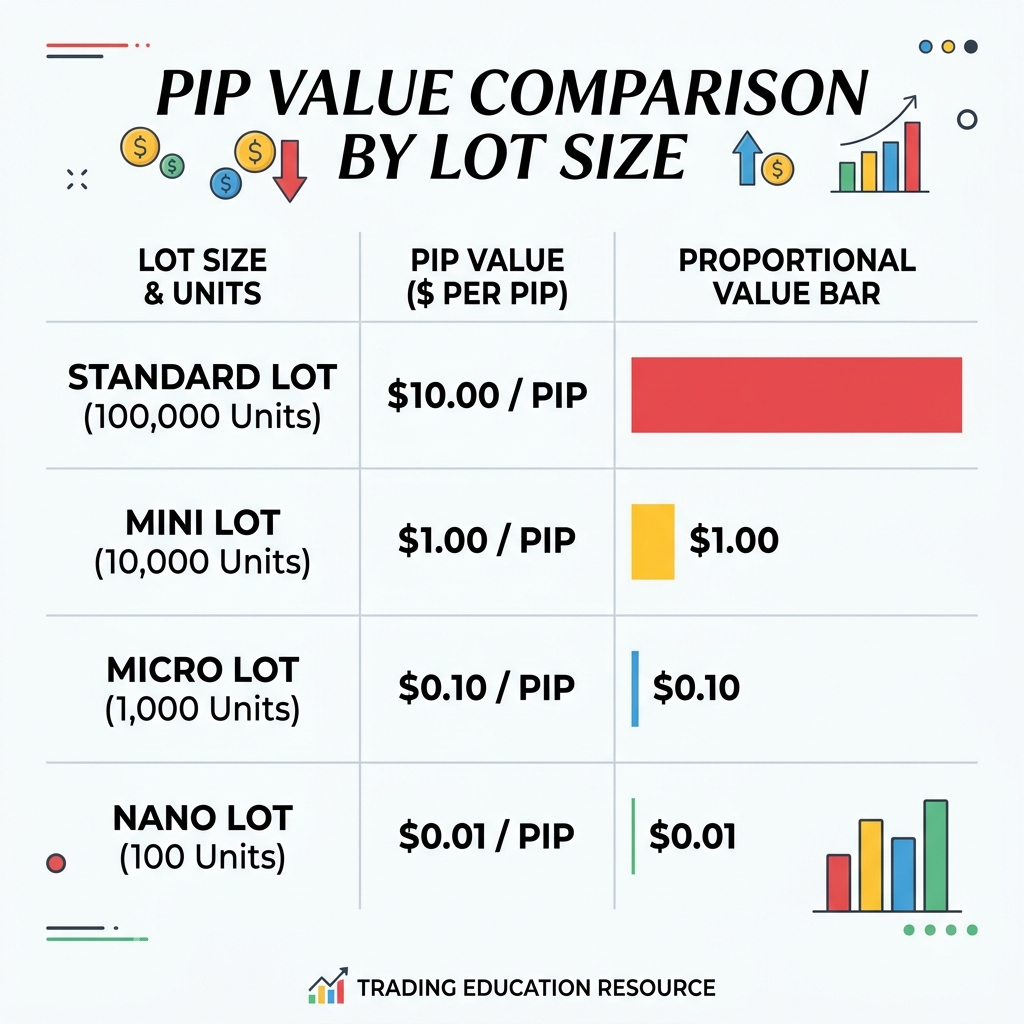
This is where it gets practical. A pip isn't worth the same amount in every trade — its value depends on two things:
- Your position size (how many units you're trading)
- The currency pair you're trading
Here's the formula:
Pip Value = (0.0001 ÷ Exchange Rate) × Position Size
But let's skip the math headaches. Here's a cheat sheet for the most common scenario — trading EUR/USD:
| Lot Type | Units | Pip Value |
|---|---|---|
| Standard Lot | 100,000 | $10 per pip |
| Mini Lot | 10,000 | $1 per pip |
| Micro Lot | 1,000 | $0.10 per pip |
| Nano Lot | 100 | $0.01 per pip |
⚠️ Important: When USD is not the quote currency (like in USD/JPY or EUR/GBP), the pip value changes with the exchange rate. Your broker calculates this automatically, but it's good to know why your P&L might look slightly different.
Pips in Action: Real Trade Examples
Let's make this concrete with real scenarios:
Example 1: A Winning Trade
- You buy EUR/USD at 1.1050
- Price rises to 1.1085
- Movement: 35 pips in your favor
- Position: 1 mini lot (10,000 units)
- Profit: 35 × $1 = $35
Example 2: A Losing Trade
- You sell GBP/USD at 1.2700
- Price rises to 1.2725 (goes against you)
- Movement: 25 pips against you
- Position: 1 standard lot (100,000 units)
- Loss: 25 × $10 = $250
See how the same number of pips can mean vastly different dollar amounts? That's why position sizing matters just as much as direction.
Why Pips Matter More Than You Think
Pips aren't just a unit of measurement. They're the language of risk management. Here's how professional traders use pips every single day:
| Use Case | How Pips Help |
|---|---|
| Stop Loss | "I'll risk 30 pips on this trade" = precise risk control |
| Take Profit | "My target is 60 pips away" = clear reward objective |
| Risk-Reward Ratio | 30 pip risk vs 60 pip reward = 1:2 ratio ✅ |
| Spread Cost | "The spread is 1.5 pips" = knowing your entry cost |
| Volatility | "EUR/USD moved 80 pips today" = market activity gauge |
Once you start thinking in pips, you stop seeing random numbers on a screen and start seeing opportunities and risks in precise terms.
Frequently Asked Questions
How many pips is $1?
It depends on your position size. With a micro lot (1,000 units) on EUR/USD, $1 = 10 pips. With a mini lot, $1 = 1 pip. With a standard lot, $1 = 0.1 pips.
What does "50 pips" mean?
It means the exchange rate moved by 0.0050 (or 0.50 for JPY pairs). Whether that's profit or loss depends on your trade direction and position size.
Are pips the same for all currency pairs?
The concept is the same, but the value differs. A pip on EUR/USD is worth a different dollar amount than a pip on USD/JPY or GBP/CHF because of exchange rate differences.
Do I need to calculate pip values manually?
No — your trading platform does this automatically. But understanding the concept helps you make better decisions about position sizing and risk.
Quick Recap
- ✅ A pip = the fourth decimal place (0.0001) for most pairs
- ✅ JPY pairs are the exception: one pip = 0.01
- ✅ Pip value depends on your position size and currency pair
- ✅ Standard lot = $10/pip, Mini = $1/pip, Micro = $0.10/pip
- ✅ Pips are the foundation of risk management and trade planning
🎯 Your Action Step
Open your demo account and pull up EUR/USD. Watch the price for 60 seconds. Count how many pips it moves. Now calculate: if you had a mini lot open, how much would you have gained or lost?
That's your first real-world pip calculation. And from here, everything else in trading starts to make sense.