The Market That Never Sleeps — But You Should
Forex trades 24 hours a day, 5 days a week. Sounds amazing, right? Trade whenever you want!
But here's what nobody tells beginners: not all hours are created equal. Trading at the wrong time is like fishing in an empty pond — you'll sit there for hours with nothing to show for it.
The secret isn't that the market is always open. It's knowing when the market is actually alive — and when to step away.
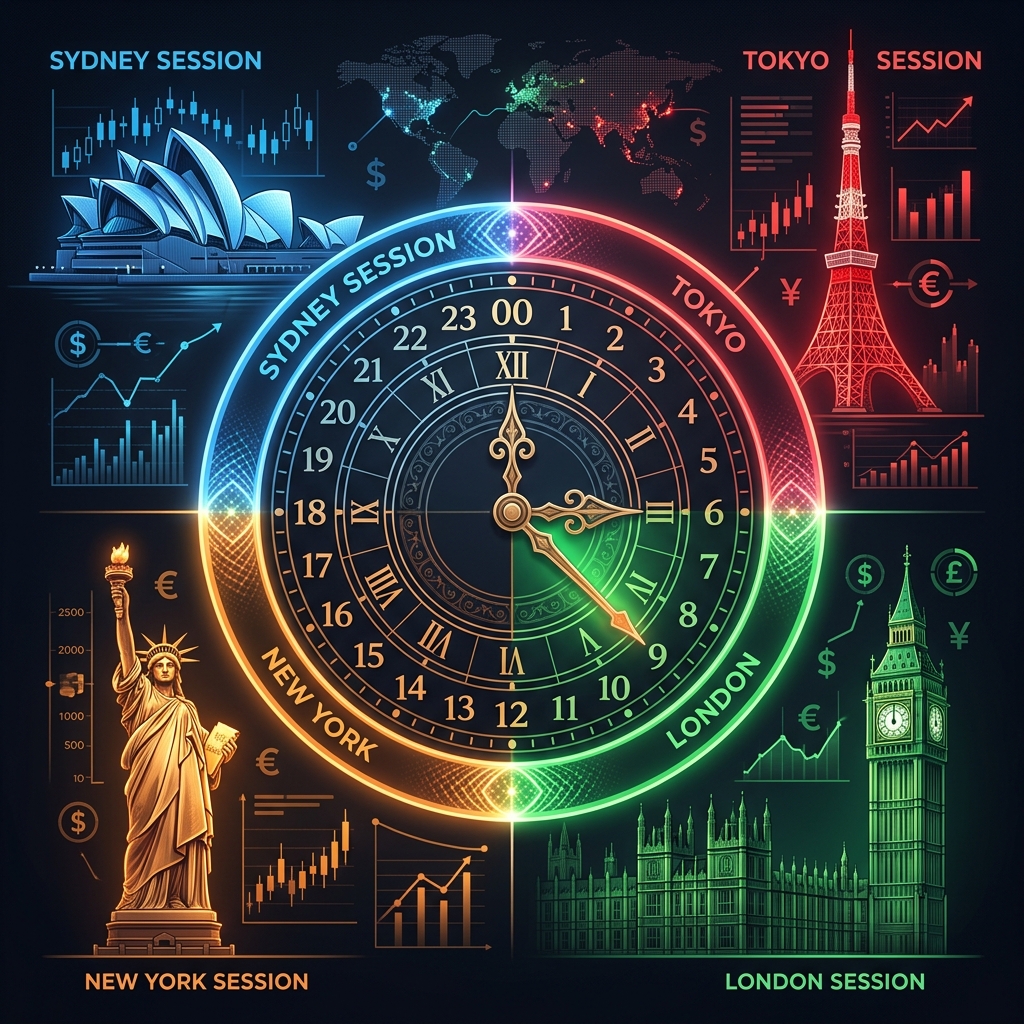
The Four Global Trading Sessions
The forex market doesn't operate from one location. Instead, it follows the sun across four major financial hubs. As one closes, another opens — creating a continuous cycle.
| Session | Local Open | UTC Open | UTC Close | Character |
|---|---|---|---|---|
| 🇦🇺 Sydney | 7:00 AM AEST | 10:00 PM | 7:00 AM | Calm start to the week |
| 🇯🇵 Tokyo | 9:00 AM JST | 12:00 AM | 9:00 AM | JPY pairs dominate, steady flow |
| 🇬🇧 London | 8:00 AM GMT | 8:00 AM | 4:00 PM | Highest volume, trend-setting |
| 🇺🇸 New York | 8:00 AM EST | 1:00 PM | 10:00 PM | USD pairs surge, news-driven |
The trading week begins Sunday 10 PM UTC (when Sydney opens) and ends Friday 10 PM UTC (when New York closes).
Session Overlaps — Where the Real Action Happens
The most profitable times to trade are when two sessions overlap. During overlaps, more traders are active, which means: more volume, more volatility, tighter spreads, and bigger moves.
| Overlap | Time (UTC) | Why It Matters |
|---|---|---|
| 🇬🇧🇺🇸 London + New York | 1:00 PM – 4:00 PM | The most liquid period — 58% of all FX trades happen here |
| 🇦🇺🇯🇵 Sydney + Tokyo | 12:00 AM – 7:00 AM | Good for AUD, NZD, and JPY pairs |
| 🇯🇵🇬🇧 Tokyo + London | 8:00 AM – 9:00 AM | Brief but can produce sharp moves |
The London-New York overlap is king. If you can only trade during one window, make it this one. Nearly 58% of all forex trades happen during this 3-hour period.
How Each Session Behaves
Sydney Session (10 PM – 7 AM UTC)
The quietest session. Low volatility, small pip ranges. Good for easing into the week — but don't expect fireworks. AUD and NZD pairs see the most action.
Tokyo Session (12 AM – 9 AM UTC)
USD/JPY is the star here, thanks to the Bank of Japan's enormous influence. The Tokyo session tends to have steady, trending moves rather than sharp spikes. If you're in Asia or a night owl in the West, this is your window.
London Session (8 AM – 4 PM UTC)
This is the heavyweight champion. London accounts for ~38% of global forex trading. The session opens with institutional traders entering the market aggressively, often setting the day's direction.
Average pip movement per pair during London:
| Pair | Avg. Pips (London) | Avg. Pips (Tokyo) |
|---|---|---|
| EUR/USD | 114 | 76 |
| GBP/USD | 127 | 92 |
| USD/JPY | 66 | 51 |
| GBP/JPY | 151 | 118 |
London moves are significantly larger than Tokyo. More movement = more opportunity (and more risk).
New York Session (1 PM – 10 PM UTC)
The New York session is driven by economic data releases — NFP (Non-Farm Payrolls), CPI (inflation data), and FOMC announcements all hit during this session. USD pairs see massive spikes around these events.
Best and Worst Days of the Week
Even the days of the week have different personalities:
| Day | Character | Best For |
|---|---|---|
| Monday | Slow start, gaps from weekend | Analyzing, setting up |
| Tuesday | Volatility picks up | Entering positions |
| Wednesday | Peak activity | Active trading |
| Thursday | Highest average pip range | Active trading |
| Friday | Active until noon EST, then dies | Morning trades only, close positions |
Pro tip: Most experienced traders are most active Tuesday through Thursday. Monday is for analysis, Friday afternoon is for closing positions — not opening new ones.
What Other Sites Don't Tell You
- Trading during low-volume hours (7–10 PM UTC) can be dangerous. Spreads widen, and a single large order can create fake breakouts.
- Sunday night gaps are real. If major news breaks over the weekend, prices can "gap" — opening at a different level than Friday's close. Your stop loss might not protect you.
- "24 hours" doesn't mean you should trade 24 hours. Overtrading is one of the top account killers. Pick YOUR session, master it, and ignore the rest.

Frequently Asked Questions
What's the best forex session for beginners?
The London session (8 AM – 4 PM UTC). It has the most volume, clearest trends, and tightest spreads. If you can catch the London-New York overlap (1–4 PM UTC), even better.
Can I trade forex on weekends?
The standard forex market is closed Saturday and Sunday. Some brokers offer weekend trading on select pairs, but liquidity is extremely low and spreads are wide — it's not recommended for beginners.
How do I know what timezone the market hours are in?
Most sources use either UTC (Coordinated Universal Time) or EST (Eastern Standard Time). Use a world clock app or tools like Forex Factory's market hours page to convert to your local time.
Does daylight savings affect market hours?
Yes! Countries that change clocks in spring and fall (US, UK, Australia) shift their session times by an hour. Always double-check during March/April and October/November transitions.
Quick Recap
- ✅ Forex runs 24/5 across 4 sessions: Sydney → Tokyo → London → New York
- ✅ The London-New York overlap (1–4 PM UTC) is the most active and liquid period
- ✅ Tuesday–Thursday are the best days; Monday is slow, Friday afternoon is dead
- ✅ London session produces the largest pip movements
- ✅ Pick ONE session that fits your schedule and master it — don't try to trade 24 hours
🎯 Your Action Step
Figure out which session matches YOUR daily schedule:
- Convert the London-New York overlap (1:00 PM – 4:00 PM UTC) to your local time
- Can you trade during those hours? If yes — that's your sweet spot
- If not, check the Tokyo session or early London open
- Write it down: "My trading window is _____ to _____ local time"
Having a defined trading schedule is the first step toward discipline — and discipline is what separates profitable traders from everyone else.