You Already Trade Forex — You Just Don't Know It Yet
Every time you've bought something from Amazon, booked a flight overseas, or scrolled past a "USD/EUR" ticker on the news — you've brushed against the forex market. You just didn't know it had a name.
Forex (short for Foreign Exchange) is the global marketplace where currencies are bought, sold, and exchanged. It's the single largest financial market on the planet, and it dwarfs everything else you've ever heard of.
How big? $6.6 trillion changes hands every single day.
To put that in perspective: the New York Stock Exchange — the most famous stock market in the world — trades roughly $16.7 billion daily. That's huge. But forex? Forex does 400 times that amount. Every. Single. Day.
And yet, most people have never heard a proper explanation of what it actually is. Let's fix that — right now.
So What Exactly is the Forex Market?
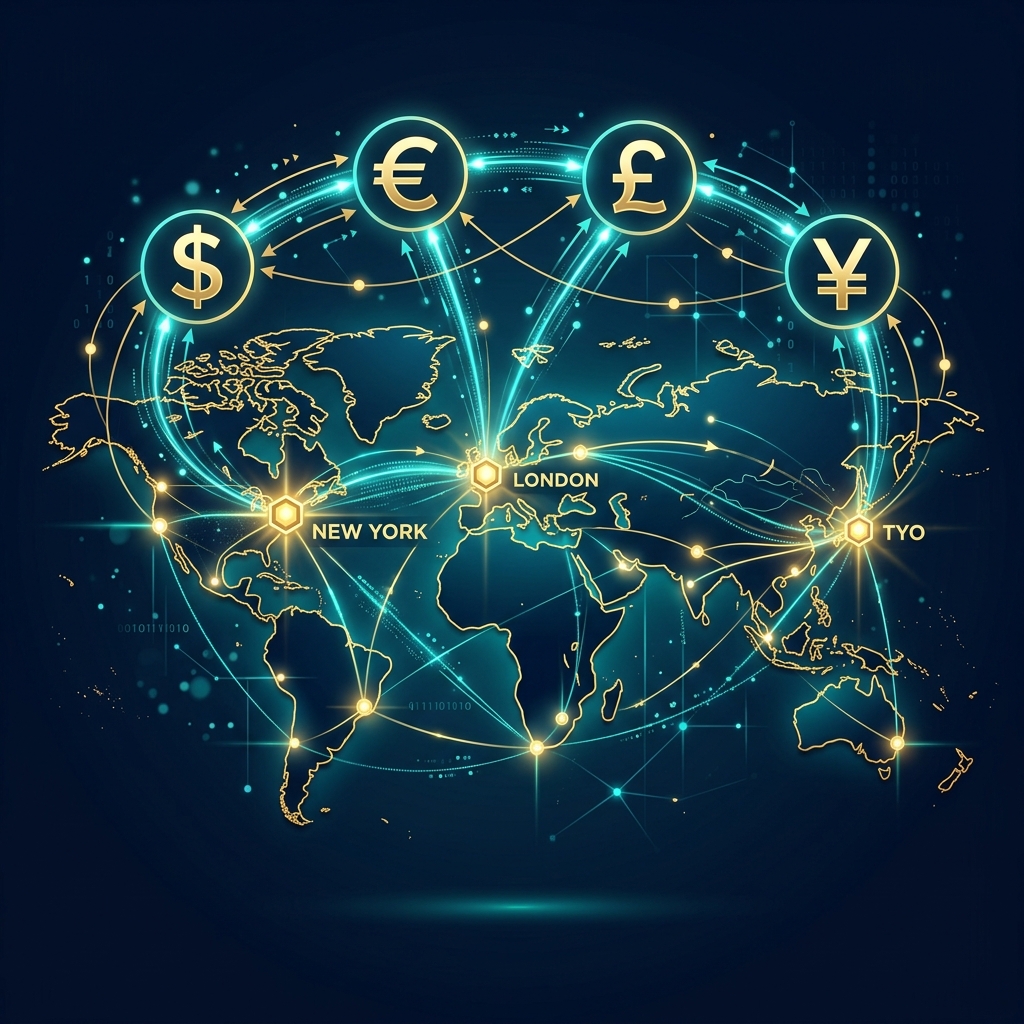
At its core, the forex market is beautifully simple: it's where one currency gets exchanged for another.
Think about the last time you traveled abroad. You walked into an airport booth, handed over your US dollars, and received euros, yen, or baht. That transaction — swapping one currency for another — is forex in action.
The difference? Professional forex traders do this on a massive scale, and they're not exchanging money for a vacation. They're speculating on which currency will get stronger or weaker — and profiting from the difference.
Here's the simple version:
- If you think the euro will strengthen against the US dollar → you buy EUR/USD
- If the euro actually goes up → you sell it back at the higher price → profit
- If the euro goes down instead → you take a loss
That's it. That's forex trading.
Why Forex is Different From Every Other Market
If you're coming from stocks, crypto, or real estate, the forex market might feel like a different universe. That's because it is. Here's what makes it unique:
1. It Never Sleeps (Well, Almost)
Unlike the stock market, which opens at 9:30 AM and closes at 4 PM, the forex market runs 24 hours a day, 5 days a week. It follows the sun around the globe:
| Session | Opens (UTC) | Closes (UTC) | Key Feature |
|---|---|---|---|
| 🇦🇺 Sydney | 10:00 PM | 7:00 AM | Week kicks off here |
| 🇯🇵 Tokyo | 12:00 AM | 9:00 AM | JPY pairs come alive |
| 🇬🇧 London | 8:00 AM | 4:00 PM | Biggest volume session |
| 🇺🇸 New York | 1:00 PM | 10:00 PM | USD pairs dominate |
When New York winds down, Sydney wakes up. The cycle never stops — giving you flexibility to trade on your schedule.
2. Insane Liquidity
With $6.6 trillion flowing through daily, forex is the most liquid market in the world. What does that mean for you?
- You can get in and out instantly. No waiting around for a buyer.
- Spreads are tight. The cost of entering a trade on major pairs (like EUR/USD) is extremely low.
- Minimal slippage. The price you see is usually very close to the price you get.
3. You Can Profit in Any Direction
In stocks, most beginners only know how to "buy low, sell high." In forex, you can also sell first and buy back later at a lower price — known as "going short."
Currency going up? You can make money. Currency going down? You can make money. This two-way flexibility is a game-changer.
4. Low Barriers to Entry
You don't need $25,000 like US stock day traders. Many forex brokers let you open an account with as little as $50–$100, with micro lots that make risk manageable even for small accounts.
How Forex Trading Actually Works
Here's what a real forex trade looks like, step by step:
The Setup
Let's say you believe the euro will strengthen against the US dollar. You look at the EUR/USD pair, currently trading at 1.1000.
This price means: one euro costs 1.10 US dollars.
The Trade
- You buy EUR/USD at 1.1000 (you're buying euros, selling dollars)
- Price rises to 1.1100 — the euro got stronger
- You close the trade — pocketing the 100-pip difference
On a standard lot (100,000 units), that 100-pip move = $1,000 profit.
Of course, if EUR/USD had dropped to 1.0900 instead? That's a $1,000 loss. Forex is a double-edged sword — which is exactly why risk management matters (we'll cover that in Level 3).
The 4 Key Differences: Forex vs Stocks
| Feature | Forex Market | Stock Market |
|---|---|---|
| Daily Volume | ~$6.6 trillion | ~$16.7 billion |
| Hours | 24/5 (non-stop) | Fixed exchange hours |
| Liquidity | Extremely high | Varies by stock |
| Direction | Long & Short equally easy | Shorting is restricted |
| Commission | Usually zero (spread-based) | Broker commission applies |
What Other Sites Don't Tell You
Most "What is Forex?" articles make it sound like free money. Let's be honest about the other side:
- Leverage amplifies both profits AND losses. You can control $100,000 with $1,000 — but a small move against you can wipe out your account.
- 71% of retail traders lose money. That's not a scary statistic to scare you away — it's a fact that should motivate you to learn properly before risking real money.
- Forex is NOT a get-rich-quick scheme. The traders who survive long-term treat it as a skill — like learning a musical instrument. It takes months of practice.
The good news? You're already ahead of most beginners because you're reading this — learning the fundamentals before jumping in blind.
Frequently Asked Questions
Is forex trading legal?
Yes, forex trading is legal in most countries, including the US, UK, EU, Australia, and most of Asia. However, regulations vary — always check with your country's financial authority and trade with a regulated broker.
How much money do I need to start trading forex?
Many brokers offer accounts starting from $50–$100. However, most experienced traders recommend starting with at least $200–$500 on a micro account to practice proper risk management.
Can I trade forex on my phone?
Absolutely. All major platforms (MetaTrader 4, MetaTrader 5, TradingView) have mobile apps. Many traders analyze on desktop and execute on mobile.
Is forex riskier than stocks?
Not inherently — but the high leverage available in forex can make it riskier if misused. Without leverage, currency moves are relatively small. The key is proper position sizing and risk management.
Quick Recap
- ✅ Forex is the global market for exchanging currencies — $6.6 trillion daily
- ✅ It operates 24 hours a day, 5 days a week across 4 major sessions
- ✅ You can profit from currencies going up or down
- ✅ High liquidity means low costs and fast execution
- ✅ Leverage is powerful but dangerous if misused
🎯 Your Action Step
Open a free demo account with any regulated broker (MT4 or MT5). Don't trade yet — just open the EUR/USD chart and watch the price move for 5 minutes. Notice how it ticks up and down, constantly. You're watching the world's largest market breathe.
That movement? That's $6.6 trillion flowing. And soon, you'll understand exactly how to read it.