You're Not "Paying" to Trade — You're Putting Down a Deposit
When you hear "margin" in everyday life, you think of margins on a page or profit margins. In forex, margin means something very different — and misunderstanding it is how traders get margin calls that forcefully close their positions at the worst possible time.
Margin is simply the deposit your broker requires to open and maintain a trade. It's not a fee. It's not a cost. It's collateral — like a security deposit on an apartment. You get it back when you close the trade (minus any losses).
But here's where it gets critical: if your losses eat into your margin, your broker will start closing your trades whether you like it or not. That's a margin call. And it's every trader's nightmare. Let's make sure it never happens to you.
Margin Terminology: The 4 Numbers You Must Know
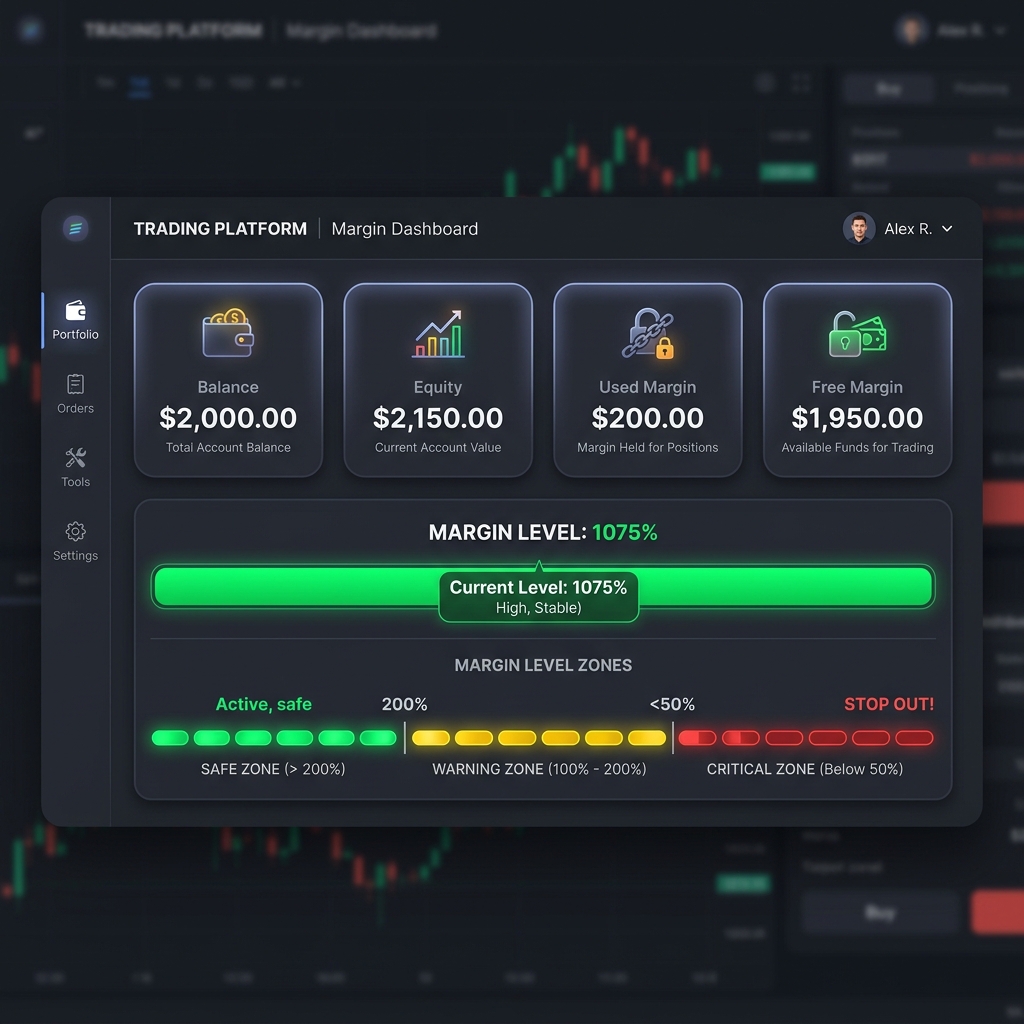
Get comfortable with these terms — they'll be on your trading platform at all times:
| Term | Definition | Example ($2,000 account) |
|---|---|---|
| Balance | Your total deposited funds (doesn't change with open trades) | $2,000 |
| Equity | Balance + unrealized P&L of open positions | $2,150 (if +$150 floating profit) |
| Used Margin | Amount "locked" as collateral for your open trades | $200 (for a position requiring 10% margin) |
| Free Margin | Equity minus Used Margin — what's available for new trades | $1,950 |
The most important number? Free Margin. When it hits zero, you can't open new trades. When your equity drops below a certain percentage of your used margin, you get a margin call.
How Margin is Calculated
The margin your broker requires depends on two things: your position size and the leverage your account is set to.
Required Margin = Position Size ÷ Leverage
Example Calculations
| Position | Leverage | Required Margin |
|---|---|---|
| $100,000 (1 standard lot) | 100:1 | $1,000 |
| $100,000 (1 standard lot) | 50:1 | $2,000 |
| $10,000 (1 mini lot) | 100:1 | $100 |
| $10,000 (1 mini lot) | 50:1 | $200 |
| $1,000 (1 micro lot) | 100:1 | $10 |
Notice the pattern: higher leverage = lower margin requirement. That's why leverage is tempting — it lets you open bigger positions with less money locked up. But don't confuse "less margin required" with "less risk." The risk comes from position size, not margin.
Margin Level: Your Account's Health Meter
Your trading platform shows a percentage called Margin Level. This is the critical health indicator of your account:
Margin Level = (Equity ÷ Used Margin) × 100%
| Margin Level | Status | What Happens |
|---|---|---|
| Above 200% | 🟢 Healthy | Trading normally, room for new positions |
| 100% – 200% | 🟡 Caution | Still open, but limited room |
| 100% | 🟠 Margin Call | Broker warns you — no new trades allowed |
| Below 50% (varies) | 🔴 Stop Out | Broker automatically closes your losing positions |
⚠️ The stop-out level varies by broker — some close at 50%, others at 20%. Always check your broker's specific margin call and stop-out levels.
The Margin Call: What It Looks Like in Real Time
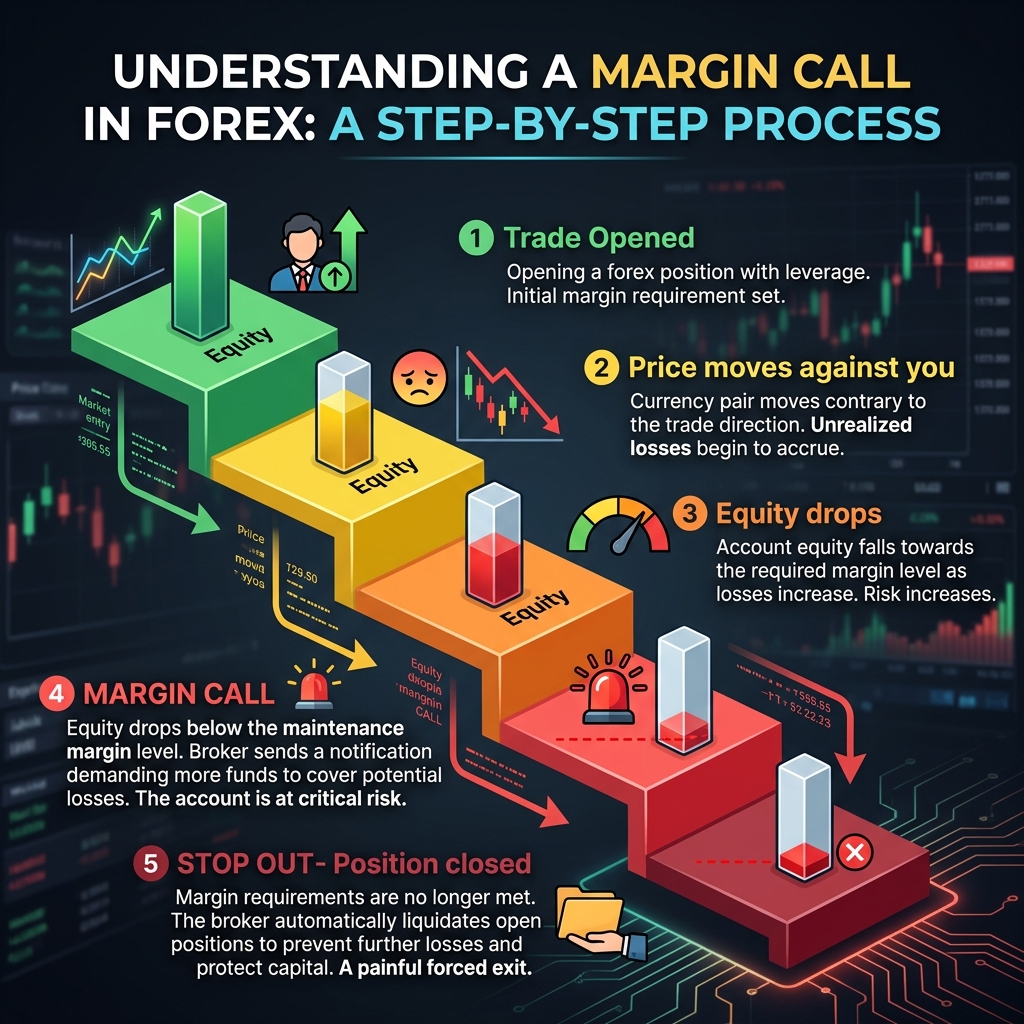
Here's a real scenario that plays out every day:
- Account balance: $1,000
- You open: 1 standard lot EUR/USD (margin required: $1,000 at 100:1)
- Free margin: $0 — you've used everything
- EUR/USD drops 10 pips → Loss: $100 → Equity: $900
- Margin level: 90% → Margin call triggered
- EUR/USD drops 40 more pips → Equity: $500 → Stop out — position forcefully closed
- Final balance: $500 → You lost 50% of your account on one trade
The painful irony? EUR/USD might have recovered the next day. But you weren't in the trade anymore — because your broker closed it to protect themselves (and you) from further losses.
How to Avoid Margin Calls: 3 Golden Rules
Rule 1: Never Use More Than 10-15% of Your Account as Margin
If you have $2,000, keep your total used margin under $300. This gives you massive breathing room for floating losses.
Rule 2: Always Use Stop Losses
A stop loss closes your trade at a predetermined level, preventing losses from spiraling into margin call territory. Every single trade should have a stop loss.
Rule 3: Monitor Your Margin Level
Check your margin level before opening any new trade. If it's below 300%, think twice. If it's below 150%, you're in the danger zone.
Frequently Asked Questions
Is margin the same as leverage?
They're related but different. Leverage is the ratio (100:1). Margin is the actual dollar amount required as collateral. 100:1 leverage means 1% margin. 50:1 means 2% margin. They're two sides of the same coin.
Do I get my margin back?
Yes — when you close a trade, the margin is released back into your available balance (minus any losses from the trade).
Can I add money to avoid a margin call?
Yes — depositing additional funds increases your equity and margin level. Some traders do this in emergencies, but it's better to avoid the situation entirely through proper position sizing.
What happens if I have multiple positions open?
The margin requirements add up. If you have 3 mini lots open, you need 3x the margin of a single mini lot. This is why over-trading (too many positions at once) is dangerous.
Quick Recap
- ✅ Margin is a deposit, not a fee — you get it back when you close a trade
- ✅ Required Margin = Position Size ÷ Leverage
- ✅ Margin Level = Equity ÷ Used Margin (keep it above 200%)
- ✅ A margin call happens when equity drops below used margin
- ✅ Stop out = broker forcefully closes your positions — avoid at all costs
🎯 Your Action Step
Open your demo account and look at the bottom of your trading terminal. Find these four numbers: Balance, Equity, Used Margin, Free Margin. Now open a small trade and watch how they change in real-time. Close the trade and watch them reset. That cycle — margin locked → margin released — is the mechanics of every trade you'll ever make.