The Tool That Can 10x Your Gains — Or Destroy Your Account Overnight
Imagine you want to buy a $200,000 apartment, but you only have $10,000. A bank lends you the rest. If the property goes up 5%, you didn't make $500 on your $10,000 — you made $10,000. A 100% return on your actual investment.
That's leverage. And in forex, it works the same way — except the "property" is currency, the "bank" is your broker, and the stakes are much, much faster.
Leverage is the reason a trader with $500 can control $50,000 worth of currency. It's also the reason most beginners blow their accounts in the first 3 months. Let's learn how to use it wisely.
What is Leverage in Forex?
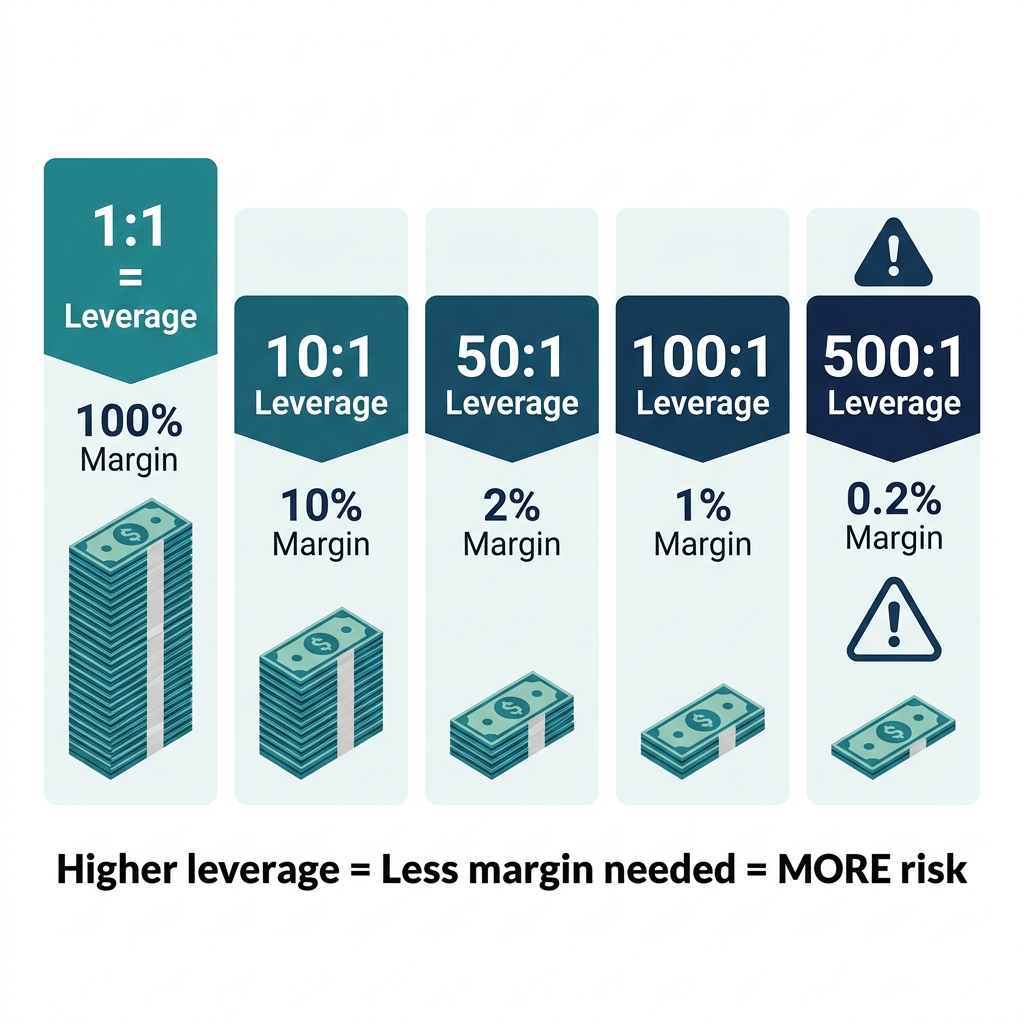
Leverage is borrowed capital from your broker that allows you to control a larger position than your account balance would normally allow.
It's expressed as a ratio:
| Leverage | Capital Needed for $100,000 Position | Margin Required |
|---|---|---|
| 1:1 (No leverage) | $100,000 | 100% |
| 10:1 | $10,000 | 10% |
| 50:1 | $2,000 | 2% |
| 100:1 | $1,000 | 1% |
| 500:1 | $200 | 0.2% |
With 100:1 leverage, every $1 in your account controls $100 in the market. Sounds amazing, right? Keep reading.
The Double-Edged Sword: A Real Example

Let's compare two traders with the same $1,000 account, both buying EUR/USD:
Trader A: Uses 10:1 Leverage
- Controls $10,000 position (1 mini lot)
- EUR/USD rises 50 pips → +$50 profit (5% gain)
- EUR/USD drops 50 pips → -$50 loss (5% loss)
Trader B: Uses 100:1 Leverage
- Controls $100,000 position (1 standard lot)
- EUR/USD rises 50 pips → +$500 profit (50% gain) 🎉
- EUR/USD drops 50 pips → -$500 loss (50% loss) 💀
Same market. Same move. But Trader B is one bad trade away from losing half their account. Two bad trades in a row? Account gone.
💡 Key insight: Leverage doesn't change how much the market moves. It changes how much that movement costs you.
Leverage Around the World
Different countries have different leverage limits — for good reason. Here's the current landscape:
| Region | Max Leverage (Retail) | Regulator |
|---|---|---|
| 🇺🇸 United States | 50:1 | NFA/CFTC |
| 🇪🇺 Europe | 30:1 | ESMA |
| 🇬🇧 United Kingdom | 30:1 | FCA |
| 🇦🇺 Australia | 30:1 | ASIC |
| 🌏 Offshore Brokers | 500:1 – 3000:1 | Varies (risky) |
⚠️ Warning: Brokers offering 500:1 or higher leverage are usually offshore and lightly regulated. Higher leverage isn't a benefit — it's a trap for undisciplined traders.
How Much Leverage Should You Actually Use?
Just because your broker offers 100:1 leverage doesn't mean you should use 100:1 leverage. Here's what professionals recommend:
| Experience Level | Recommended Effective Leverage | Why |
|---|---|---|
| Beginner | 5:1 – 10:1 | Survive learning mistakes |
| Intermediate | 10:1 – 25:1 | Scale with proven strategy |
| Advanced | 15:1 – 50:1 | Optimize returns with tight risk |
The key concept here is effective leverage — the ratio between your total open position size and your account equity. Even if your broker offers 100:1, if you only open a $5,000 position with $1,000, your effective leverage is just 5:1.
🎯 Pro tip: Control your leverage through lot sizing, not by changing your broker's leverage settings. A small lot with high available leverage is safer than a big lot with low available leverage.
The Leverage Trap: Why Most Beginners Fail
Studies consistently show that 70-80% of retail forex traders lose money. The #1 reason? Over-leveraging.
Here's the psychology behind it:
- You win a few trades → Confidence grows
- You increase leverage → "Why trade small when I can trade big?"
- A normal losing streak hits → 3-4 losses in a row (happens to everyone)
- Account is destroyed → Because each loss was amplified by leverage
The market didn't change. Your analysis didn't get worse. Your position size killed you because the leverage magnified normal losses into fatal ones.
Frequently Asked Questions
Can I lose more than my deposit with leverage?
Most regulated brokers offer negative balance protection, meaning your losses are capped at your account balance. However, in extreme market gaps, some brokers may not guarantee this. Always check your broker's policy.
Does leverage cost money?
Leverage itself is free — your broker doesn't charge interest for intraday positions in most cases. However, holding positions overnight incurs a swap fee (covered in a later lesson).
Should I always use the maximum leverage available?
Absolutely not. Maximum leverage is like driving at maximum speed — technically possible, but a recipe for disaster. Use what your risk management formula dictates.
What's the difference between leverage and margin?
They're two sides of the same coin. Leverage is the ratio (e.g., 100:1), and margin is the deposit required (e.g., 1% of position value). Higher leverage = lower margin requirement. We cover margin in detail in the next lesson.
Quick Recap
- ✅ Leverage lets you control larger positions with less capital
- ✅ It amplifies both gains AND losses equally
- ✅ Beginners should use 5:1 to 10:1 effective leverage
- ✅ Position size controls your actual leverage, not your broker's settings
- ✅ Over-leveraging is the #1 killer of trading accounts
🎯 Your Action Step
Open your demo account and run this experiment: place two identical buy trades on EUR/USD — one with 0.01 lots and one with 0.10 lots. Watch for 30 minutes. Notice how the 0.10 lot position's P&L fluctuates 10x more aggressively for the same price movement. That's leverage at work.
Now ask yourself: which one would let you sleep at night?