Why "How Much" Matters More Than "Which Direction"
Ask any experienced trader what destroyed their first account, and most won't say "I picked the wrong direction." They'll say: "I traded too big."
Position size — how many units of currency you buy or sell — is the single most important risk management decision you make on every trade. And in forex, position sizes are measured in lots.
Get your lot size wrong, and a 20-pip move could wipe out your account. Get it right, and you'll survive the inevitable losing streaks that every trader faces. Let's break it all down.
What is a Lot in Forex?
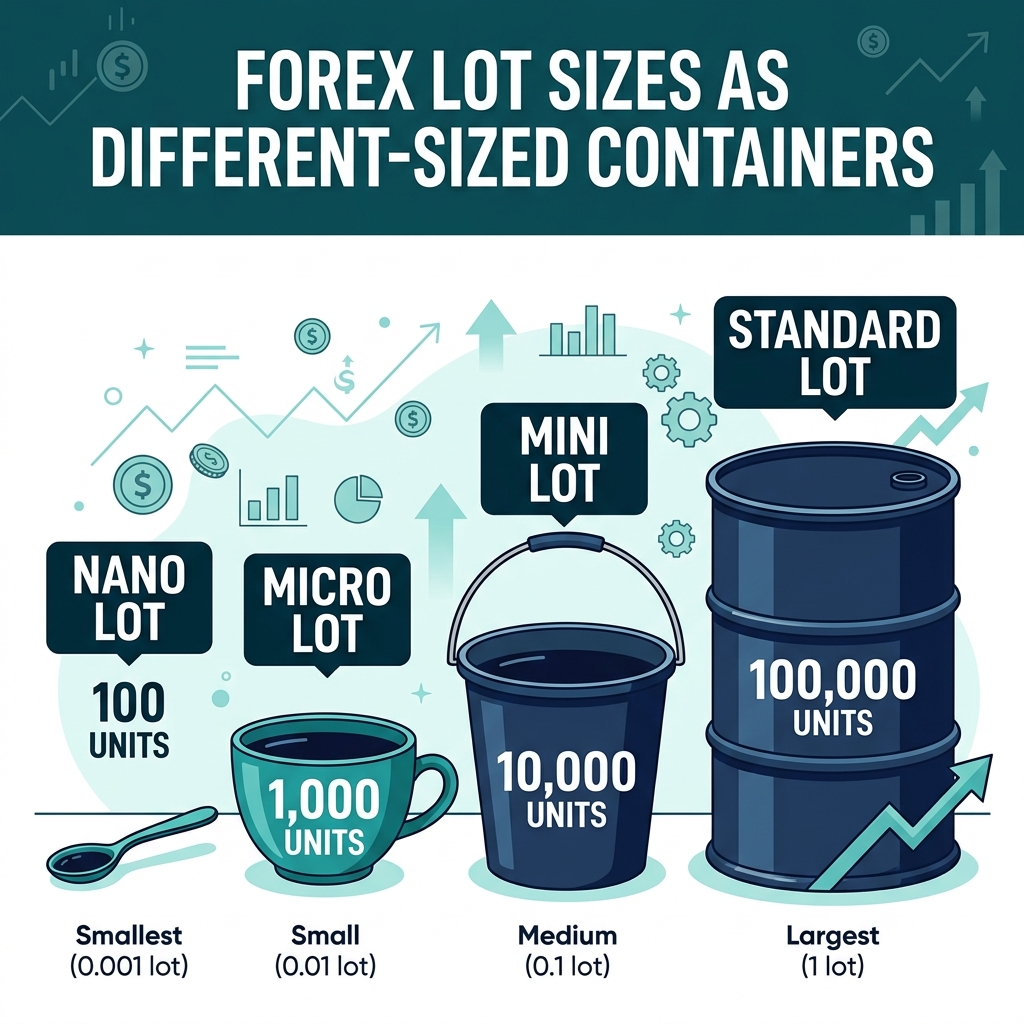
A lot is a standardized unit that measures the amount of currency you're trading. Think of it like buying eggs — you don't buy one at a time, you buy a dozen. In forex, you don't trade one unit of currency — you trade in lots.
There are four lot sizes, each designed for different account sizes and risk tolerances:
| Lot Type | Units | Pip Value (USD pairs) | Best For |
|---|---|---|---|
| 🟢 Nano Lot | 100 | $0.01 | Testing strategies |
| 🔵 Micro Lot | 1,000 | $0.10 | Small accounts ($100-$500) |
| 🟡 Mini Lot | 10,000 | $1.00 | Growing accounts ($500-$5,000) |
| 🔴 Standard Lot | 100,000 | $10.00 | Funded/large accounts ($10,000+) |
Each step up is 10x the size of the previous one. That means each pip is worth 10x more — both when you win and when you lose.
The Real-World Impact of Lot Size
Let's say EUR/USD drops 50 pips against your buy position. How much do you lose?
| Lot Type | 50-Pip Loss | Account Impact ($1,000 account) |
|---|---|---|
| Micro (0.01) | $5.00 | 0.5% — barely noticeable ✅ |
| Mini (0.10) | $50.00 | 5% — manageable ⚠️ |
| Standard (1.0) | $500.00 | 50% — devastating ❌ |
Same market move. Same currency pair. Same direction. But the lot size made the difference between a scratch, a bruise, and a broken account.
How to Choose the Right Lot Size
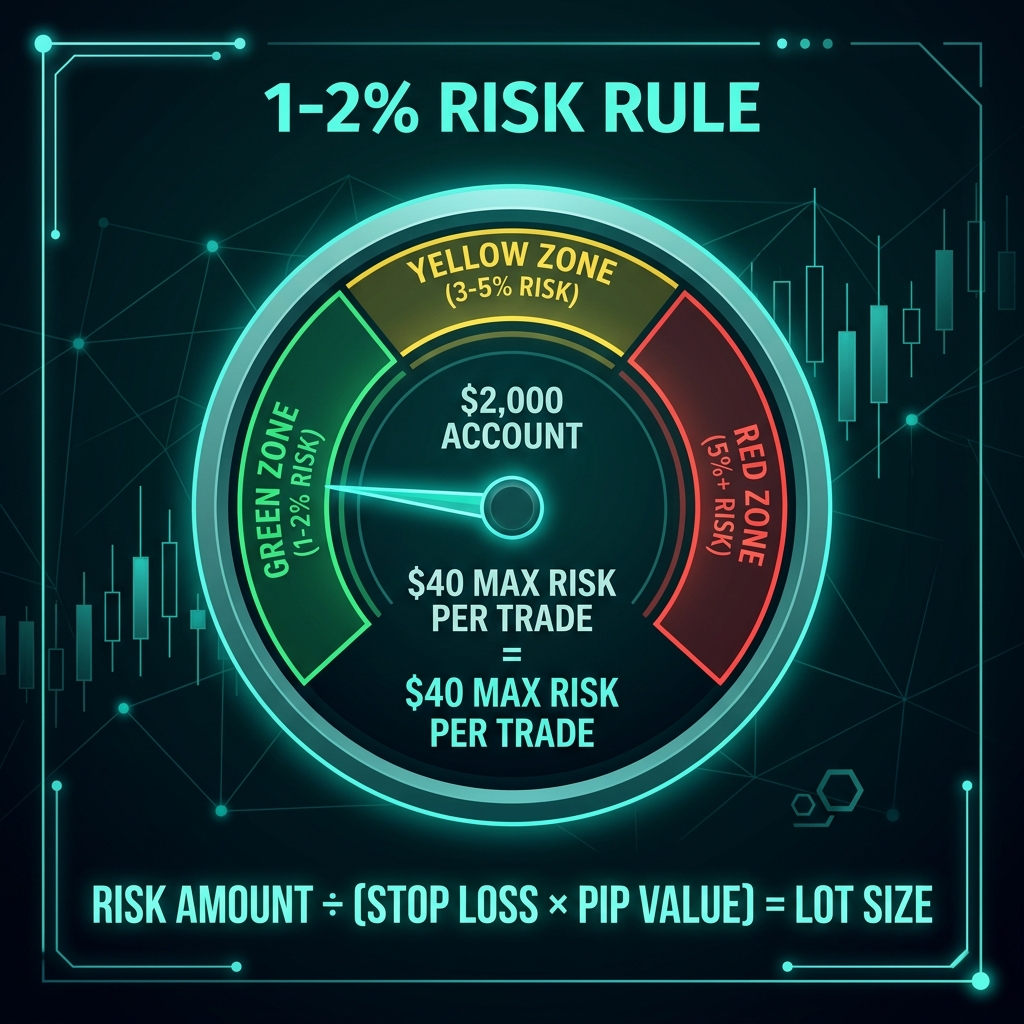
Professional traders don't pick lot sizes randomly. They use a simple formula based on two rules:
The 1-2% Rule
Never risk more than 1-2% of your account on a single trade. This is the golden rule of position sizing. Here's how to apply it:
Lot Size = (Account Balance × Risk %) ÷ (Stop Loss in Pips × Pip Value)
Step-by-Step Example
- Account: $2,000
- Risk per trade: 2% = $40
- Stop loss: 40 pips
- Pip value (mini lot): $1
$40 ÷ (40 × $1) = 1 mini lot
If your stop was only 20 pips, you could trade 2 mini lots and still risk the same $40. The lot size adjusts to the trade — not the other way around.
Common Lot Size Mistakes (And How to Avoid Them)
❌ Mistake 1: Trading Standard Lots on a Small Account
With $500 and a standard lot, a 50-pip move costs $500 — your entire account. Always match lot size to account balance.
❌ Mistake 2: Keeping the Same Lot Size for Every Trade
Different trades have different stop losses. A trade with a 20-pip stop should be twice the size of a trade with a 40-pip stop (assuming the same risk percentage).
❌ Mistake 3: Scaling Up Too Fast
You win 5 trades with micro lots and think "I should be trading standard lots!" Don't. Scale gradually. A 10x jump in size means a 10x jump in emotional pressure.
✅ The Fix: Let the Math Decide
Always calculate your position size before entering a trade. Your platform's built-in calculator or a simple formula will keep your risk consistent regardless of the trade setup.
Lot Sizes and Leverage: The Connection
You might wonder: "How can I trade 100,000 units with a $2,000 account?" The answer is leverage — which we'll cover in the next lesson.
For now, understand this: leverage lets you control larger positions with smaller deposits. But your risk per pip is still determined by your lot size. Leverage doesn't change pip value — it changes how much capital you need to open the trade.
Frequently Asked Questions
What's the smallest lot I can trade?
Most brokers offer micro lots (1,000 units). Some offer nano lots (100 units). Check your broker's minimum trade size.
Can I trade fractional lots?
Yes! Most brokers let you trade in increments of 0.01 lots (1 micro lot). You can trade 0.03, 0.15, 0.47 — whatever the math calls for.
Should beginners always use micro lots?
Yes, until you've proven consistent profitability on a demo account and have at least 2-3 months of live trading experience. The goal is to learn while preserving capital.
How do I know if I'm using the right lot size?
If a losing trade makes you feel sick to your stomach, your lot size is too big. If a winning trade makes you feel nothing at all, it might be too small. The sweet spot is where losses are manageable and wins are meaningful.
Quick Recap
- ✅ Lots are the standardized unit for measuring trade size in forex
- ✅ Four types: Nano (100), Micro (1,000), Mini (10,000), Standard (100,000)
- ✅ Never risk more than 1-2% of your account per trade
- ✅ Lot size should be calculated per trade based on stop loss distance
- ✅ Start small — you can always scale up later
🎯 Your Action Step
Open your demo account. Place two trades on EUR/USD — one with 0.01 lots (micro) and one with 0.10 lots (mini). Watch how the P&L moves differently for the same price movement. That visual difference is the power of lot sizing in action.