
Ever Wondered How Traders Control $100,000 With Just $1,000?
It sounds like magic, right? You open a trading account with a grand, and suddenly you're trading positions that would normally require a six-figure bank account.
That's leverage in action. And it's the single most misunderstood tool in forex trading.
Here's the deal: leverage is basically a loan from your broker. It lets you control a much larger position than your account balance would normally allow. But like any loan, there's a catch — if things go wrong, you still owe the money.
Let me show you exactly how it works, where most beginners get slaughtered, and how to use it without blowing up your account.
What Is Leverage in Forex? (The Simple Breakdown)
Leverage in forex is a ratio that shows how much buying power you get for every dollar of your own money.
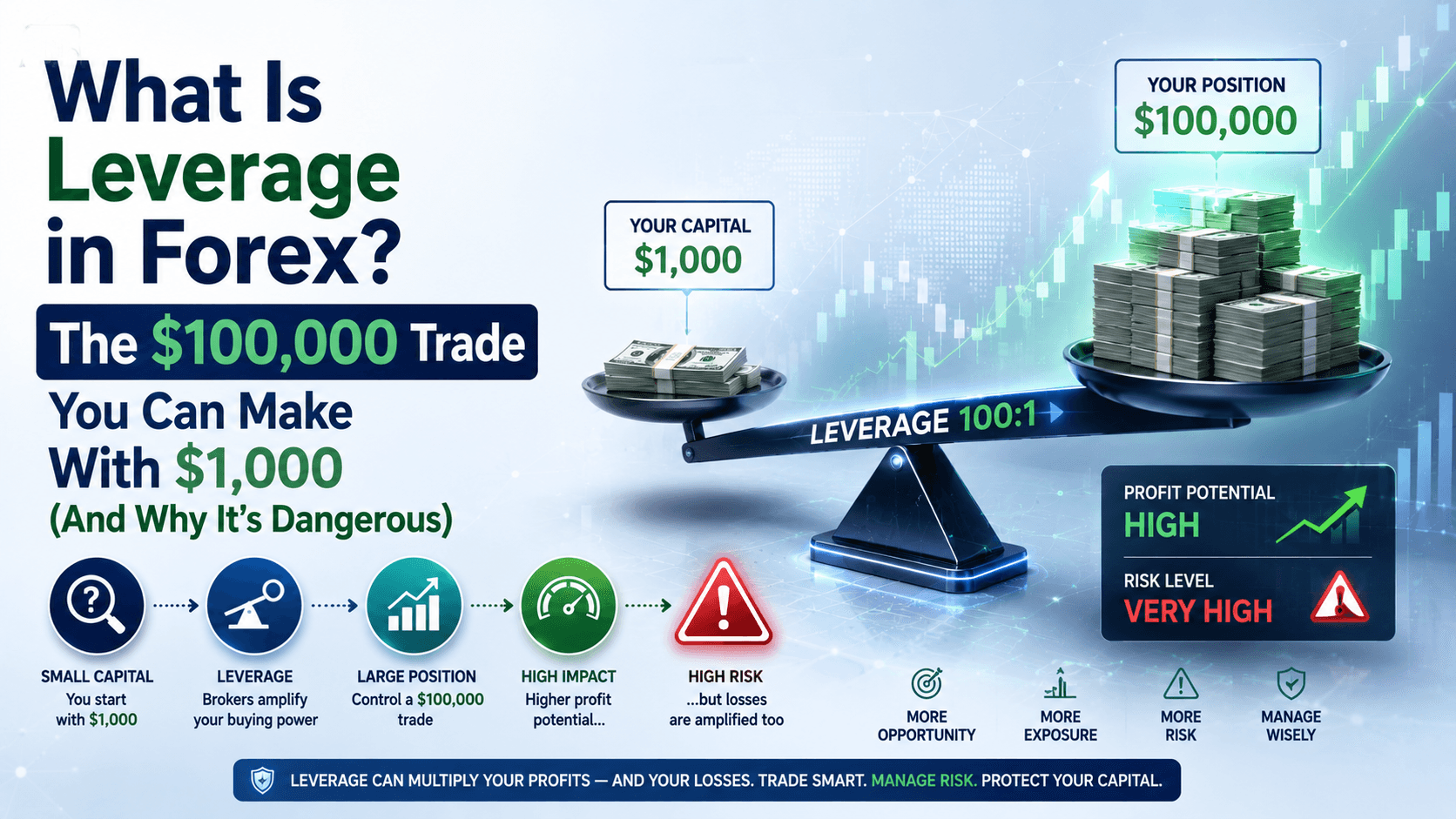
If your broker offers 100:1 leverage, it means for every $1 you put up, you can control $100 in the market. So with $1,000 in your account, you can open a position worth $100,000.
Sounds amazing, right? But here's what nobody tells you — that $100,000 position moves exactly the same way whether you used leverage or not. If the market drops 1%, you lose $1,000. That's your entire account.
So leverage doesn't just amplify your buying power. It amplifies your risk exactly the same way.
How Leverage Works — The Real Numbers
Let me walk you through a concrete example using EUR/USD, the most traded currency pair in the world.

Scenario: You have $1,000 in your account. You want to buy 1 standard lot of EUR/USD (100,000 units) at 1.0850.
Without leverage, you'd need $108,500 in your account. That's not happening with $1,000.
With 100:1 leverage, here's what happens:
- Your deposit (margin): $1,000
- Position size: $100,000 worth of EUR/USD
- Broker lends you: $99,000
- 1 pip movement = $10 profit or loss
Now imagine EUR/USD moves 50 pips in your favor. That's $500 profit — a 50% return on your $1,000 investment. Pretty sweet, right?
But here's the other side: if EUR/USD moves 50 pips against you, you just lost $500. Half your account. Gone. In one trade.
That's the double-edged sword nobody talks about enough.
The 3 Biggest Mistakes Beginners Make With Leverage
Mistake #1: Using Maximum Leverage Every Time
Your broker offers 500:1 leverage. You think, "Why not use it?" Because 500:1 means a 0.2% move against you wipes out your entire account.
EUR/USD moves 50-100 pips in a normal day. That's 0.5-1%. On 500:1 leverage, you're dead before lunch.
Mistake #2: Not Calculating Position Size Properly
Most beginners see "100:1 leverage" and think they can trade 1 standard lot with $1,000. Technically yes. But their stop loss is 20 pips away. That's $200 risk — 20% of their account on one trade.
Professional traders risk 1-2% per trade. Not 20%.
Mistake #3: Ignoring Margin Calls
Here's what happens when a trade goes against you: your account equity drops. If it falls below the required margin, your broker issues a margin call.
They'll close your position automatically — often at the worst possible time. You don't get to wait for a recovery. You're out.
Leverage Ratios — Which One Should You Use?
| Leverage Ratio | Margin Required | Best For |
|---|---|---|
| 10:1 | 10% | Beginners, long-term traders |
| 50:1 | 2% | Swing traders, intermediate |
| 100:1 | 1% | Day traders, experienced |
| 200:1 | 0.5% | Scalpers, pros only |
The smart move? Start with 10:1 or 20:1. You can always increase later. You can't get back blown-up capital.
The Wrong Way vs. The Right Way
The wrong way: You have $500. You use 500:1 leverage to trade 0.5 lots of GBP/USD. Your stop loss is 30 pips. Risk = $150 (30% of account). One bad trade and you're almost done.
The right way: You have $500. You use 20:1 leverage. You trade 0.02 lots. Your stop loss is 30 pips. Risk = $6 (1.2% of account). You can survive 80 losing trades in a row.
See the difference? The second trader will still be in the game next month. The first one? Probably already quit.
FAQ
Can I lose more money than I deposit with leverage?
Yes, if your broker doesn't offer negative balance protection. Without it, losses can exceed your deposit if the market gaps sharply against your position.

What's the safest leverage for a beginner?
10:1 or 20:1. It limits your risk and lets you learn without the emotional pressure of huge position sizes.
Does leverage affect swap fees?
Indirectly yes. Larger positions (enabled by leverage) mean larger swap fees if you hold overnight. Always check your broker's swap rates.
Can I change my leverage after opening an account?
Most brokers let you adjust leverage settings in your account dashboard. You can usually lower it anytime, but increasing it may require approval.
📝 Quick Recap
- Leverage is borrowed money from your broker to control larger positions
- It amplifies both profits AND losses equally
- Start with low leverage (10:1 to 20:1) as a beginner
- Always calculate your position size so you risk 1-2% per trade
- Use stop losses — they're your safety net
Your Quick Win Today
Open your broker's platform or a demo account. Check your current leverage setting. If it's above 50:1 for a small account (under $2,000), lower it to 20:1 right now. Then calculate: with 20:1 leverage and $1,000, your max position size is 0.2 lots. Set your stop loss at 20 pips. That's $40 risk — 4% of your account. Still high. Drop to 0.1 lots: $20 risk (2%). Better.
Do this before you place another trade. Your future self will thank you.