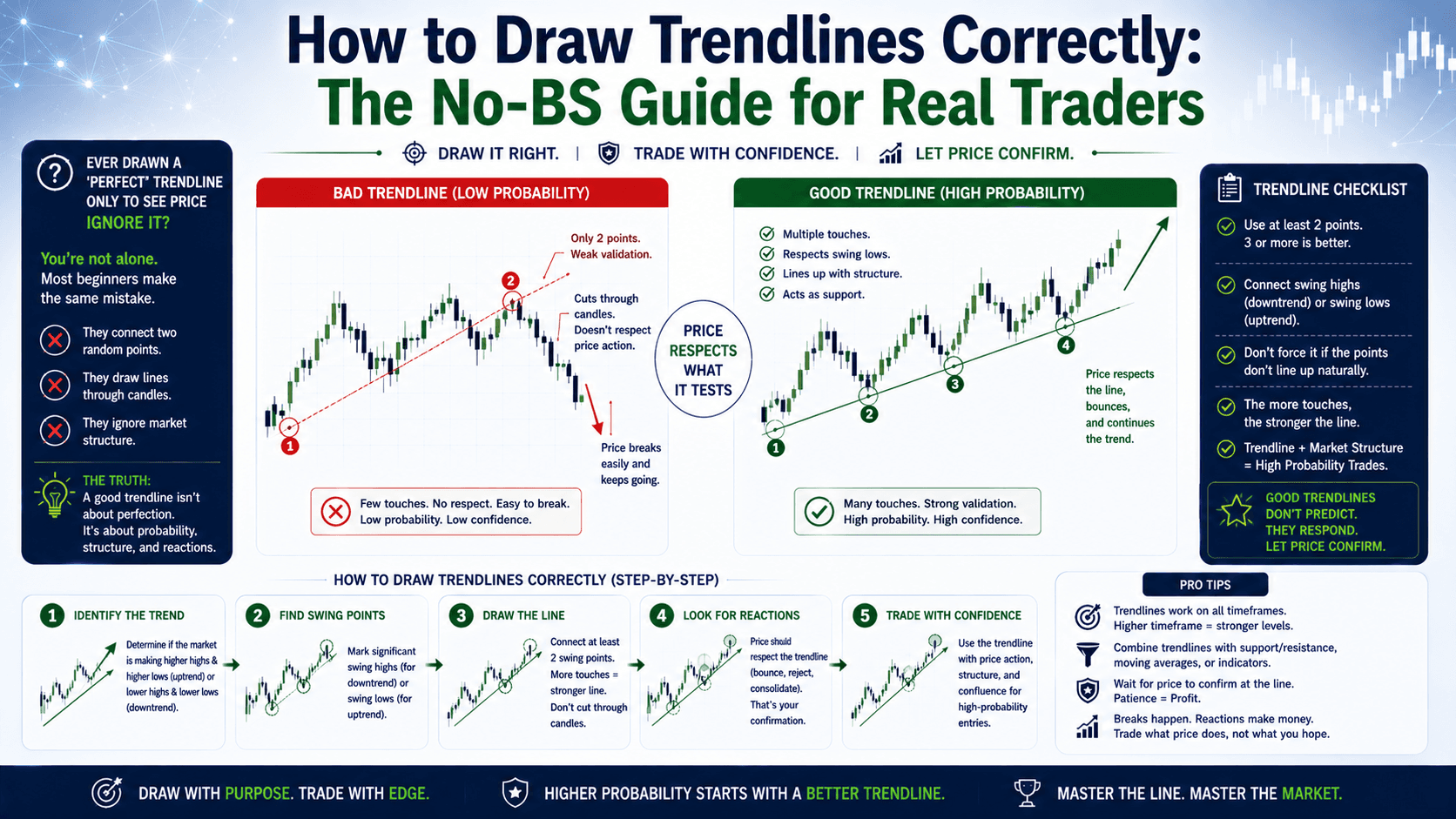

Ever Drawn a "Perfect" Trendline Only to See Price Ignore It?
You’re not alone. Most beginners make the same mistake. They connect two random points, draw a line, and pray it holds. Then price slices right through it, stops them out, and moves in the "right" direction. Sound familiar? That sting of frustration? Yeah, I’ve felt it too.
The thing is, trendlines are one of the most powerful tools in technical analysis. They're a visual roadmap of supply and demand, showing you where the market has been and where it might go. But if you don't know how to draw trendlines correctly, they're worse than useless – they're a trap.
Today, we're cutting through the noise. We're going to build your trendline skills from the ground up, so you can stop guessing and start seeing the market clearly. We'll cover the core rules, common traps, and how to use them for actual trade setups. No fluff, just real talk.
Why Most Traders Mess Up Trendlines (and How to Fix It)
Here’s the harsh truth: a poorly drawn trendline is a self-fulfilling prophecy of bad trades. If your lines are arbitrary, your trades will be too. Let's look at the two biggest mistakes:
Mistake #1: The "Two-Point Wish"
You see two swing highs or lows, you connect them, and instantly declare it a trendline. The problem? Any two points on a chart can be connected. It's like drawing a random line on a map and hoping it's a real road. It usually isn't.
The Fix: The Three-Touch Rule. A trendline only becomes "confirmed" after it has been touched and respected by price at least three times. The first two touches establish the potential line, but the third touch validates it. Think of it as a market consensus – if enough traders react to that level, it becomes significant.
Mistake #2: Ignoring Price Structure Changes
You draw a trendline, it works for a bit, then price takes off in a new direction. But you cling to the old line, hoping price will eventually come back to it. Spoiler alert: it probably won't in a meaningful way. That old line is obsolete.
The Fix: Adapt or Die. The market is dynamic. Trendlines are too. If price action drastically changes, your old trendline is likely invalid. You need to reassess and draw new lines that reflect the current market structure. Holding onto an obsolete trendline is like using a map from 1990 to navigate a city today – the roads have changed!
The Captain's Guide: How to Draw Trendlines Correctly, Step-by-Step
Now that we know what *not* to do, let's nail down the right way. This isn't rocket science, but it requires precision and consistency.

Step 1: Identify Key Swing Highs and Lows
A trendline connects the "extremes" of price movement. For an uptrend, you connect the lower swing lows. For a downtrend, you connect the higher swing highs. These are the pivot points where the market changed direction.
Uptrend: Connect two or more rising swing lows. This forms dynamic support.
Downtrend: Connect two or more falling swing highs. This forms dynamic resistance.
Step 2: Wicks or Bodies? (The Age-Old Debate)
This is where most beginners get hung up. Should you connect the absolute tip of the wick or the candle body? Here’s the deal: there's no single "right" answer. The market isn't a geometry textbook.
The Captain's Rule: Confluence & Consistency.
Confluence: Draw the line that gives you the most confirmed touches without being violated too much. Sometimes it's the wicks, sometimes the bodies, sometimes a mix. The goal is to capture the market's *tendency*.
Consistency: Once you decide on an approach for a specific chart or strategy, stick with it. If you use wicks for one trendline, try to use wicks for others on the same chart, or at least be clear about your choice.
Step 3: Extend and Confirm (The Third Touch is Gold)
Once you have your initial two points, extend the line out into the future. Wait for price to approach and ideally touch that line for a third time. If price respects it (bounces off, forms a reversal candle), that trendline is now confirmed. This is where the magic happens – the third touch often presents a high-probability trading opportunity.
"Confidence in trading is crucial to follow your strategy rules, and trend lines can deliver this confidence by visually showing what the price is doing and where it might go next."
Beyond the Basics: Using Trendlines for Actual Trades
Drawing is one thing, using them to make money is another. Here’s how to put them to work.
Trendline Flips: Resistance Becomes Support (and Vice Versa)
This is a classic. Imagine a downtrend where price keeps bouncing off a resistance trendline. Then, one day, price smashes through it. What happens next? Often, that old resistance trendline "flips" and becomes new support. Price might pull back to retest it, giving you a perfect entry for a long trade.
Example: EUR/USD at 1.0850. A downtrend line holds for weeks, offering resistance. Price breaks above 1.0850. You wait for a pullback to the old trendline, maybe around 1.0840. If it holds, you go long with a stop below the trendline at 1.0825 (15 pips risk). Target the next swing high, say 1.0880 (40 pips reward). That's a 1:2.6 risk:reward setup, all thanks to the flip.
Trendline Takeoffs: The Warning Sign of an Overextended Move
Sometimes, price rockets away from a trendline with crazy momentum. This "takeoff" can be tempting, but it's often a red flag. It tells you the trend might be overextended and due for a correction. Early money is cashing out, and you could be left holding the bag.
The Data Suggests: While breakouts can be opportunities, a rapid, unsustainable takeoff often leads to a sharp reversal or consolidation. It’s a sign to be cautious, not aggressive.
The Slope & Angle: How Strong is the Trend?
The steeper the angle of your trendline, the stronger the momentum. A very steep uptrend line (think 70-80 degrees) suggests an overheated market. It's often unsustainable and prone to a sharp pullback. A shallow trendline (20-30 degrees) indicates a slow, steady trend.
Captain's Tip: Look for medium-angle trendlines (45-60 degrees) for more sustainable moves. They show healthy momentum without being overextended. Compare the angle of different trendlines over time to see if the trend is accelerating or losing steam.
Rules for Drawing Trendlines Correctly: A Comparison
Different traders have different rules. But having *some* rules is key. Here's a comparison of common approaches:

Rule Aspect | Common Beginner Approach | Captain TheNextTrade's Approach (Rule-Based) |
|---|---|---|
Number of Touches | Any 2 points | Minimum 3 confirmed touches (2 to draw, 3rd to validate) |
Wicks vs. Bodies | Exact wick tips, always | Confluence & Consistency (what gives most touches, stick to it) |
Relevance | Always relevant once drawn | Dynamic: Old lines become obsolete if price structure changes significantly |
Trade Entries | Blindly on any touch | On 3rd/4th touch or trendline flip, with other confirmations (e.g., reversal candle) |
Purpose | Hope price bounces | Identify dynamic S/R zones, measure trend strength, guide entries/exits |
The "Math It Out" Technique: Trendlines & Risk Management
Trendlines aren't just for entries; they're fantastic for placing your stop loss and take profit. This is where the numbers come in.
Let's say EUR/USD is in an uptrend, bouncing off a trendline. Price is currently at 1.0840. You want to go long when it touches the trendline at 1.0830. You spot a solid bullish rejection candle there. Your entry is 1.0832.
Stop Loss: Place it a few pips *below* the trendline, giving your trade breathing room. If the trendline is at 1.0830, a stop loss at 1.0820 (12 pips from entry) makes sense. This means if price breaks the trendline significantly, your trade is invalid.
Take Profit: You target the previous swing high at 1.0880 (48 pips from entry).
Risk: 12 pips. Reward: 48 pips. That's a 1:4 Risk:Reward. Now, calculate your lot size:
Account size: $1,000
Max risk per trade (2%): $20
Value per pip for EUR/USD (0.01 lot): $0.10
Risk in pips: 12 pips
Max pips you can risk: $20 / $0.10 per pip = 200 pips on 0.01 lot.
Since your risk is only 12 pips, you can trade more. $20 / 12 pips = $1.66 max per pip.
This means you can trade 0.16 lots ($1.60/pip) or round down to 0.15 lots ($1.50/pip).
On 0.15 lots, your risk is 12 pips * $1.50/pip = $18. Your reward is 48 pips * $1.50/pip = $72.
See? Trendlines + math = clear trade parameters and controlled risk. That's what professional traders do.
FAQ
What is the most important rule for drawing trendlines?
The most important rule is the "three-touch confirmation." A trendline is only considered valid and reliable after price has touched and respected it at least three times. This signifies market consensus.
Should I use wicks or candle bodies when drawing trendlines?
There's no strict rule. Focus on "confluence" – draw the line that connects the most touches without being violated. Consistency is also key; once you choose an approach for a chart, try to stick to it.
Can trendlines be used on all timeframes?
Yes, trendlines work on all timeframes, from 1-minute to monthly charts. However, trendlines on higher timeframes (e.g., Daily, 4-hour) generally offer more significant and reliable signals due to less market noise.
How often should I adjust my trendlines?
Trendlines are dynamic. You should adjust them if new price action reveals a clearer path, or if the market structure changes significantly, rendering the old line obsolete. Regularly review your charts.
📝 Quick Recap
Three Touches Rule: Don't trust a trendline until price has touched it at least three times.

Support and resistance levels confirmed by trendlines Confluence & Consistency: Choose wicks or bodies based on which gives you the most reliable touches, then stick to that method.
Dynamic S/R: Trendlines act as dynamic support and resistance, showing where price might react.
Watch for Flips & Takeoffs: Use trendline flips as potential entry signals and takeoffs as warning signs of overextension.
Risk Management: Use trendlines to place precise stop losses and targets with real numbers.
🚀 Quick Win: Practice Right Now
Open your trading platform. Pull up EUR/USD on the 1-hour timeframe. Find a clear uptrend or downtrend that has been running for at least a day.
Now, draw a trendline connecting at least two swing lows (for an uptrend) or two swing highs (for a downtrend). Extend the line. Go back in time and see if price respected it a third time. If not, adjust until you find a line that had at least three solid touches.
Then, look for a "trendline flip" where an old resistance trendline became new support. Find where you could have entered and placed your stop loss. Do the math. This hands-on practice makes all the difference.