
How the Forex 66 Trillion Market Actually Works
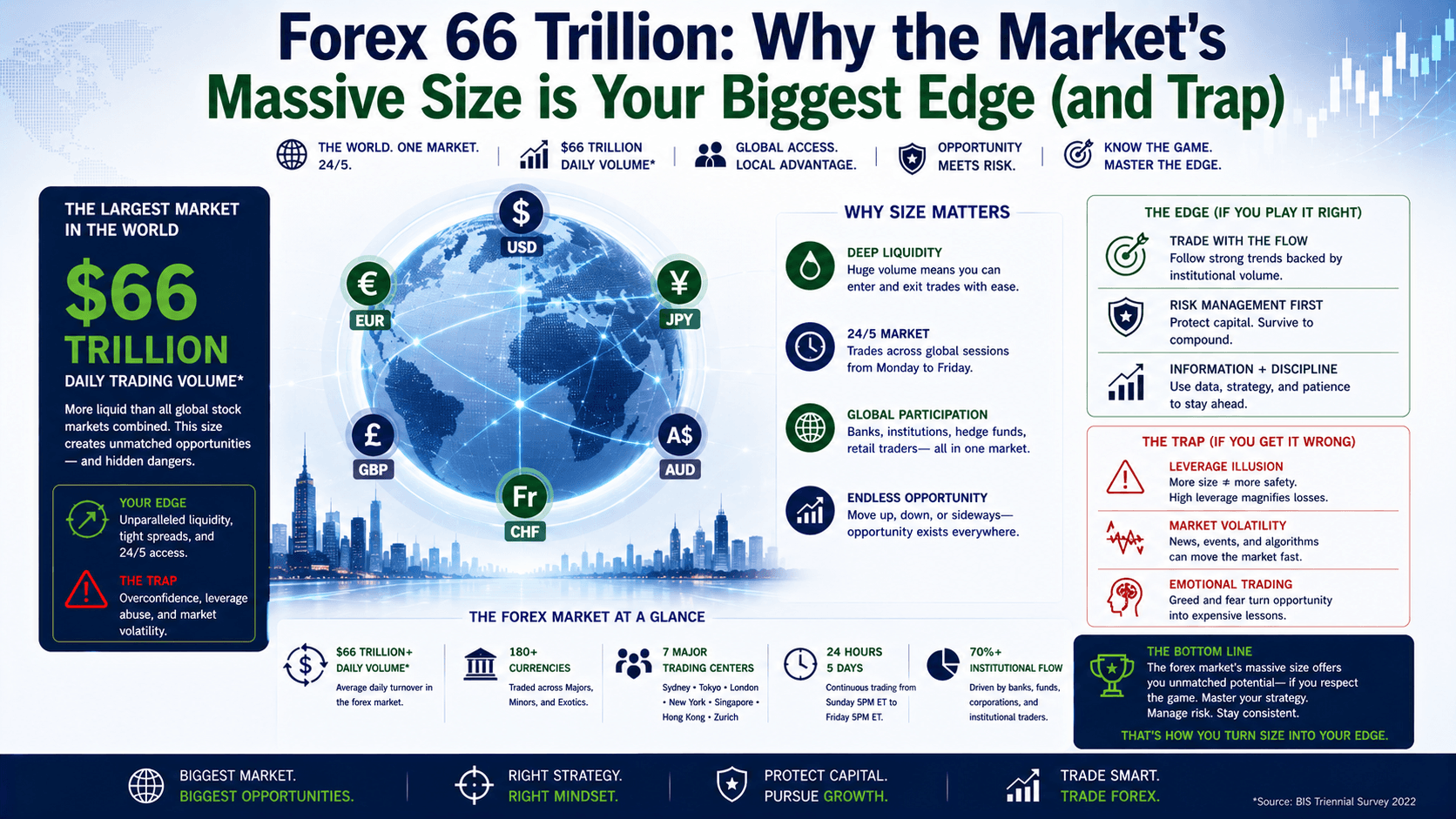
Most traders enter the financial world thinking the New York Stock Exchange (NYSE) is the center of the universe. It isn't. The NYSE handles roughly $200 billion in daily volume. That sounds massive until you look at the currency markets. The forex 66 trillion daily volume (based on recent triennial bank surveys reporting $6.6 trillion daily) means this market is over 30 times larger than the biggest stock exchange on earth. It is the deep ocean, and everything else is just a swimming pool.
But here is the catch: that massive liquidity doesn't mean it’s easy money. It means the big banks—the 'sharks'—have enough room to move billions without breaking a sweat. If you jump in without understanding the basic plumbing of how money moves, you aren't trading. You're providing 'exit liquidity' for someone who actually knows the math.
I’ve been trading these markets for over a decade. I’ve blown accounts, and I’ve built them back up. The biggest lesson I learned? Most people fail because they try to be clever instead of being disciplined. Let's break down how this forex 66 trillion monster actually works so you don't become another statistic.
The Mechanics of the Tug-of-War: Currency Pairs
In the stock market, you buy a share of Apple. You own a piece of a company. In forex, you aren't buying a physical object. You are participating in a relative exchange. Currencies are always traded in pairs because you cannot buy one without selling another. You are essentially betting on the economic strength of one country against another.
Every pair has a Base Currency (the first one) and a Quote Currency (the second one). Think of it as a tug-of-war. If you trade the EUR/USD, the Euro is the base and the US Dollar is the quote. If the exchange rate is 1.0850, it means 1 Euro costs $1.0850.
- Going Long: You believe the Euro will get stronger or the Dollar will get weaker.
- Going Short: You believe the Euro will get weaker or the Dollar will get stronger.
Forex vs. Stocks: A Professional Comparison
The sheer scale of the forex 66 trillion environment creates a different set of rules compared to equity trading. Understanding these differences is the first step toward a professional mindset.

| Market Feature | Forex Market | Stock Market (NYSE) |
|---|---|---|
| Daily Volume | $6.6 Trillion+ | ~$200 Billion |
| Trading Hours | 24 Hours / 5 Days | 9:30 AM - 4 PM EST |
| Liquidity | Ultra-High (Instant) | Variable |
| Market Structure | Decentralized (OTC) | Centralized Exchange |
| Primary Driver | Interest Rates & Macro | Company Earnings |
The Math of a Trade: Real Numbers Only
Stop thinking in percentages and start thinking in pips and dollars. A pip (Percentage in Point) is usually the fourth decimal place in a currency quote. This is where your profit and loss (P&L) is born. Let's look at a concrete trade scenario on EUR/USD.
Imagine you have a $1,000 account. You decide to trade a 0.10 lot (known as a mini lot). At this size, every 1-pip movement is worth exactly $1.00.
The $30 Risk Management Example
You enter a 'Long' position at 1.0850. You set your Stop Loss at 1.0820 (30 pips of risk) and your Take Profit at 1.0910 (60 pips of reward).
- Scenario A (The Loss): Price drops to 1.0820. You lose 30 pips. Since 1 pip = $1, you lose $30. Your account is now $970. You risked 3% of your capital.
- Scenario B (The Win): Price hits 1.0910. You gain 60 pips. You make $60. Your account is now $1,060.
Professional traders focus on Scenario A before they ever dream about Scenario B. If you don't know exactly how many dollars you are risking before you click 'Buy,' you are gambling.
The Psychology of Failure: Why Most Traders Lose
Why do 90% of retail traders lose money in a forex 66 trillion market? It’s not because they are bad at math. It’s because of Loss Aversion. Behavioral psychology shows that the pain of losing $100 is twice as powerful as the joy of gaining $100.
This creates a deadly cycle. Beginners hold onto losing trades, hoping the market will 'come back' so they don't have to feel the pain of the loss. Meanwhile, they cut their winning trades almost immediately to 'lock in' a tiny profit. They end up with Big Losses and Small Wins. To survive, you must reverse this. Accept the small loss as a business expense and let your winners run.
The Wrong Way vs. The Right Way
The Wrong Way (The FOMO Trap): You see a green candle shooting up on GBP/USD. You feel like you're missing out on the 'big move.' You buy at the very top with a huge lot size (0.50). Price retraces just 10 pips—a normal move—but because your lot size was too big, you are down $50 instantly. You panic and close the trade at the bottom, only to watch the price continue upward five minutes later.
The Right Way (The Planned Entry): You identify a support level at 1.0800. You wait for the price to pull back to 1.0810. You set a Stop Loss at 1.0795 (15 pips risk) and a Take Profit at 1.0840 (30 pips reward). On a 0.10 lot, you are risking $15 to make $30. If the stop is hit, you lose $15 and walk away. No stress, no panic, just a calculated business decision.
FAQ
Is forex trading risky?
Yes. Because of leverage and high volatility, you can lose your entire account quickly if you don't use stop losses and proper lot sizing.

How much money do I need to start?
Most brokers allow you to start with $100, but $500 to $1,000 is recommended to practice proper risk management without blowing the account on a single mistake.
Can I trade forex part-time?
Yes. Since the market is open 24/5, many traders focus on specific 'sessions' like the London/New York overlap (8 AM - 12 PM EST) when liquidity is highest.
What is the most traded pair?
The EUR/USD is the most liquid pair, accounting for nearly 25% of all daily volume in the forex market.
Quick Recap
- The forex 66 trillion context proves that the market is too big for any single player to manipulate for long.
- Currencies are traded in pairs (Base/Quote).
- Risk is managed through Pips, Lot Sizes, and Stop Losses.
- Successful trading requires overcoming Loss Aversion—keeping losses small and wins large.
Quick Win
Open your trading platform right now and pull up a EUR/USD 1-hour chart. Find the current price and calculate how much you would lose if you bought 0.01 lots and the price moved 20 pips against you. (Hint: It’s $2.00). Doing this simple math before every trade is the difference between a pro and a gambler.