
What Is Forex Trading? Let's Start With What It's NOT
Ever exchanged dollars for euros at the airport and noticed the rate wasn't exactly what you saw on Google? That's forex in action — the global marketplace where currencies are bought and sold.
But here's what most beginner guides don't tell you: forex trading isn't about exchanging money for a vacation. It's about speculating on price movements to make a profit.
Think of it this way: when you trade forex, you're not buying a currency to spend it. You're buying it because you believe it will go up in value against another currency. If you're right, you sell it back for more than you paid. Simple, right?
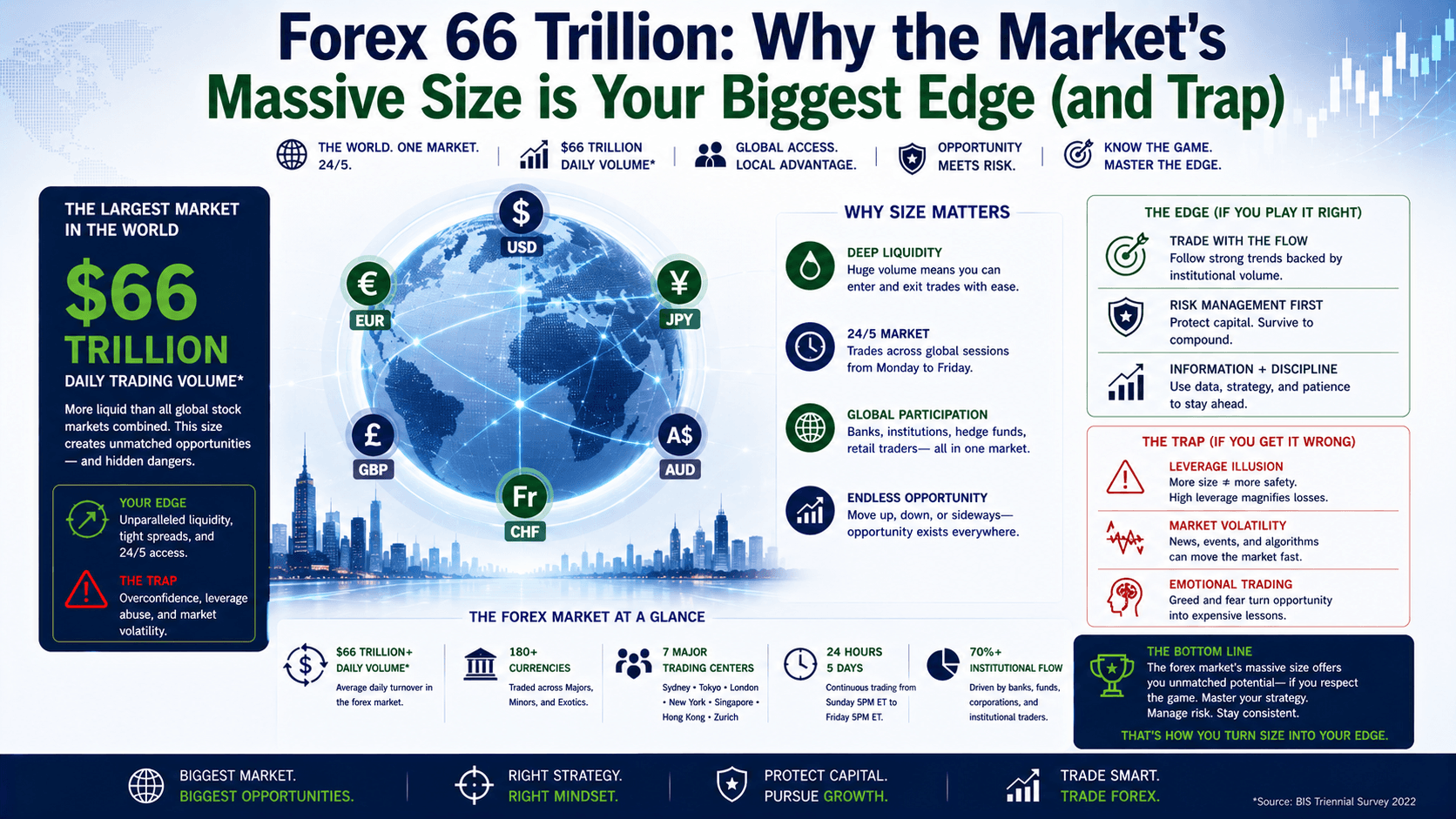
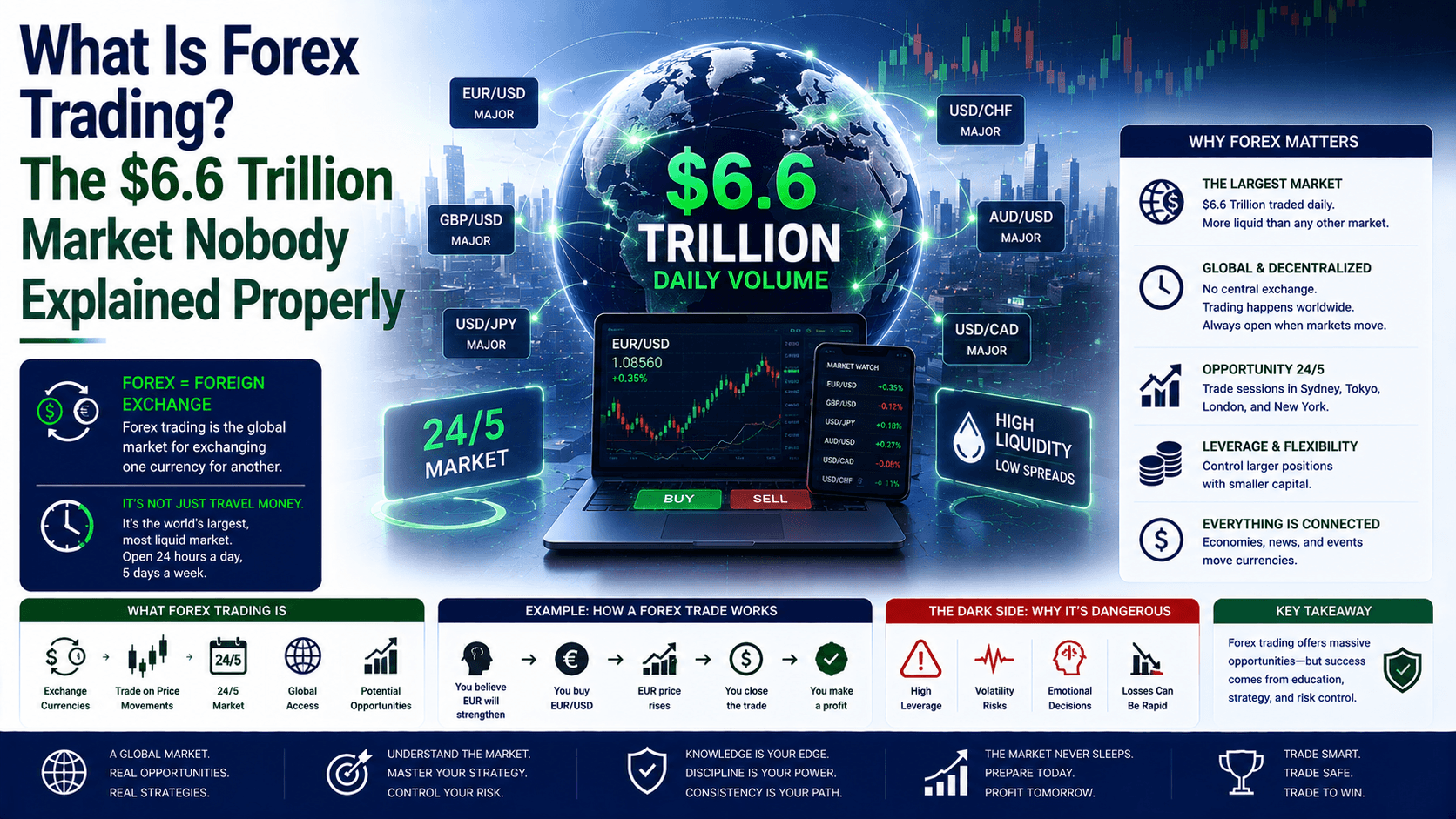
The forex market is the largest financial market in the world. We're talking $6.6 trillion traded every single day. That's trillion with a 't'. To put it in perspective, the entire New York Stock Exchange does about $200 billion daily. Forex is 30 times bigger.
And the cool part? Anyone with an internet connection and a few hundred dollars can participate. Let me show you how.
How Does Forex Trading Actually Work?
Forex trading works by exchanging one currency for another, hoping the one you bought goes up in value. But here's the twist — you never actually hold the currency. It's all electronic.
Every trade involves two currencies, called a currency pair. The most popular is EUR/USD (euro vs. U.S. dollar). When you buy EUR/USD, you're buying euros and selling dollars simultaneously.
Let me make this real with numbers:
Say EUR/USD is trading at 1.0850. You think the euro will strengthen against the dollar, so you buy 0.1 lots (10,000 units). If EUR/USD moves to 1.0880 — that's 30 pips higher — your profit is $30. (One pip = $1 on 0.1 lots for EUR/USD.)
Not bad for a move that can happen in minutes, right?
But here's the other side: if EUR/USD drops to 1.0820, you just lost $30. And if you didn't use a stop loss? That loss can keep growing.
| Currency Pair | What It Represents | Example Quote |
|---|---|---|
| EUR/USD | Euro vs. U.S. Dollar | 1.0850 |
| GBP/USD | British Pound vs. U.S. Dollar | 1.2650 |
| USD/JPY | U.S. Dollar vs. Japanese Yen | 150.25 |
| AUD/USD | Australian Dollar vs. U.S. Dollar | 0.6650 |
Why 90% of Beginners Lose Money (And How to Avoid It)
Let me be straight with you — most retail forex traders lose money. The numbers aren't pretty. Studies show 70-80% of retail traders lose. The reason? It's not the market. It's how they approach it.

The biggest mistake beginners make is jumping in without understanding leverage.
Leverage lets you control a large position with a small amount of money. Sounds great, right? Well, it cuts both ways.
Here's the math:
You have a $1,000 account. Your broker offers 50:1 leverage. That means you can control $50,000 worth of currency with your $1,000.
You buy EUR/USD at 1.0850 with 0.5 lots ($50,000 position). The market moves against you by 20 pips. That's a $100 loss — 10% of your account. Gone in minutes.
Now imagine that same move without leverage: you'd lose $2. See the difference?
Leverage is a magnifying glass for your money — it makes wins bigger and losses bigger. Professional traders use it carefully. Beginners often blow up their accounts with it.
The 3 Things You MUST Know Before Your First Trade
1. Pips — The Language of Forex
A pip is the smallest price movement in most currency pairs. For EUR/USD, one pip is 0.0001. For USD/JPY, it's 0.01.
Here's why pips matter: they tell you exactly how much you're risking or making.
On a standard lot (100,000 units), one pip = $10. On a mini lot (10,000 units), one pip = $1. On a micro lot (1,000 units), one pip = $0.10.
2. The Bid/Ask Spread
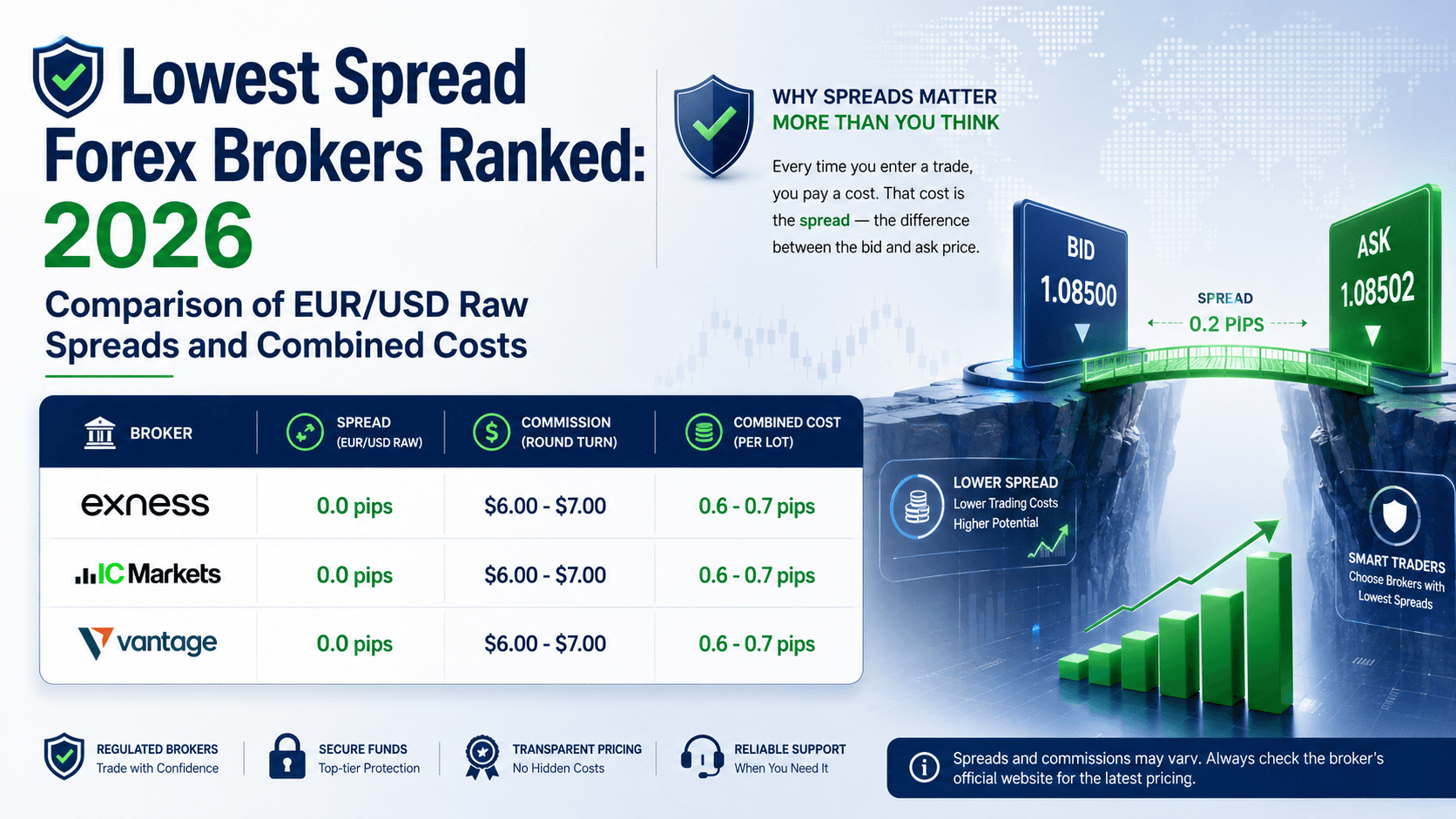
Every currency pair has two prices: the bid (what you sell at) and the ask (what you buy at). The difference is the spread — that's how your broker makes money.
For major pairs like EUR/USD, the spread is usually 1-2 pips. For exotic pairs like USD/TRY, it can be 50+ pips.
Think of it as a small entry fee for each trade.
3. The 24-Hour Market
Forex trades 24 hours a day, 5 days a week. It opens Sunday evening in New York and closes Friday afternoon. This means you can trade whenever you want — but it also means you can't just set it and forget it.
Major trading sessions:
- Tokyo session: 7 PM - 4 AM ET (quiet, range-bound)
- London session: 3 AM - 12 PM ET (most volatile)
- New York session: 8 AM - 5 PM ET (high volume, overlaps with London)
Most price action happens during the London-New York overlap (8 AM - 12 PM ET).
Forex vs. Stocks: Which One Should You Trade?
If you're coming from stocks, here's what's different:
| Feature | Forex | Stocks |
|---|---|---|
| Market hours | 24 hours, 5 days | 6.5 hours, 5 days |
| Leverage | Up to 50:1 (or more) | 2:1 (typical) |
| Commissions | Usually none (spread-based) | Often per trade |
| Number of instruments | ~30 major pairs | Thousands |
| Liquidity | $6.6 trillion daily | $200 billion (NYSE) |
| Regulation | Less regulated | Highly regulated |
Forex is simpler in some ways — fewer instruments to watch, no earnings reports. But the leverage makes it more dangerous if you don't respect it.
FAQ
Is forex trading risky?
Yes — especially with leverage. You can lose more than your initial deposit if you don't use stop losses. But with proper risk management (1-2% risk per trade), it's manageable.

How much money do I need to start forex trading?
You can start with as little as $100 on micro accounts. But $500-$1,000 gives you more breathing room. Never trade money you can't afford to lose.
Can I make a living trading forex?
Some do, but it takes years of practice, discipline, and a large account. Most professional traders have $50,000+ accounts and treat it like a business, not a get-rich-quick scheme.
Do I need to be an expert in economics to trade forex?
Not at all. Many successful traders use technical analysis (charts, patterns, indicators) without understanding central bank policies. Start with price action — it's the most reliable.
Quick Recap
- Forex trading is buying one currency while selling another, hoping the one you buy goes up in value
- The market trades $6.6 trillion daily, 24 hours a day, 5 days a week
- Leverage amplifies both profits and losses — use it carefully
- Start with EUR/USD, use stop losses, and risk no more than 1-2% per trade
- Most beginners lose money because they don't respect risk management
Your Quick Win
Open a demo account right now. I'm serious — do it before you finish reading this. Most brokers offer free demo accounts with virtual money. Place your first trade on EUR/USD with 0.1 lots. Set a stop loss 20 pips away. See what happens. No real money, no stress. Just learning.
That's how you actually learn forex trading — by doing, not by reading.