
Ever opened a trade, watched the numbers change, and had no idea what you just made or lost?
Yeah, I've been there. It's confusing. You see EUR/USD go from 1.0850 to 1.0851, and you're thinking, "Did I just make money? Lose money? Both?"
That tiny movement — that 0.0001 shift — is called a pip. And understanding what a pip is in forex is the single most important thing you'll learn as a beginner. Without it, you're flying blind.
Let's fix that right now.
So What Actually Is a Pip in Forex?
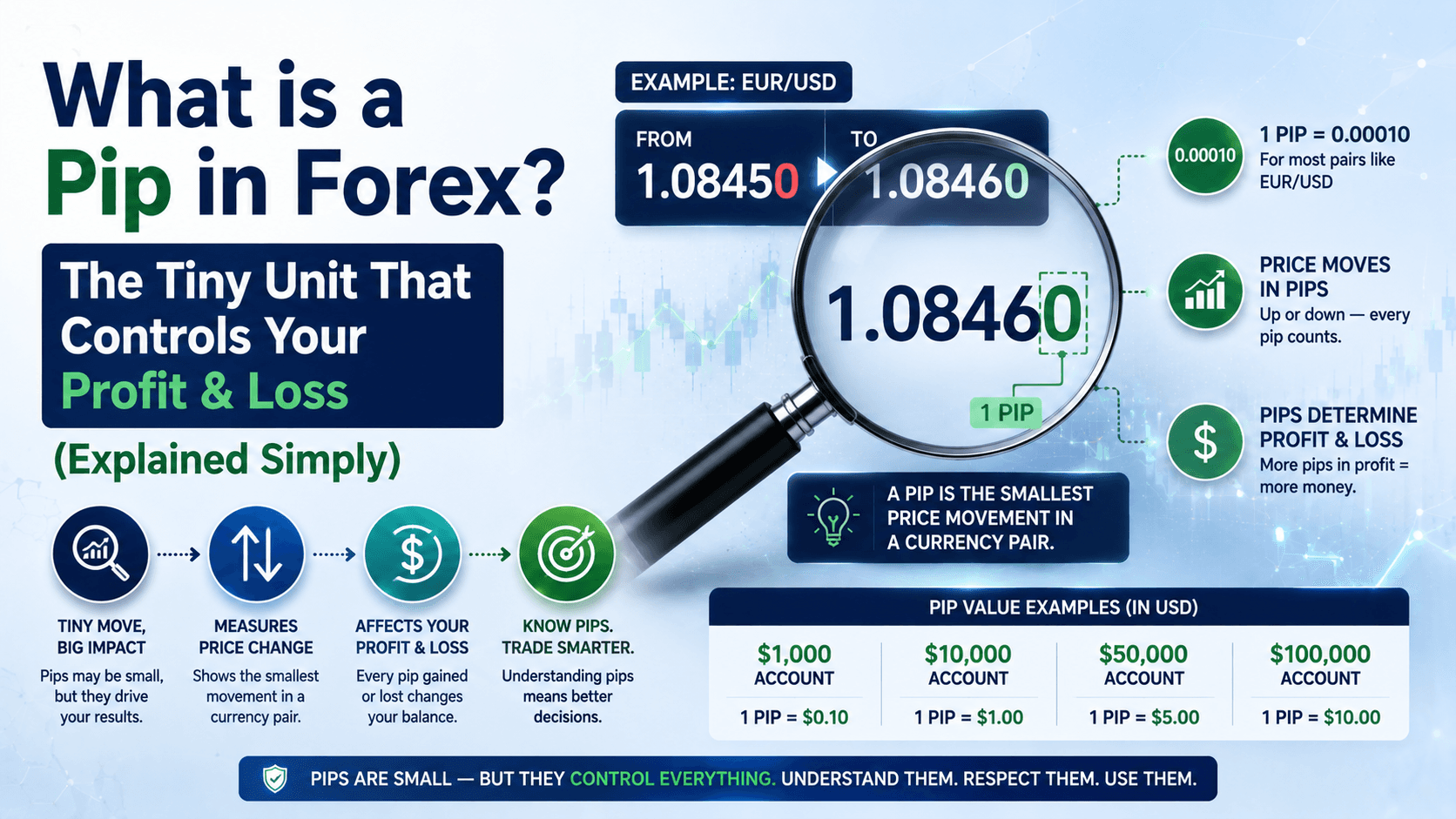
Pip stands for "Percentage in Point" or "Price Interest Point." Fancy names for a simple idea: it's the smallest standard price move a currency pair can make.
For most pairs, that's the 4th decimal place.
Look at EUR/USD at 1.0850. If it moves to 1.0851, that's 1 pip. Simple.
But there's an exception — the Japanese Yen. Yen pairs like USD/JPY are quoted to 2 decimal places. So for USD/JPY at 154.50, a move to 154.51 is also 1 pip.
Here's a quick cheat sheet:
| Currency Pair | Decimal Places | 1 Pip = | Example Move |
|---|---|---|---|
| EUR/USD | 4 | 0.0001 | 1.0850 → 1.0851 |
| GBP/USD | 4 | 0.0001 | 1.2700 → 1.2701 |
| USD/JPY | 2 | 0.01 | 154.50 → 154.51 |
| XAU/USD (Gold) | 2 | 0.01 | $2,350.00 → $2,350.01 |
Pretty straightforward, right? Now let's make it real.
The "Show Me The Money" Part: What's 1 Pip Worth?
Here's where most lessons get boring. Not this one.
The value of 1 pip depends on two things: the pair you're trading and the lot size you're using.
Let's use EUR/USD since it's the most traded pair in the world.
Standard Lot (100,000 units): 1 pip = $10
Mini Lot (10,000 units): 1 pip = $1
Micro Lot (1,000 units): 1 pip = $0.10
Now let's see this in action.
You buy 1 mini lot of EUR/USD at 1.0850. Price moves to 1.0880 — that's 30 pips. Your profit? 30 × $1 = $30.
But what if it drops 30 pips to 1.0820? You lose $30.
See how that works? Pips are just the ruler. Lot size determines the dollar value per tick.
The Wrong Way Most Beginners Use Pips (And Why It Costs Them)
Here's the mistake I see all the time.

A beginner opens a trade without checking pip value. They think, "It's just a few pips, how bad can it be?"
Then they trade a standard lot without realizing each pip is $10. A 50-pip loss? That's $500 gone. On a $500 account, that's their entire balance.
Here's the right way:
Before you click buy or sell, calculate your risk in pips and dollars.
Let's say you have a $1,000 account. You want to risk 2% per trade — that's $20.
You're trading EUR/USD with a mini lot (1 pip = $1). Your stop loss is 20 pips away. That's $20 risk — perfect.
But if you accidentally used a standard lot (1 pip = $10), a 20-pip stop would cost you $200 — 20% of your account. One bad trade and you're in serious trouble.
The math protects you. Always do the math.
What About Pipettes? (And Why You Should Care)
You've probably seen prices with 5 decimal places instead of 4. Like EUR/USD at 1.08505 instead of 1.0850.
That 5th digit is a pipette — one-tenth of a pip. It gives you more precision, especially if you're scalping or day trading.
But here's the thing: most traders focus on full pips. Pipettes are nice-to-know, not need-to-know for beginners. Don't overcomplicate it.
Real Trade Example: Pips in Action
Let me walk you through a real scenario using numbers you'd actually see.
The Setup:
Pair: GBP/USD
Entry: 1.2700
Stop Loss: 1.2670 (30 pips)
Take Profit: 1.2750 (50 pips)
Lot Size: 0.05 (5,000 units — 1 pip ≈ $0.50)
Scenario A — Price hits target:
- Price moves from 1.2700 to 1.2750
- That's 50 pips
- 50 × $0.50 = $25 profit
Scenario B — Price hits stop:
- Price drops from 1.2700 to 1.2670
- That's 30 pips
- 30 × $0.50 = $15 loss
Risk:Reward = 1:1.67 — a solid trade.
Notice how everything starts with pips. Without them, you can't measure risk, set targets, or know if a trade is worth taking.
Why Pips Are the Backbone of Risk Management
Every professional trader I know thinks in pips first, dollars second.
Here's why: pips remove the emotion.
When you say "I'll risk 30 pips," that's a fixed number. It doesn't change based on how you feel about the trade. It's a rule.
Compare that to: "I'll exit if it looks bad." What does "looks bad" mean? It means you'll probably hold a losing trade too long because you're hoping it turns around.
Pips give you structure. Structure keeps you disciplined. Discipline keeps you profitable.
FAQ
Is a pip the same for all currency pairs?
No. Most pairs use 4 decimal places (1 pip = 0.0001). Yen pairs use 2 decimal places (1 pip = 0.01). Gold and commodities also vary — always check.

How do I calculate pip value for my account?
If USD is the quote currency (like EUR/USD), it's simple: 1 pip = $10 for a standard lot, $1 for a mini lot, $0.10 for a micro lot. For other pairs, use a pip calculator — most brokers have one built-in.
Do I need to worry about pipettes?
Not as a beginner. Pipettes are for precision scalping. Focus on full pips until you're comfortable with the basics.
What's the difference between a pip and a point?
Some traders use "point" to mean pip. Others use it for pipettes. In forex, "pip" is the standard term. Stick with pips to avoid confusion.
📝 Quick Recap
- A pip is the smallest price move in forex — usually 0.0001 for most pairs
- Pip value depends on lot size: $10 (standard), $1 (mini), $0.10 (micro) for USD pairs
- Always calculate your risk in pips and dollars before entering a trade
- Yen pairs use 2 decimal places — 1 pip = 0.01
- Pipettes are one-tenth of a pip — nice to know, not essential for beginners
Your Quick Win (Do This Right Now)
Open your trading platform. Pull up EUR/USD on the 1-hour chart. Look at the last 5 candles. For each one, measure how many pips the candle traveled from high to low. Do this for 5 minutes. You'll start seeing pips everywhere — and that's exactly the point. The more you practice, the more natural it becomes.