
Ever Wondered Who Actually Lets You Trade Forex?
So you want to trade forex. You've seen the charts, heard the stories, and you're ready to buy EUR/USD or take a shot on Gold. But there's one question that trips up almost every beginner: who am I actually trading through?
That's where a forex broker comes in.
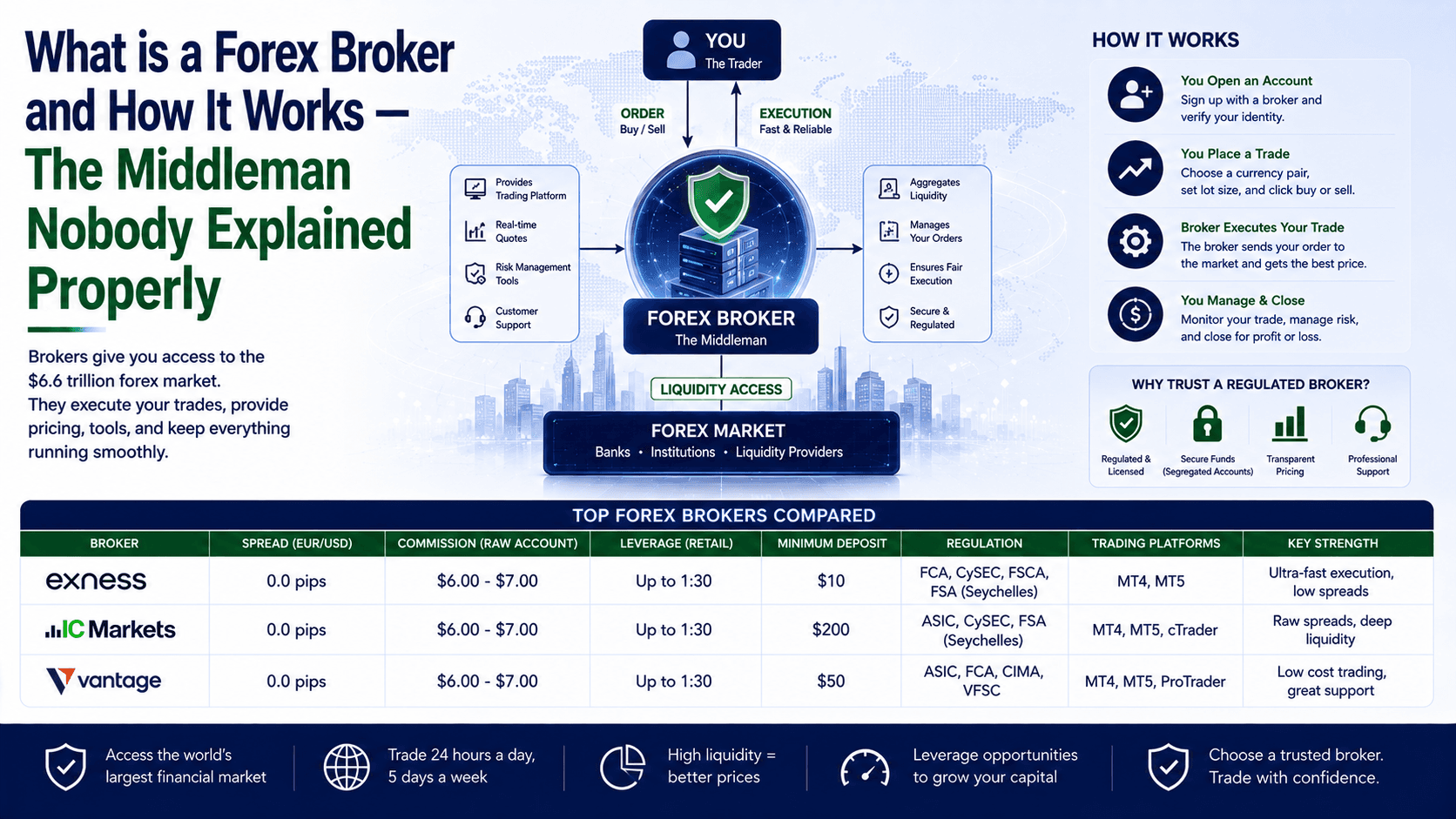
Think of a forex broker as the middleman between you and the global currency market. You don't call up a bank in London to place a trade. You use a platform — and that platform is run by a broker. They give you access to the market, provide the software, and handle the execution.
But here's the thing — not all brokers are the same. Some are great. Some will cost you money without you even realizing it. And some? They're straight-up scams.
Let's break down what a forex broker actually is, how they make money, and what you need to look for before opening an account.
What Is a Forex Broker? (The Simple Version)
A forex broker is a financial services company that gives you a platform to buy and sell currency pairs. They're the bridge between you and the interbank market — where banks, hedge funds, and institutions trade trillions of dollars every day.
Without a broker, you can't trade forex. Period.
Here's the deal: the forex market is decentralized. There's no building like the New York Stock Exchange where currencies are traded. Instead, it's a global network of banks and dealers. A broker connects you to that network.
Most brokers today are online platforms. You open an account, deposit money, and start trading within minutes. Pretty straightforward, right?
Who Uses a Forex Broker?
You might think it's just retail traders like you and me. But actually, brokers serve two main groups:
- Retail traders — individual people trading from home with accounts from $100 to $100,000
- Institutional clients — banks, hedge funds, and large financial firms trading millions
The broker handles both. But the experience is very different. Retail traders get smaller lot sizes, higher spreads, and more hand-holding. Institutions get tighter spreads and dedicated support.
How Does a Forex Broker Actually Work?
Okay, so you open your trading platform. You see EUR/USD at 1.0850. You click "buy" for 0.1 lots. What happens next?

Here's the behind-the-scenes flow:
- You place the order on the broker's platform (MT4, MT5, or their own software)
- The broker processes the order — either matching it with another client or passing it to a liquidity provider
- The trade is executed at the current market price (or close to it)
- The broker tracks your position — profit/loss, margin, and open trades
Sound simple? It is — on the surface. But how the broker handles step 2 makes all the difference.
The Two Types of Brokers: Market Makers vs ECN/STP
This is where most beginners get confused. Let me make it crystal clear:
| Broker Type | How It Works | Best For |
|---|---|---|
| Market Maker (Dealing Desk) | The broker takes the other side of your trade. If you buy, they sell. If you win, they lose. | Beginners who want fixed spreads and no slippage |
| ECN/STP (No Dealing Desk) | The broker passes your trade to a liquidity provider (bank or institution). They don't trade against you. | Experienced traders who want tighter spreads and direct market access |
⚠️ Important: Market makers can have a conflict of interest — if you win, they lose. That's why some shady brokers "hunt" your stop losses. ECN/STP brokers don't have this problem because they just pass the trade through.
My advice? Start with a reputable ECN/STP broker. You'll get fairer execution and no conflict of interest.
How Forex Brokers Make Money (The Spread Explained)
Brokers aren't charities. They need to make money. And they do it in two main ways:
1. The Spread
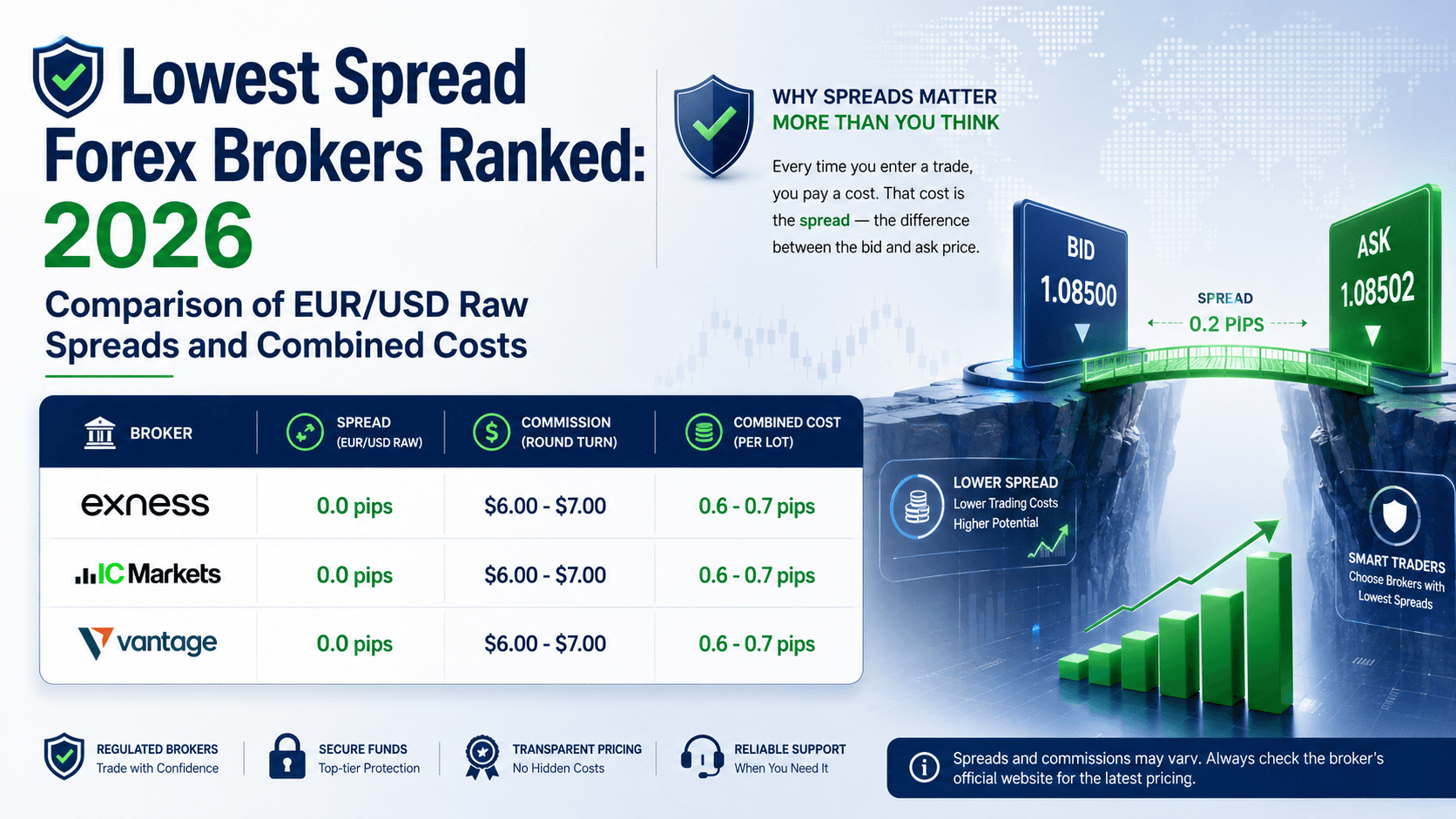
This is the most common way. Every currency pair has two prices: the bid (sell price) and the ask (buy price). The difference between them is the spread.
Example: EUR/USD is quoted at 1.0850/1.0852. The spread is 2 pips. When you buy, you pay 1.0852. When you sell, you get 1.0850. The broker keeps that 2-pip difference.
Let's do the math: On 0.1 lots of EUR/USD, 1 pip is worth $1. So a 2-pip spread = $2 cost to open the trade. On 1.0 lots, that's $20. Doesn't sound like much? Trade 10 times a day for a month and it adds up fast.
2. Commissions
Some brokers — especially ECN brokers — charge a commission instead of (or in addition to) the spread. This is usually a fixed fee per trade, like $3-$7 per 100k units traded.
Which is better? It depends on your trading style:
- Scalpers — prefer low spreads with commissions (they trade often and need tight execution)
- Swing traders — can handle wider spreads with no commissions (they trade less frequently)
Compare both before choosing. A broker with "zero spread" but $10 commission might cost you more than one with a 2-pip spread and no commission.
The Wrong Way vs The Right Way to Choose a Broker
Most beginners do this: They Google "best forex broker," pick the first one with a flashy website, deposit $200, and start trading. Then they wonder why they got stopped out 10 times in a row.
Here's the right way:
- Check regulation first. In the US, look for CFTC and NFA registration. In the UK, FCA. In Australia, ASIC. If a broker isn't regulated by a major body, walk away.
- Test the platform. Open a demo account. Place 20 trades. See how fast they execute and if the spreads match what they advertise.
- Read the fine print. Some brokers charge inactivity fees, withdrawal fees, or have minimum deposit requirements that catch you off guard.
- Check leverage limits. Some countries cap leverage at 30:1 for retail traders. Others allow 500:1. Higher leverage means higher risk.
💡 Quick Win: Go to the NFA website right now and search for any broker you're considering. If they're not listed? Don't trade with them.
FAQ
What is a forex broker and how it works in simple terms?
A forex broker is a company that gives you a platform to buy and sell currencies. You open an account, deposit money, and use their software to place trades. They connect you to the global forex market and earn money through spreads or commissions.

Do I need a lot of money to open a forex broker account?
No. Many brokers let you open an account with as little as $50-$100. But remember: start small. Use a demo account first to practice. Trading with real money before you're ready is the fastest way to lose it.
Are all forex brokers regulated?
No. Some operate without regulation, especially in offshore jurisdictions. Always choose a broker regulated by a major body like the CFTC (US), FCA (UK), or ASIC (Australia). Unregulated brokers are risky — you have no protection if they go under or scam you.
How do I know if a broker is trustworthy?
Check their regulation status on the regulator's website. Read reviews from multiple sources (not just the broker's own site). Test their customer support. And always start with a demo account to see how they execute trades.
📝 Quick Recap
- A forex broker is the middleman between you and the global currency market
- They make money through spreads (bid/ask difference) and commissions
- ECN/STP brokers pass your trades to liquidity providers; market makers trade against you
- Always check regulation before depositing money
- Test a broker with a demo account before going live
Your 5-Minute Quick Win
Open a demo account with a regulated broker right now. Place 5 trades on EUR/USD. Pay attention to the spread — write down how many pips it is for each trade. Then check how fast your order gets filled. This simple test will tell you more about a broker than any review ever will.