
The Truth About Demo Accounts Most Brokers Won't Tell You
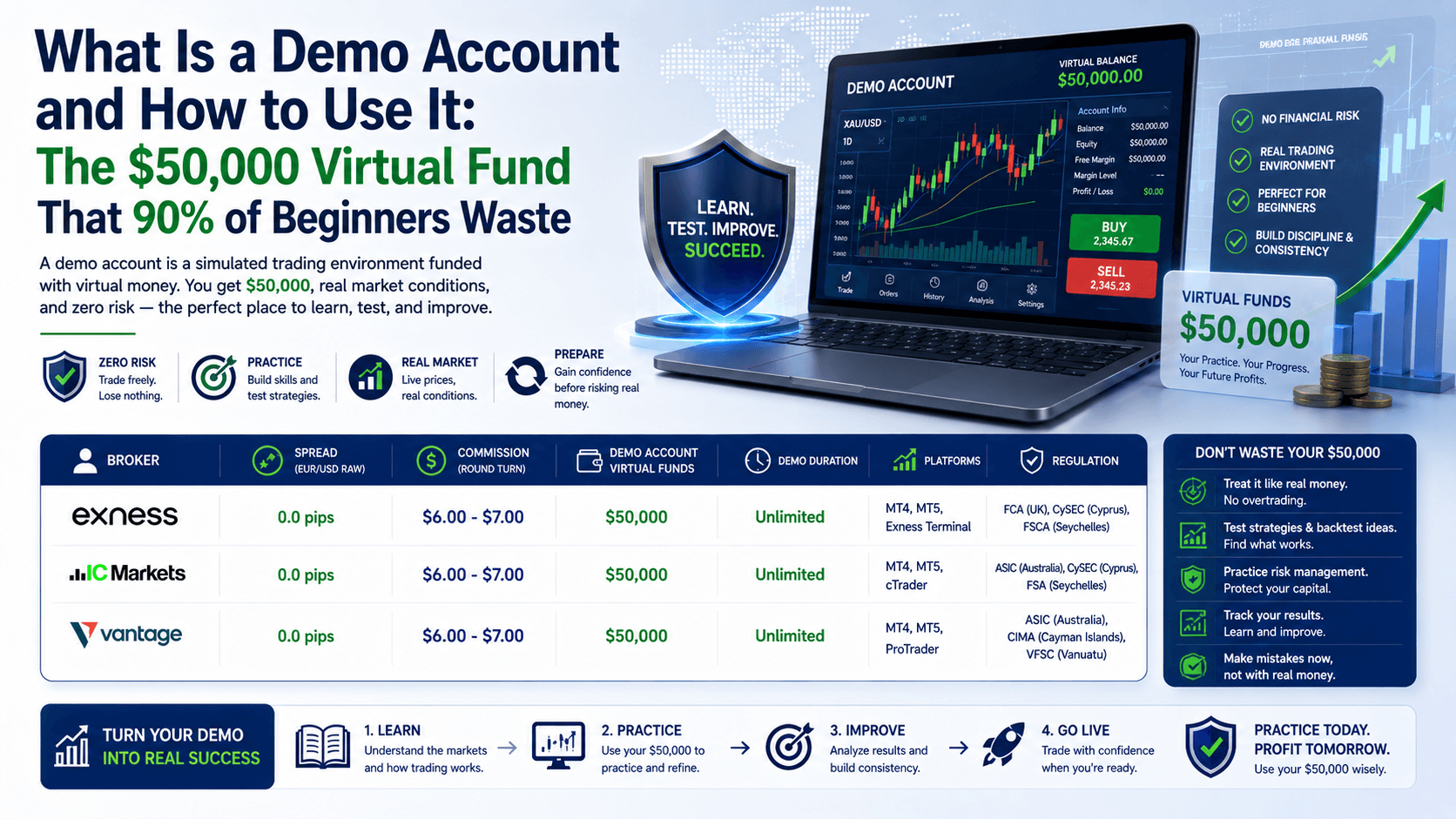
A demo account is a simulated trading environment funded with virtual money. You get $50,000, $100,000, sometimes even $500,000 in play money. You place trades on real markets with real prices. You can turn that virtual $50,000 into $80,000 in a week. And you'll feel like a genius.
Then you open a live account with $500 of your own money. And suddenly, nothing works the same way.
Data from multiple brokers suggests over 90% of retail traders lose money. The gap between demo success and live failure isn't about strategy. It's about what a demo account actually teaches you — and what it doesn't.
Let's break down what is a demo account, how to use it properly, and why most beginners waste theirs completely.
What Is a Demo Account? The Mechanism Behind the Virtual Money
A demo account connects you to the broker's live price feed but routes your orders through a simulated environment. You see the same EUR/USD at 1.0850 that a live trader sees. You can place buy and sell orders. You see profit and loss in real time.
But here's the critical distinction: your orders don't hit the actual interbank market. They're matched internally by the broker's demo server. This means:
- No slippage on most orders — you get filled at exactly the price you see
- No liquidity constraints — you can trade 10 lots on a pair that barely moves
- No emotional weight — losing $5,000 in virtual money feels like losing $5 in real life
This is why understanding what is a demo account and how to use it correctly matters more than most beginners realize.
The Three Critical Differences Between Demo and Live Trading
1. Execution Quality: The Slippage Blind Spot
In a demo account, you place a market order to buy EUR/USD at 1.0850. It fills at 1.0850. Perfect.

In a live account during the London open, you place the same order. The market moves 3 pips while your order processes. You get filled at 1.0853. On a 0.1 lot trade, that's $0.30 extra cost. On 1.0 lot, it's $3. Do this 50 times a month and you've lost $150 to slippage — an expense your demo account never showed you.
This is backed by evidence: demo accounts typically provide idealized fills that don't reflect real-market conditions, especially during high-volatility periods.
2. Capital Psychology: The $50,000 Illusion
Most brokers let you choose your demo balance. A beginner picks $50,000. They risk 2% per trade — that's $1,000 per trade. They win a few, lose a few, and the account barely moves. Feels safe, right?
Then they deposit $500 into a live account. Suddenly, 2% risk is only $10 per trade. That EUR/USD trade they were taking with a 30-pip stop? On 0.1 lots, that's $3 risk. On 0.01 lots, it's $0.30. The math completely changes.
Research shows that demo accounts often give traders a false sense of safety because the simulated capital is unrealistically high.
3. Emotional Reality: The Missing Variable
Here's the single biggest difference that no demo account can replicate: fear and greed with real money.
In your demo account, you see EUR/USD drop 50 pips against your position. You think, "It'll come back." You hold. It does. You break even. No big deal.
In your live account, EUR/USD drops 50 pips against your $500 position. Your heart rate spikes. Your palms sweat. You close the trade at a loss because you can't handle the feeling of losing real money. Price reverses 60 pips the next hour. You just lost $50 that you would have recovered if you'd held.
This emotional gap is why so many successful demo traders fail with real money.
How to Use a Demo Account: The Professional's Approach
Now that you understand what is a demo account and its limitations, here's exactly how to use it effectively.
Step 1: Set Your Demo Balance to Your Real Deposit Amount
If you plan to deposit $500, set your demo account to $500. Not $50,000. Not $10,000. $500.
This forces you to trade with the same position sizing and risk parameters you'll use live. You'll feel the weight of a $10 loss much more when it represents 2% of your account.
Step 2: Trade Your Actual Strategy — Not Random Experiments
Most beginners use demo accounts to "try things out." They buy EUR/USD because it looks low. They sell GBP/USD because a friend mentioned it. This teaches nothing.
Instead, create a trading plan first. Define:
- Which pairs you'll trade (start with 1-2 major pairs)
- Your entry criteria (specific price action or indicator signals)
- Your stop loss placement (always, on every trade)
- Your take profit target (risk:reward ratio of at least 1:2)
Then execute that plan on demo for at least 50-100 trades. Track everything.
Step 3: Keep a Trading Journal
Every trade gets documented:
- Date and time
- Pair and direction
- Entry price, stop loss, take profit
- Reason for entry
- Outcome (win/loss and P&L in dollars)
- Emotional state during the trade
After 50 trades, review the journal. What patterns emerge? Do you win more in certain sessions? Do you lose after consecutive wins? This data is gold.
Step 4: Introduce Realistic Friction
To simulate live conditions, add 1-2 pips of slippage to every trade in your journal. If your demo filled you at 1.0850, record the trade as if it filled at 1.0852 for buys or 1.0848 for sells. This accounts for the spread and slippage you'll face live.
Also, assume you won't always get filled at the exact price. If you place a limit order at 1.0800, assume it fills 50% of the time. This aligns your expectations with reality.
Demo Account vs Live Account: The Comparison Table
| Factor | Demo Account | Live Account |
|---|---|---|
| Capital | Virtual, often $50,000+ | Your real money, often $500-$5,000 |
| Execution | Instant fills at displayed price | Slippage possible, especially in volatile markets |
| Emotions | None — virtual losses don't hurt | Fear, greed, anxiety — real psychological pressure |
| Spreads | Often tighter than live | Variable spreads depending on market conditions |
| Liquidity | Unlimited — trade any size | Limited by actual market depth |
| Learning Value | Platform familiarity, strategy testing | Real market experience, emotional discipline |
| Cost | Free | Spread, commission, potential losses |
The Wrong Way vs The Right Way
The Wrong Way: Open a demo account with $100,000. Trade randomly for a week. Turn it into $120,000. Feel invincible. Deposit $500 into a live account. Lose $200 in the first hour because you're trading 0.5 lots on a $500 account (that's 10% risk per trade). Blame the broker.
The Right Way: Open a demo account with $500. Trade your plan for 3 months. Keep a journal. Review your data. If you're consistently profitable after 100 trades with a risk:reward of at least 1:2, deposit $500 into a live account. Start with 0.01 lots ($0.10 per pip on EUR/USD). Trade for 1-2 months. If you survive without blowing up, slowly increase position size.
FAQ
Are demo accounts completely free?
Yes, most brokers offer free demo accounts. Some may have time limits (e.g., 30 days) or require you to fund a live account after the trial period. Always check the broker's terms before signing up.

How long should I use a demo account before trading live?
There's no fixed rule, but a common benchmark is 50-100 trades with a consistent strategy. If you can't achieve profitability on demo, you won't achieve it live. Some traders spend 3-6 months on demo before transitioning.
Can I make real money with a demo account?
No. Demo accounts use virtual funds. You cannot withdraw demo profits. They are purely for practice and education. Real trading requires a live funded account.
Does demo trading reflect real market conditions?
Partially. Demo accounts use real-time prices, but execution, slippage, and liquidity are simulated. Emotional factors are completely absent. This makes demo results typically better than live results.
Quick Recap
- A demo account is a risk-free simulation for practicing trading with virtual money
- The main differences from live trading: execution quality, capital psychology, and emotional pressure
- Set your demo balance to match your planned live deposit for realistic practice
- Trade a defined strategy and keep a detailed journal for at least 50-100 trades
- Introduce simulated slippage and partial fills to bridge the gap between demo and live
Quick Win
Open a demo account with your preferred broker today. Set the balance to exactly $500 — no more. Trade EUR/USD with 0.01 lots and a 20-pip stop loss. Take one trade. Write down how you felt when it moved against you by 10 pips. That feeling? That's the start of real learning.