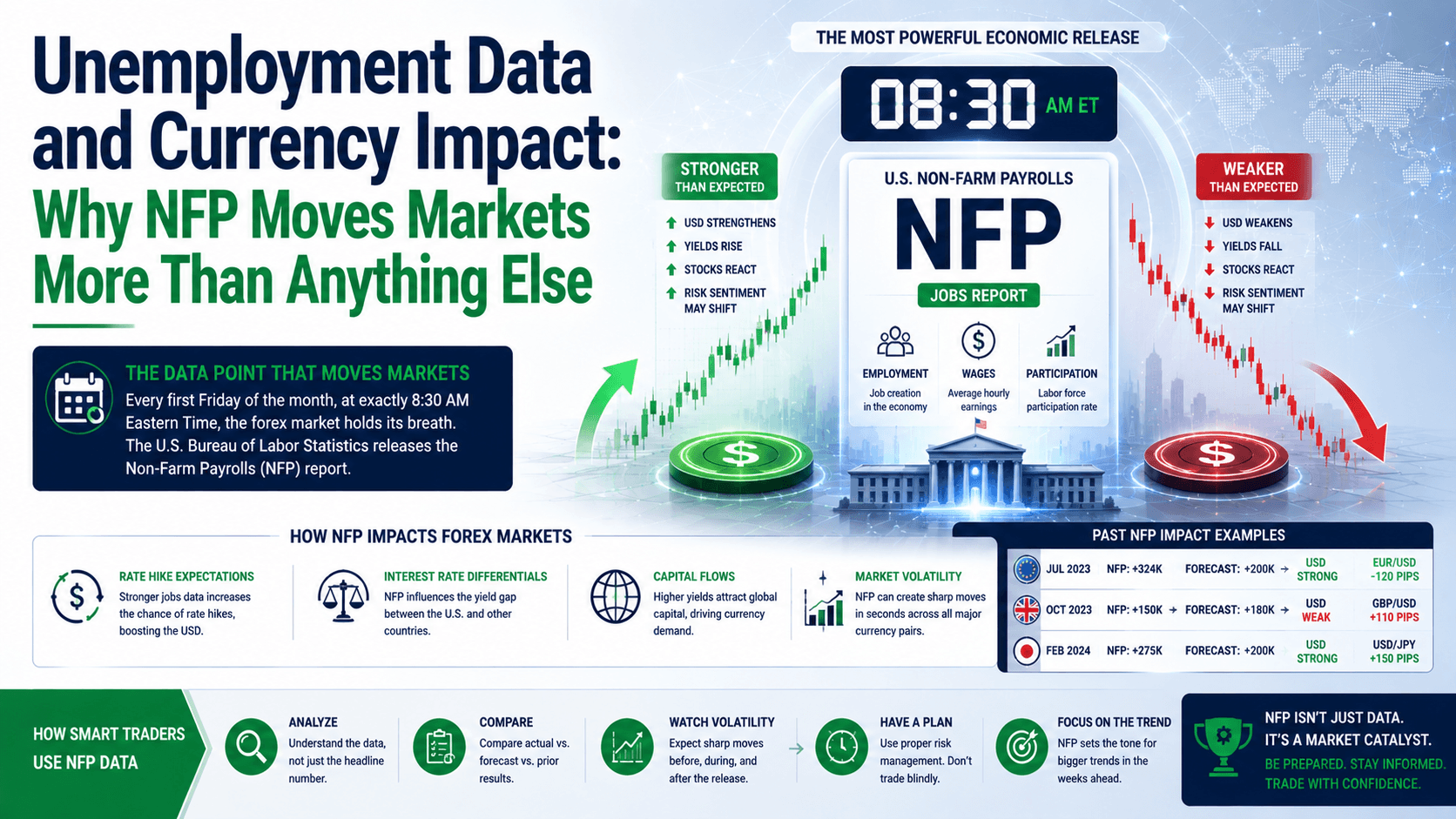

The Data Point That Moves Markets
Every first Friday of the month, at exactly 8:30 AM Eastern Time, the forex market holds its breath. The U.S. Bureau of Labor Statistics releases the Non-Farm Payrolls (NFP) report. Within seconds, currency pairs can move 50, 80, even 100 pips.
This isn't hype. It's data. The NFP report tracks employment numbers across the U.S. economy, excluding farm workers and a few other small categories. And because the U.S. dollar is the world's primary reserve currency, this single report influences every major currency pair.
But here's what most beginners miss: it's not the number itself that matters. It's the difference between what the market expected and what actually happened. That gap determines whether the dollar strengthens or weakens, and by how much.
The Mechanism: How Unemployment Data Drives Currency Values
The relationship between unemployment data and currency impact operates through two distinct channels. Understanding both is essential for any trader who wants to trade news events rather than get run over by them.
Direct Channel: Investor Sentiment
When employment data comes in stronger than expected, investors perceive the economy as healthy. This confidence translates directly into demand for that country's currency. Institutional investors, hedge funds, and multinational corporations adjust their currency holdings based on these signals.
Conversely, weak employment data signals economic distress. Investors reduce exposure to that currency, and the selling pressure drives its value down.
Indirect Channel: Central Bank Policy
This is where the real power lies. Central banks — the Federal Reserve, the European Central Bank, the Bank of England — use employment data as a key input for interest rate decisions.
Strong employment → potential inflation → higher interest rates → stronger currency.
Weak employment → economic slowdown → rate cuts → weaker currency.
The indirect channel often produces larger and more sustained moves because it affects the fundamental carry of holding that currency.
The January 10, 2025 NFP: A Perfect Case Study
On January 10, 2025, the U.S. released its December 2024 NFP report. The numbers were striking:
| Metric | Expected | Actual | Surprise |
|---|---|---|---|
| Jobs Added | 164,000 | 256,000 | +92,000 |
| Unemployment Rate | 4.2% | 4.1% | -0.1% |
The market reaction was immediate and decisive. The U.S. Dollar Index (DXY) rose 0.4% within minutes. EUR/USD dropped approximately 0.45%, moving from roughly 1.0300 to 1.0255. That's about 45 pips in under 30 minutes.
Let's put that in dollar terms. If you were trading 0.1 lots of EUR/USD (€10,000 notional value), that 45-pip move was worth $45. If you were trading 1.0 standard lot (€100,000), it was $450. In less than an hour.
The reason? Traders immediately repriced the probability of a Federal Reserve rate cut. Before the report, markets had priced in a 60% chance of a cut in March. After the report, that probability dropped to 35%. The dollar strengthened because the Fed was now less likely to ease monetary policy.
Australia's Surprise: December 12, 2024
This wasn't a U.S.-only phenomenon. On December 12, 2024, Australia released its November employment data:

| Metric | Expected | Actual | Surprise |
|---|---|---|---|
| Jobs Added | ~20,000 | 35,600 | +15,600 |
| Unemployment Rate | 4.2% (rise expected) | 3.9% | -0.3% |
The Australian dollar gained roughly 0.25% against the U.S. dollar within the first hour. AUD/USD moved from approximately 0.6370 to 0.6386. Traders reduced expectations for a Reserve Bank of Australia rate cut, and the currency responded accordingly.
Notice the pattern: the mechanism is identical regardless of which country's data is released. Strong employment data reduces rate cut expectations, which strengthens the currency.
The Only Number That Actually Matters: The Surprise Factor
Experienced traders understand something that beginners often miss. The market doesn't react to the unemployment data itself. It reacts to the deviation from consensus expectations.
If the market expects 200,000 jobs and the actual number is 210,000, the dollar might strengthen modestly. But if the market expects 200,000 and the actual number is 300,000, you'll see a violent move.
This is why professional traders don't just watch the release — they track economist surveys, whisper numbers, and even monitor real-time data from private payroll processors like ADP to gauge what the market is pricing in.
Why This Matters for Your Trading
If you're trading around employment data releases, you need to know three things before the number hits:
- The consensus estimate — what economists expect
- The previous month's number — the baseline for comparison
- The range of estimates — how much surprise the market can absorb
A number within the range of estimates typically produces a muted reaction. A number outside that range produces volatility. The further outside, the larger the move.
Common Mistakes Traders Make With Employment Data
After 10+ years watching these releases, I've seen the same errors repeated. Here are the three most costly:
Mistake 1: Trading the headline number only. The NFP headline is important, but revisions to prior months and average hourly earnings matter too. A strong headline with downward revisions to previous months is a mixed signal.
Mistake 2: Ignoring the unemployment rate. The unemployment rate can move independently from the payrolls number. If payrolls are strong but the unemployment rate rises (because more people entered the labor force), the signal is less bullish for the currency.
Mistake 3: Entering before the release. Spreads widen dramatically in the seconds before and after major data releases. Many retail traders get stopped out by the initial spike even if the market eventually moves in their direction.
Practical Strategies for Trading Employment Data
There are three approaches that professional traders use around employment data releases. Each has different risk profiles.
| Strategy | How It Works | Risk Level |
|---|---|---|
| Pre-release positioning | Estimate market expectations and enter before the release based on your analysis | High — you're betting against the consensus |
| Straddle trade | Place pending buy stop and sell stop orders above and below current price to catch the breakout | Medium — you capture the move regardless of direction |
| Post-release confirmation | Wait 10-15 minutes after release, let the initial volatility settle, then trade the direction | Lower — you miss the first move but have better risk management |
For most retail traders, the third approach is the most sustainable. The initial spike often reverses or retraces, and waiting gives you a better entry with a tighter stop loss.
FAQ
Is the unemployment rate or NFP more important for currency impact?
The NFP headline number typically generates the most immediate volatility because it's released monthly and provides a clear growth signal. The unemployment rate is important but tends to move more slowly, making it more relevant for medium-term positioning.

How long does the currency impact from employment data last?
The initial volatility usually lasts 30-60 minutes. However, the trend that emerges can persist for days or weeks if the data significantly changes expectations for central bank policy. The January 2025 NFP influenced dollar positioning for the remainder of the month.
Can employment data from other countries affect the U.S. dollar?
Indirectly, yes. Strong employment data from the Eurozone or Japan can strengthen the euro or yen against the dollar. The U.S. dollar is most directly affected by U.S. employment data, but global employment trends create cross-currency dynamics.
What's the best way to prepare for NFP release as a beginner?
Start by observing. Don't trade the first 3-4 NFP releases you watch. Track the consensus estimate, the actual number, and the market reaction. Note how long the volatility lasts and where price settles. Build a reference library of how different surprise magnitudes affect price action.
Quick Recap
- Unemployment data and currency impact operate through two channels: direct investor sentiment and indirect central bank policy expectations
- The surprise factor (actual vs. expected) matters more than the absolute number
- The January 2025 NFP showed how a +92,000 job surprise moved EUR/USD 45 pips in under 30 minutes
- Australia's December 2024 data demonstrated the same mechanism works across all developed economies
- Post-release confirmation trading is the safest approach for most retail traders
Quick Win
Open your economic calendar right now. Find the next NFP release date (first Friday of next month). Set a calendar alert for 8:25 AM ET. On that day, open a demo account or use a watchlist. Don't trade. Just watch. Track the consensus, the actual number, and the price reaction. Do this for three consecutive releases. You'll learn more about how unemployment data and currency impact actually works than from reading 50 articles.