
Here's the Problem Nobody Talks About
You've probably been told that forex trading is about predicting where price will go next. You study charts, watch news, and try to guess the bottom or top. And you keep losing.
I've been there. I spent years trying to catch reversals, buying when price looked "cheap" and selling when it looked "expensive." The result? I blew accounts. Lots of them.
The problem wasn't my analysis. It was my approach. I was fighting the market instead of joining it.
Here's the truth that took me a decade to learn: You don't need to predict anything. You just need to react to what price is actually doing. That's what a trend following strategy forex is all about.
What is a Trend Following Strategy Forex?
A trend following strategy forex is exactly what it sounds like. You identify the direction price is moving, and you trade in that direction. That's it.
You're not trying to catch the exact bottom or top. You're looking for the "meat" in the middle of the move. The part where price has established direction and momentum is on your side.
Let me show you what I mean with real numbers.
EUR/USD is at 1.0850. It's been making higher highs and higher lows for the past 5 days. The 200-period moving average is sloping up. Price is above it.
A trend follower says: "Price is moving up. I buy."
A beginner says: "Price has gone up 200 pips. It must be due for a reversal. I'll sell."
Who do you think wins more often? The person swimming with the current or the one swimming against it?
The trend is your friend isn't just a cliché. It's the foundation of every profitable long-term trader I know.
Why Most Beginners Get Trend Following Wrong
The biggest mistake I see? Beginners think trend following means "buy when price is going up." That's not a strategy. That's chasing.
Here's the difference:
| Chasing | Trend Following |
|---|---|
| Buy when price is already moving fast | Wait for a pullback within the trend |
| No defined entry rules | Clear rules for entry, stop, and target |
| No stop loss (or one that's too tight) | Stop loss based on market structure |
| Exit when scared (usually too early) | Exit when the trend shows signs of ending |
See the difference? Trend following isn't impulsive. It's systematic.
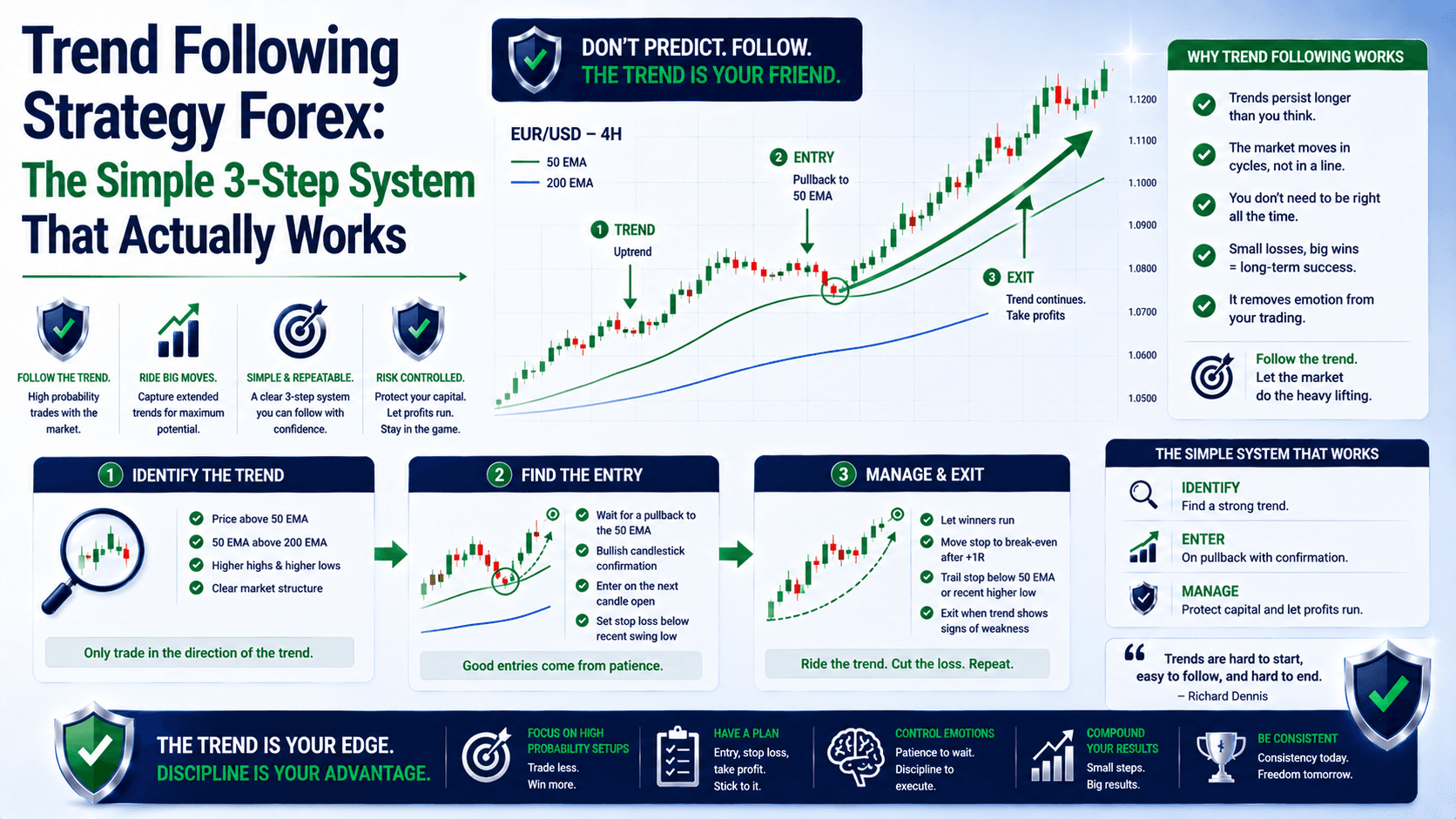
The 3-Step Trend Following Strategy Forex
Here's the exact system I teach in TheNextTrade Academy. It's simple. It works. And it's based on price action and one moving average.

Step 1: Identify the Trend
Open your daily or 4-hour chart. Add the 200-period Exponential Moving Average (EMA).
If price is above the 200 EMA, you only look for buy setups. If price is below, you only look for sell setups.
That's it. No second-guessing. No "what if." Price above the line = bullish bias. Price below = bearish bias.
This one filter alone will eliminate about 50% of the bad trades you'd normally take.
Step 2: Wait for a Pullback
This is where most people fail. They see price moving and they jump in immediately. Don't.
You want to wait for price to pull back toward the moving average or a key support/resistance level. Why? Because buying at the top of a move means you're buying at the worst possible price. The pullback gives you a better entry.
Let's use real numbers:
GBP/USD is at 1.2650. The 200 EMA is at 1.2600. Price has been trending up for 3 days. You wait. Price pulls back to 1.2610 — near the EMA. That's your entry zone.
Step 3: Confirm with a Price Action Signal
You don't just buy because price touched the EMA. You wait for a confirmation candle.
Look for a bullish engulfing candle or a pin bar with a long lower wick at the pullback level. This tells you that buyers are stepping in.
Here's your entry:
- Entry: 1.2615 (just above the confirmation candle)
- Stop Loss: 1.2580 (below the recent swing low — about 35 pips)
- Target: 1.2700 (previous high — 85 pips away)
Risk: 35 pips. Reward: 85 pips. That's a 1:2.4 risk-reward ratio.
On a 0.1 lot trade: Risk = $35. Potential profit = $85. That's a solid trade.
The Psychology of Trend Following — Why It's Hard
Here's the part nobody talks about. Trend following is emotionally brutal.
You'll have losing streaks. You'll watch price hit your stop loss and then immediately reverse in your direction. You'll sit through drawdowns that test your patience.
But here's the math that keeps me going:
In Curtis Faith's backtest of the Dual Moving Average system (a simple trend following strategy), the win rate was only 39%. That means 61% of trades lost money. But the system still produced a 57.8% annual return.
How? Because the winners were 3-4 times larger than the losers. You don't need to be right often. You need to be right big when you are.
That's the secret. Most traders can't handle losing 6 out of 10 trades, even if the 4 winners pay for all the losses and then some.
Trend Following vs Mean Reversion — Which is Right for You?
Not every trader is built for trend following. Here's a quick comparison to help you decide:
| Characteristic | Trend Following | Mean Reversion |
|---|---|---|
| Win rate | Low (30-45%) | High (60-80%) |
| Loss profile | Frequent, small losses | Rare, but large losses |
| Holding period | Days to weeks | Minutes to hours |
| Best market | Strong trends | Ranging markets |
| Psychological challenge | Enduring losing streaks | Handling sudden reversals |
If you can handle losing 5 trades in a row without changing your system, trend following might be for you. If you need frequent wins to stay confident, look at mean reversion.
Common Mistakes in Trend Following
Here are the traps I see beginners fall into — and how to avoid them:
Mistake 1: Entering too late. You see a big green candle and buy at the top. The trend was already 200 pips old. Fix: Wait for pullbacks. You'll get better entries.
Mistake 2: Exiting winners too early. You're up 30 pips and you take profit because you're scared. The trend continues for another 200 pips. Fix: Use a trailing stop or let price hit your target. Don't second-guess.
Mistake 3: Abandoning the strategy during drawdown. You lose 3 trades in a row and switch to a different system. Then the trend you were waiting for happens — and you're not in it. Fix: Trust your backtest. Drawdowns are normal.
Mistake 4: Overcomplicating. You add RSI, MACD, Bollinger Bands, and a custom indicator. Your chart looks like a Christmas tree. Fix: Simpler is better. One moving average and price action is enough.
FAQ
Is trend following the best strategy for forex beginners?
Yes, because it's simple to understand and execute. You don't need complex analysis. You just need to identify the direction and trade with it. The main challenge is psychological — dealing with losing streaks.

What time frame is best for trend following?
The 4-hour and daily charts work best. Trend following is not a scalping strategy. You want to capture moves that last days or weeks, not minutes. Higher timeframes give you cleaner trends and fewer false signals.
How much capital do I need to start trend following?
You can start with $500 if you use a micro account (0.01 lots). For a standard account, $2,000-$5,000 gives you more flexibility. The key is risking 1-2% per trade, not the total account size.
What's the best indicator for trend following?
The 200-period Exponential Moving Average (EMA) is the most reliable. It's used by institutional traders and acts as a clear line between bullish and bearish markets. Combine it with price action signals for entries.
Quick Recap
- A trend following strategy forex means trading in the direction of the established trend
- Use the 200 EMA to define your bias — above = bullish, below = bearish
- Wait for pullbacks to enter, not breakouts
- Confirm entries with price action signals (pin bars, engulfing candles)
- Expect a low win rate (30-45%) but let winners run for 2-3x your risk
- Risk 1-2% per trade and trust the system through drawdowns
Your Quick Win
Open your chart right now. Pull up EUR/USD on the 4-hour timeframe. Add the 200 EMA. Look at the last 10 candles. Is price above or below the line?
If it's above, mark the last 3 pullbacks where price touched or came close to the EMA. Did price bounce from those levels? If yes, you just identified 3 potential trend following entries you missed.
Start watching for the next pullback. That's your setup.