
Here's the truth most trading courses won't tell you
You can have the best strategy in the world. The most advanced indicators. The cleanest charts.
And still lose money.
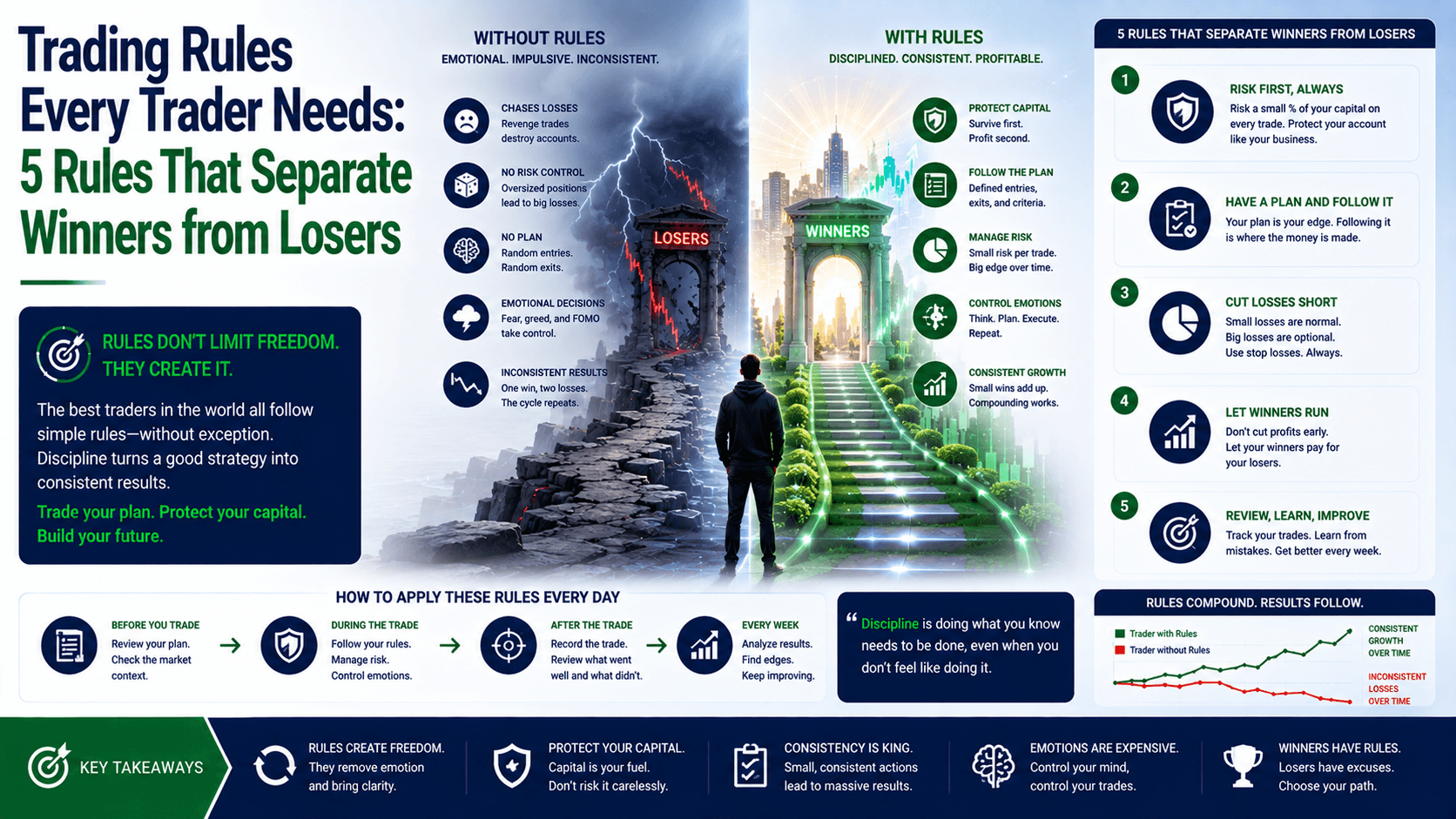
Why? Because you don't have the trading rules every trader needs to survive the emotional rollercoaster of the forex market.
I've been trading for over a decade. I've blown accounts. I've had streaks where I couldn't lose. And I've learned one thing that separates the 5% who consistently profit from the 95% who don't.
It's not intelligence. It's not a secret indicator. It's discipline backed by non-negotiable rules.
Let's break down the 5 trading rules every trader needs — the ones that will actually protect your account and help you grow.
Rule #1: The 1% Rule — Your Account's Best Friend
Most beginners risk 10%, 20%, even 50% of their account on a single trade. They don't even realize they're doing it.
Here's how it plays out:
You have a $1,000 account. You see a "sure thing" on EUR/USD. You go all in with 1 standard lot. The trade moves 20 pips against you. That's $200 loss. Your account just dropped 20%.
Now you're desperate. You take another trade to "get it back." You risk even more. And the cycle continues until your account hits zero.
The 1% rule stops this cold.
The rule: Never risk more than 1% of your account on any single trade.
With a $1,000 account, that's $10 max risk per trade.
Let's say you're trading EUR/USD at 1.0850. Your stop loss is 20 pips away. On a 0.05 lot size, each pip is worth $0.50. Your total risk is 20 x $0.50 = $10. That's exactly 1%.
Even if you lose 10 trades in a row? You're down 10%. Annoying? Yes. Account-destroying? No. You can recover.
This is the single most important of all the trading rules every trader needs. Without it, nothing else matters.
Rule #2: Always Pre-Plan Your Exit Before You Enter
Here's what most beginners do:

They see a breakout on GBP/USD. They buy. Then they stare at the screen, hoping it goes up. When it drops, they freeze. "Maybe it'll bounce back," they think.
It doesn't. They lose $200. And they feel sick.
Professional traders do the opposite.
Before you click "buy" or "sell," you must know three numbers:
- Entry price — exactly where you get in
- Stop loss — exactly where you get out if you're wrong
- Take profit — exactly where you get out if you're right
That's it. No second-guessing. No "let me see how it goes."
Here's a real example:
You're trading EUR/USD at 1.0850. You identify support at 1.0830 and resistance at 1.0890.
Your plan:
- Entry: 1.0850
- Stop loss: 1.0825 (25 pips below support — give it breathing room)
- Take profit: 1.0890 (40 pips)
- Risk: 25 pips x $0.50 (0.05 lot) = $12.50
- Reward: 40 pips x $0.50 = $20
- Risk:Reward = 1:1.6
You enter the trade. Price drops to 1.0825. Stop loss hits. You lose $12.50. No panic. No emotional decision. The plan was executed perfectly.
This is what discipline looks like. And it's one of the trading rules every trader needs to sleep well at night.
Rule #3: The 2:1 Risk-to-Reward Minimum
Let's talk about the math of winning.
If you risk $10 to make $10 (1:1 risk-to-reward), you need to win 50% of your trades just to break even. Factor in spreads and commissions, and you need to win more than 50%.
That's hard. Really hard.
But if you risk $10 to make $20 (1:2 risk-to-reward), you only need to win 33% of your trades to be profitable.
Let me show you:
| Scenario | Win Rate | Risk:Reward | Result (10 trades) |
|---|---|---|---|
| Trader A | 60% | 1:1 | 6 wins x $10 = $60, 4 losses x $10 = -$40. Net: +$20 |
| Trader B | 40% | 1:2 | 4 wins x $20 = $80, 6 losses x $10 = -$60. Net: +$20 |
Trader B wins less often but makes the same profit. Why? Because they let their winners run and cut their losers short.
The rule: Only take trades where your potential profit is at least double your potential loss.
This is non-negotiable. It's one of the trading rules every trader needs to stack the odds in your favor.
Rule #4: No Trading After a Loss — The "Cool Down" Rule
You just lost $50 on a trade. Your heart is pounding. You feel angry. You want to "get it back" immediately.
This is the most dangerous moment in trading.
Here's what happens next: You take a trade without checking your setup. You skip your analysis. You enter too late. You get stopped out again. Now you're down $100 and furious.
The fix is simple: After every loss, step away from the screen for at least 30 minutes.
Go for a walk. Make a coffee. Stretch. Do anything that breaks the emotional loop.
When you come back, your brain is calm again. You can look at the chart objectively. You can follow your rules.
This one rule has saved my account more times than I can count. It's one of the trading rules every trader needs to protect themselves from themselves.
Rule #5: Keep a Trading Journal — The Mirror You Can't Ignore
The most successful traders I know all have one thing in common: they keep a detailed trading journal.
Not just "I bought EUR/USD and made $20." That's useless.
A real trading journal includes:
- Date and time of the trade
- Currency pair and lot size
- Entry, stop loss, and take profit levels
- Reason for the trade (what setup did you see?)
- Your emotional state before entering (calm? nervous? excited?)
- What happened (did you follow the plan?)
- Lessons learned (what would you do differently?)
After 20-30 trades, patterns emerge. You might notice you always lose on Monday mornings. Or you take bad trades after 3 PM. Or you're great at catching trends but terrible at trading ranges.
Without a journal, you're flying blind. With one, you can actually improve.
This is the final piece of the trading rules every trader needs to turn experience into growth.
FAQ
How many trading rules should a beginner have?
Start with 3-5 core rules. The most important are: risk 1% per trade, pre-plan your exit, and maintain a 1:2 risk-to-reward ratio. Add more as you gain experience.

What happens if I break my trading rules?
Analyze why. Was it fear? Greed? Boredom? Write it down in your journal. Then recommit. Even professional traders slip. The key is catching it fast and fixing it.
Can I make money with just these 5 rules?
Yes. These rules protect your account and create a framework for consistent profits. Without them, no strategy works. With them, even a simple strategy can be profitable over time.
How do I stick to my trading rules when emotions are high?
Write your rules on a sticky note and put it on your monitor. Use a checklist before every trade. And always step away after a loss. Discipline is built through repetition, not willpower.
Quick Recap
- 1% rule: Never risk more than 1% of your account per trade
- Pre-plan exits: Know your stop loss and take profit before entering
- 2:1 risk-to-reward: Only take trades where profit is at least double the risk
- Cool down after losses: Step away for 30 minutes after a losing trade
- Keep a journal: Track every trade, your emotions, and lessons learned
Your Quick Win
Open your trading platform right now. Go to your trade history. Find your last 5 losing trades.
For each one, answer this: Did you pre-plan your exit before entering? If not, write down what went wrong and how you'll fix it.
Then create a simple checklist with these 5 rules. Print it. Stick it on your wall.
Next time you trade, check every box before you click "buy" or "sell."
That's the start of real discipline. And it's the only way to join the 5% who actually make it.