
Let's Get Real About Why You're Not Consistent
You've been at this for months. Maybe years. You've read every article, watched every YouTube video, and tried every indicator under the sun. But your P&L still looks like a rollercoaster — up one week, down the next, and somehow always ending in the red.
Here's the truth nobody tells you:
You don't need a better strategy. You need a better routine.
The top 5% of traders don't have magical abilities. They don't have secret indicators. What they have is a trading routine for consistency that they follow every single day — whether they feel like it or not.
And that's what we're building today.
Why Most Traders Never Build a Routine (And Why It Costs Them Everything)
Let me show you what happens when you don't have a routine.
It's Tuesday morning. You wake up, grab coffee, and open your charts. EUR/USD is at 1.0870. You see a pin bar forming at support. Your heart races. You enter 0.5 lots without checking the higher timeframe. No stop loss because "it'll bounce."
Two hours later, price drops 40 pips. You're down $200. You panic-close. Then price reverses and hits your original target.
Sound familiar?
That's not bad luck. That's no routine.
Without a routine, every trade feels urgent. Every candle feels like a life-or-death decision. You're reacting, not trading.
Here's what a routine gives you:
- Clarity — You know exactly what to look for
- Calm — No more panic decisions
- Consistency — Same process, same results
- Data — You can actually track what works
The bottom line is: if you don't have a routine, you don't have a trading business. You have a gambling habit.
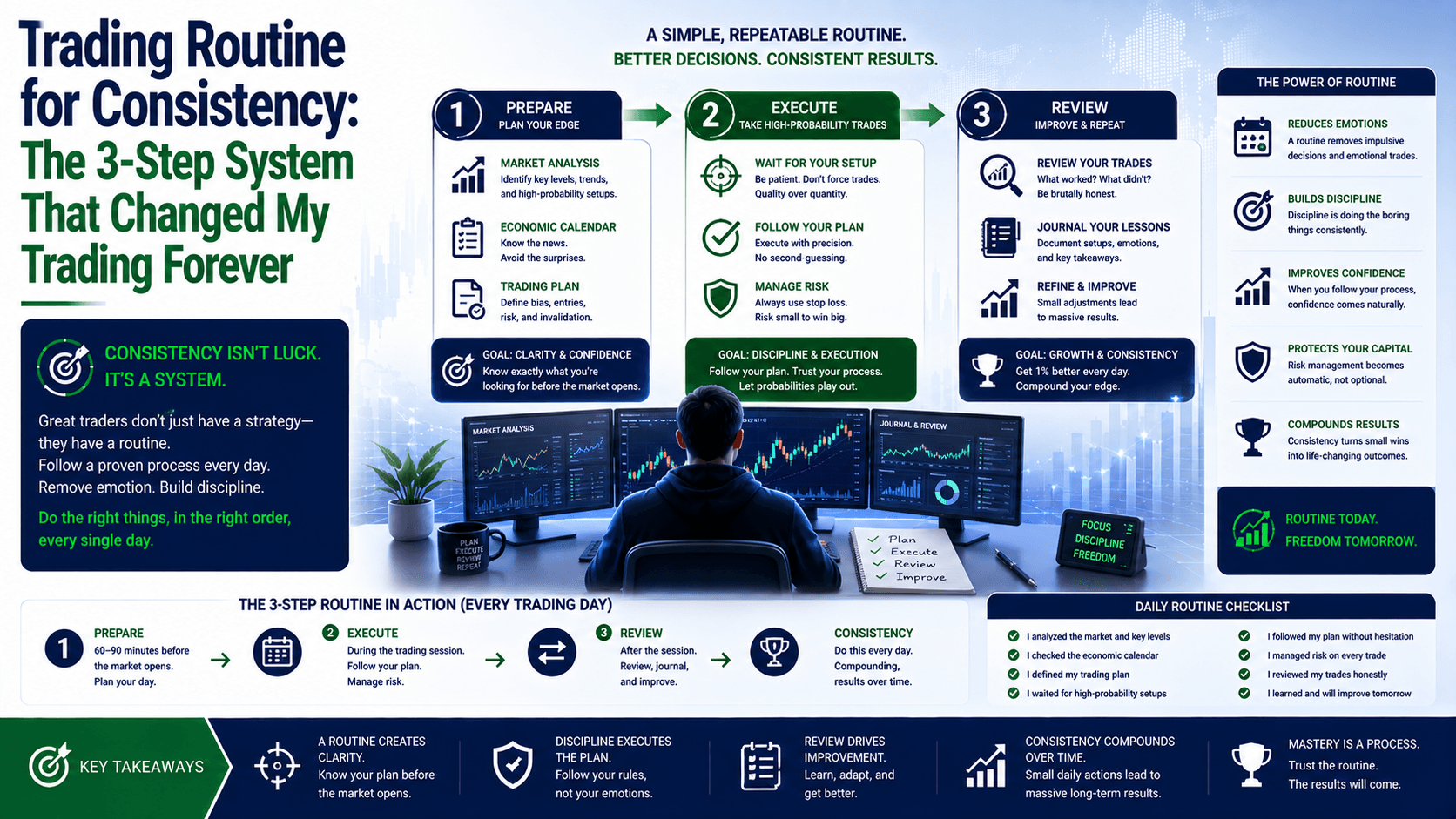
The 3-Step Trading Routine for Consistency That I've Used for 10+ Years
I've been trading for over a decade. I've blown accounts, made them back, and learned every painful lesson along the way. This is the routine that finally made me consistent.

It's not complicated. In fact, it's painfully simple. But that's exactly why it works.
Step 1: The Pre-Market Scan (15 Minutes)
Every morning, before I even think about entering a trade, I do this:
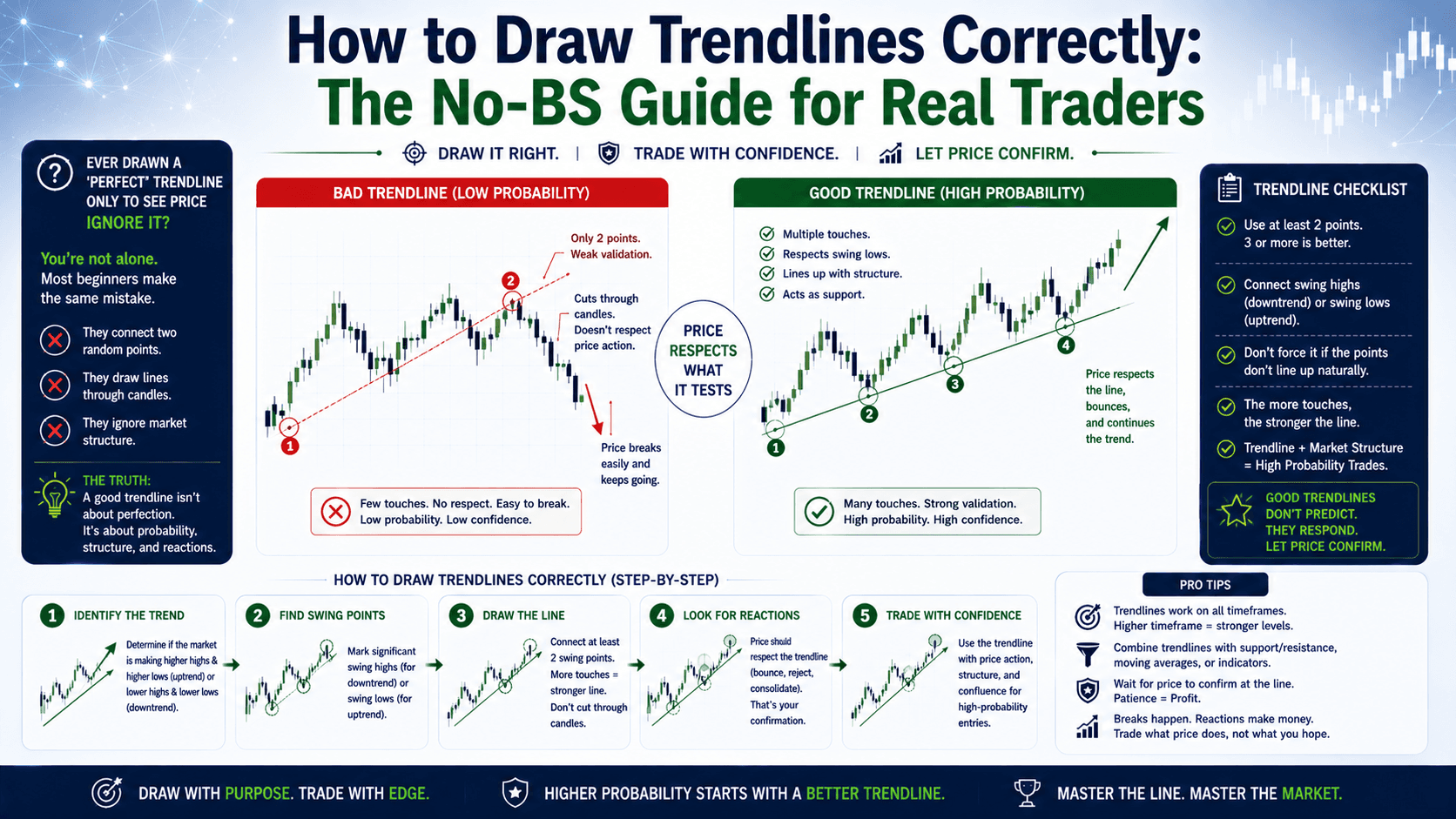
- Check the weekly chart first — I draw key support and resistance levels. I identify the overall trend. Is EUR/USD in an uptrend or downtrend on the weekly? This sets my bias.
- Drop to the daily chart — I look for the same levels, adjusted for recent price action. I note any obvious reversal signals — pin bars, engulfing candles, inside bars.
- Check the economic calendar — Are there any major news events today? Non-farm payrolls? CPI? Fed speeches? If yes, I adjust my risk accordingly.
That's it. 15 minutes. Every day.
Here's why this works: by looking at the weekly first, you see the big picture. Most beginners start on the 5-minute chart and wonder why they get chopped up. Start big, then zoom in.
Step 2: The Trade Setup (5 Minutes)
Now I know my bias. I know the key levels. I know what's happening in the news.
I'm looking for one thing: a clean setup at a key level with confluence.
Let me give you a real example from last week:
EUR/USD at 1.0850. Weekly chart shows a clear support zone at 1.0800-1.0820. Daily chart shows a hammer candle forming right at that zone. The 21 EMA is sloping upward — trend is bullish.
Confluence: Support level + hammer candle + bullish trend.
I enter long at 1.0855. Stop loss at 1.0820 (35 pips). Target at 1.0920 (65 pips). Risk:reward = 1:1.85.
On 0.1 lots, that's $35 risk for $65 potential profit. On 0.5 lots, it's $175 risk for $325 profit.
The key: I don't enter unless I have at least 2-3 points of confluence. If it's just a pin bar with no level? I pass. If it's a level with no signal? I wait.
Step 3: The Post-Market Review (10 Minutes)
This is where most traders fail. They take the trade, close it, and move on without learning anything.
Every evening, I review every trade I took:
- Did it follow my plan? If yes, good trade regardless of outcome.
- What was the outcome? Win? Loss? Breakeven?
- What did I learn? One lesson, written down.
I keep a trading journal. Nothing fancy — just a Google Sheet with columns for date, pair, setup, entry, exit, P&L, and notes.
Here's the magic: After 30 days of this, you'll start seeing patterns. You'll notice that your best trades happen during London open. You'll see that your worst trades happen when you break your own rules.
That data is gold. Use it.
The Wrong Way vs The Right Way: A Before and After
Let me show you the difference a routine makes.
| Without Routine | With Routine |
|---|---|
| Wake up, open charts, feel anxious | Wake up, pre-market scan, feel prepared |
| See a candle moving up, FOMO enters | See a candle, check weekly/daily levels first |
| Enter 1.0 lots because "this is the one" | Enter 0.2 lots because that matches risk rules |
| No stop loss, or stop at exact level | Stop 10 pips below key level for breathing room |
| Panic-close at first drawdown | Let trade breathe, trust the plan |
| End day: -$150, frustrated | End day: +$40 or -$20, calm either way |
The difference isn't intelligence. It's process.
Common Traps That Will Destroy Your Routine
Even with a routine, you'll face challenges. Here's what to watch for:
Trap 1: The "Let Me Check One More Time" Loop
You check your charts. Then you check again 5 minutes later. Then again. Before you know it, you've been staring at the screen for 3 hours. Set a timer. 15 minutes for pre-market. 5 minutes for setup. Done.
Trap 2: The "This Trade Is Different" Excuse
You see a setup that kind of fits your rules. But not really. Your brain says "just this once." Don't. One exception becomes two, then ten, then a blown account.
Trap 3: The "I'll Journal Tomorrow" Trap
You skip the post-market review because you're tired. Then tomorrow. Then next week. Journaling is non-negotiable. It takes 10 minutes. Do it.
FAQ
How long does it take for a trading routine to become a habit?
Most traders need 30-60 days of daily repetition. The first two weeks are the hardest. After that, it starts to feel strange if you don't do it.

What if I don't have time for a full routine?
Start with 10 minutes. Do the pre-market scan only. That's better than nothing. Once that sticks, add the post-market review. Build slowly.
Can I use this routine for Gold (XAU/USD) trading?
Absolutely. Gold is my specialty. The same 3-step process works — just adjust your volatility expectations. Gold moves faster, so I use wider stops and smaller lot sizes.
What's the most important part of a trading routine?
The post-market review. Most traders skip it. But that's where you actually learn. Without review, you're repeating the same mistakes over and over.
📝 Quick Recap
- A trading routine for consistency is what separates profitable traders from gamblers
- My 3-step system: Pre-market scan (15 min) → Trade setup (5 min) → Post-market review (10 min)
- Start with the weekly chart, then daily. Never trade on a lower timeframe without knowing the higher timeframe context
- Only enter trades with 2-3 points of confluence (level + signal + trend)
- Journal every trade. Review weekly. Adapt monthly.
Your Quick Win: Do This Right Now
Open your trading platform. Pull up EUR/USD on the weekly chart. Draw the last 3 major support and resistance levels. Now drop to the daily chart and do the same.
That's your pre-market scan for tomorrow. You just built the foundation of your routine.
Tomorrow morning, do it again. And the day after. And the day after that.
30 days from now, you won't recognize your trading.
Now it's your turn. Open your charts and start.