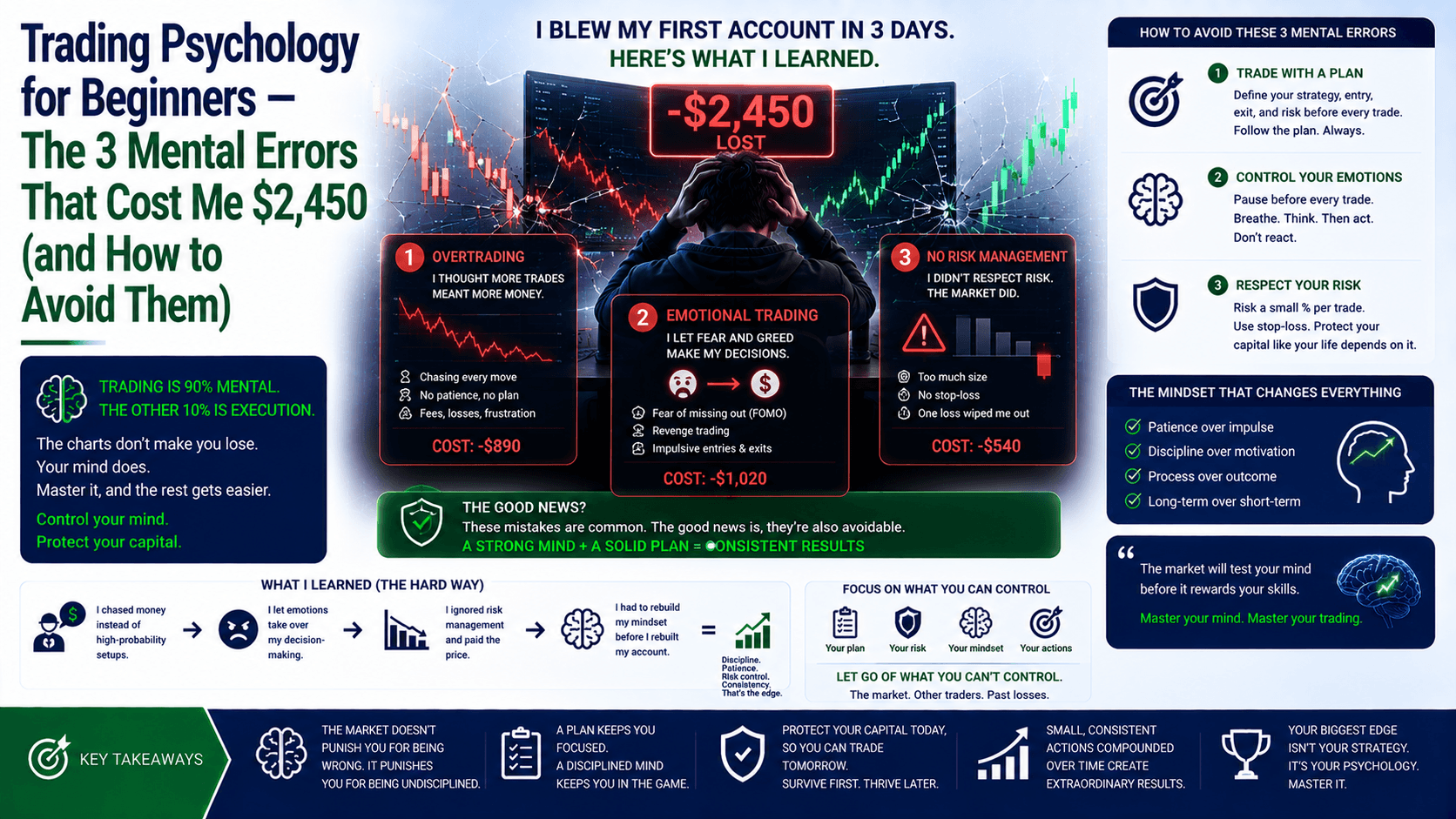

I Blew My First Account in 3 Days. Here's What I Learned.
I remember my first real trade like it was yesterday.
EUR/USD was at 1.0850. I saw a beautiful bullish engulfing candle on the 1-hour chart. I was convinced it was going to rip higher.
I went all in — 0.5 lots on a $500 account. No stop loss. "It'll bounce," I told myself.
It didn't. Price dropped 40 pips in 20 minutes. I lost $200. My heart was pounding. I felt sick.
Then I did something even dumber. I revenge traded. I doubled down on the next trade. And the next. By the end of the week, my account was gone.
That's when I realized something crucial: my strategy wasn't the problem. My brain was.
This is trading psychology for beginners — the part nobody talks about. The part that separates people who make money from people who lose it.
Let me save you the $2,450 I lost learning this lesson.
What is Trading Psychology? (The Simple Version)
Trading psychology is how your emotions and mental state affect your trading decisions.
Think of it this way: You can have the best trading strategy in the world. Perfect entries, perfect exits. But if you panic during a drawdown, that strategy is worthless.
Here's what happens in your brain when you trade:
- Fear — You see a red candle and close a trade that would have been profitable
- Greed — You hold a winning trade too long, hoping for "just a few more pips"
- Hope — You watch a losing trade drop 50 pips, praying for a bounce that never comes
- Regret — You missed a trade, so you chase the next one without a plan
Sound familiar? That's because every single trader — including me — has felt these emotions.
The difference between successful traders and everyone else? They've learned to manage their mind, not just their charts.
The 3 Mental Errors That Blew My Account
Let me break down the three biggest mistakes I made — and what I should have done instead.

Error #1: Revenge Trading (The "Get It Back" Trap)
After losing $200 on that first trade, I was angry. Not at the market — at myself. So I did what most beginners do: I tried to win it back immediately.
I took a trade on Gold (XAU/USD) at $2,350. No analysis. No plan. Just pure emotion. I went short because I wanted to feel in control again.
Gold rallied 30 points in 10 minutes. I lost another $150.
The fix: Set a daily loss limit. For me, it's 2% of my account. When I hit that number, I walk away. No exceptions. I go for a walk, watch a show, do anything but trade.
Your emotions are at their worst after a loss. You're not thinking clearly. Don't trade.
Error #2: Moving My Stop Loss (The "Just a Little More" Lie)
I entered a long trade on GBP/USD at 1.2700. My stop was at 1.2670 — 30 pips away. Price dropped to 1.2675. I was sweating.
"It'll bounce," I told myself. So I moved my stop to 1.2650.
Price hit 1.2648. I lost 52 pips instead of 30.
This is the most expensive habit in trading. You're not protecting your trade — you're protecting your ego. A 30-pip loss is manageable. A 52-pip loss hurts twice as much.
The fix: Place your stop loss before you enter the trade. Then never touch it. Treat it like a contract with yourself.
Error #3: Overconfidence After a Win (The "I'm a Genius" Trap)
After a few winning trades, I thought I'd cracked the code. I started taking bigger positions. I ignored my risk management rules.
I took a 1.0 lot trade on EUR/USD — $10 per pip. My stop was 20 pips away. That's $200 risk on a $500 account. 40% of my capital on one trade.
Price hit my stop in 15 minutes. I lost $200.
The fix: Treat every trade the same. Win or lose, your position size stays consistent. I risk 1-2% per trade, no matter how confident I feel.
How to Build Mental Discipline (The 3-Step System)
Here's the system I use now. It's simple, but it works.
Step 1: Create a Trading Plan (And Follow It)
Before you enter any trade, write down:
- Entry price
- Stop loss
- Take profit
- Position size (based on 1-2% risk)
- Why you're taking the trade (specific reason)
If you can't write it down, don't take the trade.
Step 2: Use a Trading Journal
After every trade, write down:
- What happened
- How you felt
- Did you follow your plan?
I use a simple spreadsheet. After 20 trades, patterns emerge. I noticed I always revenge trade after a loss. Seeing that in writing changed everything.
Step 3: Set Hard Limits
Three rules I never break:
- Daily loss limit: 2% of account. Hit it? Stop trading for the day.
- Max position size: Never risk more than 2% on a single trade.
- No trading after a loss: At least 30 minutes to cool down.
Trading Psychology vs. Strategy — The Real Comparison
Most beginners think they need a better strategy. Here's what actually matters:
| Factor | Impact on Results | What Beginners Think | What Actually Works |
|---|---|---|---|
| Trading Psychology | 80% | "I need a better indicator" | Manage emotions, follow the plan |
| Strategy | 20% | "This strategy will make me rich" | Simple, consistent, tested |
| Risk Management | Essential | "I'll figure it out later" | 1-2% risk per trade, always |
The bottom line: You can have a perfect strategy and still lose money if your psychology is weak. But with strong psychology, even a simple strategy can be profitable.
FAQ
Is trading psychology really that important?
Yes. Most traders lose money not because of bad strategies, but because of emotional decisions. Fear, greed, and revenge trading destroy accounts faster than any market move.

How do I stop revenge trading?
Set a daily loss limit (2% of your account). When you hit it, walk away. No exceptions. Go for a walk, watch a movie, do anything but trade.
Can I trade without emotions?
No. You're human. But you can learn to recognize your emotions and follow your plan anyway. That's the skill.
How long does it take to improve trading psychology?
It's an ongoing process. Most traders see improvement after 3-6 months of consistent journaling and self-reflection. Be patient with yourself.
Quick Recap
- Trading psychology is managing your emotions, not eliminating them
- The 3 biggest mental errors: revenge trading, moving stops, overconfidence after wins
- Follow a plan, use a journal, set hard limits
- Risk management is your emotional safety net
Your Quick Win (Do This Today)
Open your trading journal right now. Write down your last 3 trades. For each one, answer honestly: Did I follow my plan? How was I feeling?
If you don't have a journal, start one. A simple notebook or spreadsheet works. This one habit will save you more money than any indicator ever will.