
Let's Get Something Straight.
You're not a bad trader. You're an untrained one. There's a massive difference.
A bad trader keeps making the same mistakes and blames the market. An untrained trader makes mistakes, learns from them, and gets better. The fact that you're here, reading this, learning? That already puts you ahead of 80% of people who call themselves "traders."
But here's the hard truth: without a plan, you're gambling. Not trading. Gambling.
I know because I blew my first account doing exactly this. I jumped into a EUR/USD trade at 1.0850 because "it looked like it was going up." No stop loss. No target. No idea what I was doing. Price dropped 40 pips in 10 minutes. I lost $400 on a $1,000 account. That's 40% of my capital. Gone. In 10 minutes.
That's what happens when you don't have a trading plan how to create one figured out.
So let's fix that. Right now.
What Is a Trading Plan? (And Why You're Screwed Without One)
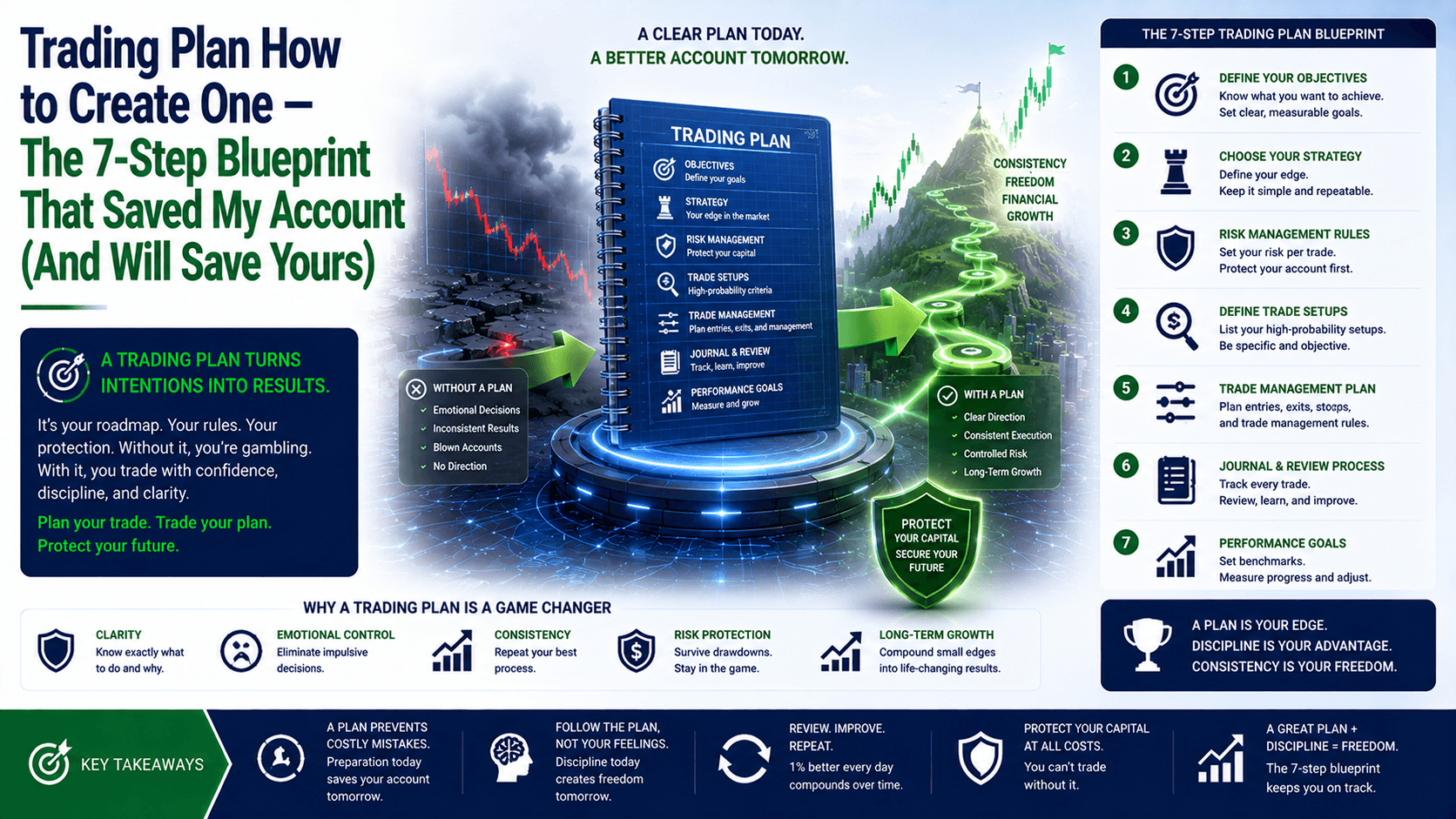
A trading plan is your personal rulebook for the markets. It tells you:
- What to trade
- When to enter and exit
- How much to risk on every single trade
- What to do when things go wrong (they will)
Think of it like a GPS for your trading. Without it, you're driving blindfolded through rush-hour traffic. With it, you know exactly where you're going and how to get there safely.
Here's the difference:
| Without a Plan | With a Plan |
|---|---|
| You enter trades on "gut feeling" | You enter based on clear rules |
| You hold losers hoping they'll turn around | You cut losses at your pre-set stop |
| You take profits too early out of fear | You let winners run to your target |
| You revenge trade after a loss | You step away and review your plan |
| You have no idea why you won or lost | Your trading journal tells you exactly why |
The bottom line is: a plan turns you from a gambler into a professional. And professionals make money over time. Gamblers lose it.
Step 1: Look in the Mirror — Be Brutally Honest About Yourself
Before you write a single rule, you need to assess yourself. This is where most people skip ahead. Don't.
Ask yourself these questions:
- How much capital can I afford to lose? Not "how much do I want to trade with." How much can you lose without it affecting your life? If losing $500 means you can't pay rent, you're not ready to trade live.
- How much time do I have? Do you have a full-time job? Kids? If you can only check charts during your lunch break, you're not a day trader. You're a swing trader. Accept it.
- What's my risk tolerance? If a $20 loss makes you physically sick, then your risk per trade needs to be tiny. Start with 0.5% of your account.
Let's make this real. Meet Sarah. She has a $3,000 account, works 9-to-5, and can check charts twice a day. Her maximum tolerable loss per trade is $30. That's 1% of her account. She's a swing trader. Period.
Your plan must fit your life. Not some YouTube guru's life. Yours.
Step 2: Define Your Trading Style — Stop Trying to Be Someone You're Not
There are four main trading styles. Pick one that matches your time and personality.

| Style | Time Commitment | Holding Period | Best For |
|---|---|---|---|
| Scalping | Full-time, constant monitoring | Seconds to minutes | People who can stare at charts all day |
| Day Trading | Several hours per day | Minutes to hours | People with flexible schedules |
| Swing Trading | 30 minutes per day | Days to weeks | People with full-time jobs |
| Position Trading | Weekly check-ins | Weeks to months | Patient, long-term thinkers |
Here's the truth: day traders aren't "cooler" than swing traders. Scalpers aren't "smarter" than position traders. The best style is the one you can actually stick to.
If you have a 9-to-5 and try to scalp, you'll fail. You'll miss setups, make rushed decisions, and blow up. Be honest with yourself.
Step 3: Set Up Your Entry and Exit Rules — Make Them So Clear a Child Could Follow Them
This is where most plans fall apart. Your rules need to be specific. Not "buy when it looks good." That's gambling.
Here's a real example:
- Entry rule: Buy EUR/USD when price closes above the 50-period moving average on the 1-hour chart AND the RSI is above 50.
- Stop loss: 15 pips below the nearest support level.
- Take profit: 30 pips above entry (2:1 risk-reward).
Now, let's math it out for Sarah with her $3,000 account:
- Risk per trade: 1% = $30
- Stop loss distance: 15 pips
- Position size: $30 ÷ 15 pips = $2 per pip
- On EUR/USD, $2 per pip = 0.2 lots (standard lot = $10 per pip)
- Target: 30 pips × $2 = $60 profit
See how that works? Every trade has a defined risk and reward. No guesswork. No emotions.
Your rules should be so clear that another trader could look at your chart and know exactly why you took that trade.
Step 4: Risk Management — The Only Thing That Actually Protects Your Account
Let me be blunt: you can be wrong on 70% of your trades and still make money. But if you ignore risk management, you'll lose everything in one bad trade.
Here are the non-negotiable rules:
- Risk 1-2% per trade. Never more. Sarah risks $30 on a $3,000 account. That's 1%.
- Use a stop loss on every trade. Every. Single. One. No exceptions.
- Never move your stop loss further away. If you're "sure" the trade will turn around, you're not trading — you're hoping. Hoping blows accounts.
Let's compare two traders:
| Trader A (No Risk Rules) | Trader B (1% Risk Rule) | |
|---|---|---|
| Account Size | $2,000 | $2,000 |
| Risk Per Trade | $200 (10%) | $20 (1%) |
| Losing Streak | 3 trades in a row | 3 trades in a row |
| Account After Streak | $1,400 (lost 30%) | $1,940 (lost 3%) |
| Recovery Needed | 43% gain to break even | 3.1% gain to break even |
Trader A is probably done. Trader B? They're still in the game. That's the power of risk management.
Step 5: Choose Your Markets — Don't Trade Everything at Once
Beginners love to trade every pair they see. Don't. It's overwhelming and you'll master none of them.
Start with 2-3 pairs. My recommendation for beginners:
- EUR/USD — Most liquid, tightest spreads, predictable behavior
- GBP/USD — More volatile, great for swing trades
- USD/JPY — Clean technical moves, good for trend trading
Learn their personalities. How do they react to news? When are they most active? After 3-6 months of consistent trading, you can add more. But honestly? Many professional traders only trade 2-3 pairs their entire career.
Step 6: Keep a Trading Journal — It's Your Secret Weapon
I know, journaling sounds boring. But it's the single most powerful tool for improvement.
Here's what to record for every trade:
- Date and time
- Pair and direction (long/short)
- Entry price, stop loss, take profit
- Position size and dollar risk
- Why you entered (specific rule triggered)
- How you felt before, during, and after
- What you learned
After 20-30 trades, review your journal. You'll spot patterns. Maybe you overtrade after a big win. Maybe you make your worst decisions on Monday mornings. These insights are gold.
Without a journal, you'll make the same mistakes forever. With one, you become a detective solving the mystery of your own success.
Step 7: Test Your Plan on a Demo Account First
This is non-negotiable. Before you risk a single dollar of real money, trade your plan on a demo for at least 1-2 months.

Here's what to look for:
- Does your plan produce consistent results?
- Can you actually follow it without deviating?
- Does it fit your schedule and lifestyle?
If you can't stick to it on demo, you definitely won't on a live account. Fix the plan first. Then go live.
FAQ
What is the most important part of a trading plan?
Risk management. Without it, one bad trade can wipe out weeks of gains. Always know exactly how much you're risking before you enter.
How long should a trading plan be?
One page is plenty. The goal is clarity, not complexity. Your rules should be so simple you can follow them at 2 AM when you're tired and emotional.
Can I change my trading plan?
Yes, but only after 20-30 trades. Don't change it after one loss. Give it enough data to know if it works or not. Then adjust based on evidence, not emotions.
Do professional traders really use trading plans?
Every single one. The best traders treat their plan like a sacred document. It's what separates professionals from gamblers.
📝 Quick Recap
- A trading plan is your GPS for the markets — without it, you're gambling
- Be honest about your capital, time, and risk tolerance
- Pick a trading style that fits your life, not someone else's
- Write specific entry and exit rules with real numbers
- Risk 1-2% per trade and use a stop loss every time
- Start with 2-3 pairs and learn them deeply
- Keep a trading journal to spot patterns
- Test your plan on demo before going live
Your Quick Win — Do This in 5 Minutes
Open a blank document or a notebook. Write down these three things right now:
- Your account size and the maximum dollar amount you can risk per trade (1% is a good start).
- Your trading style based on your available time (be honest).
- One rule for entering a trade — make it specific. Example: "I only buy EUR/USD when price closes above the 50 MA on the 1-hour chart."
That's the start of your trading plan. Tomorrow, add your exit rules. The day after, your risk management rules. Build it one piece at a time.
You've got this. Now go build your plan.