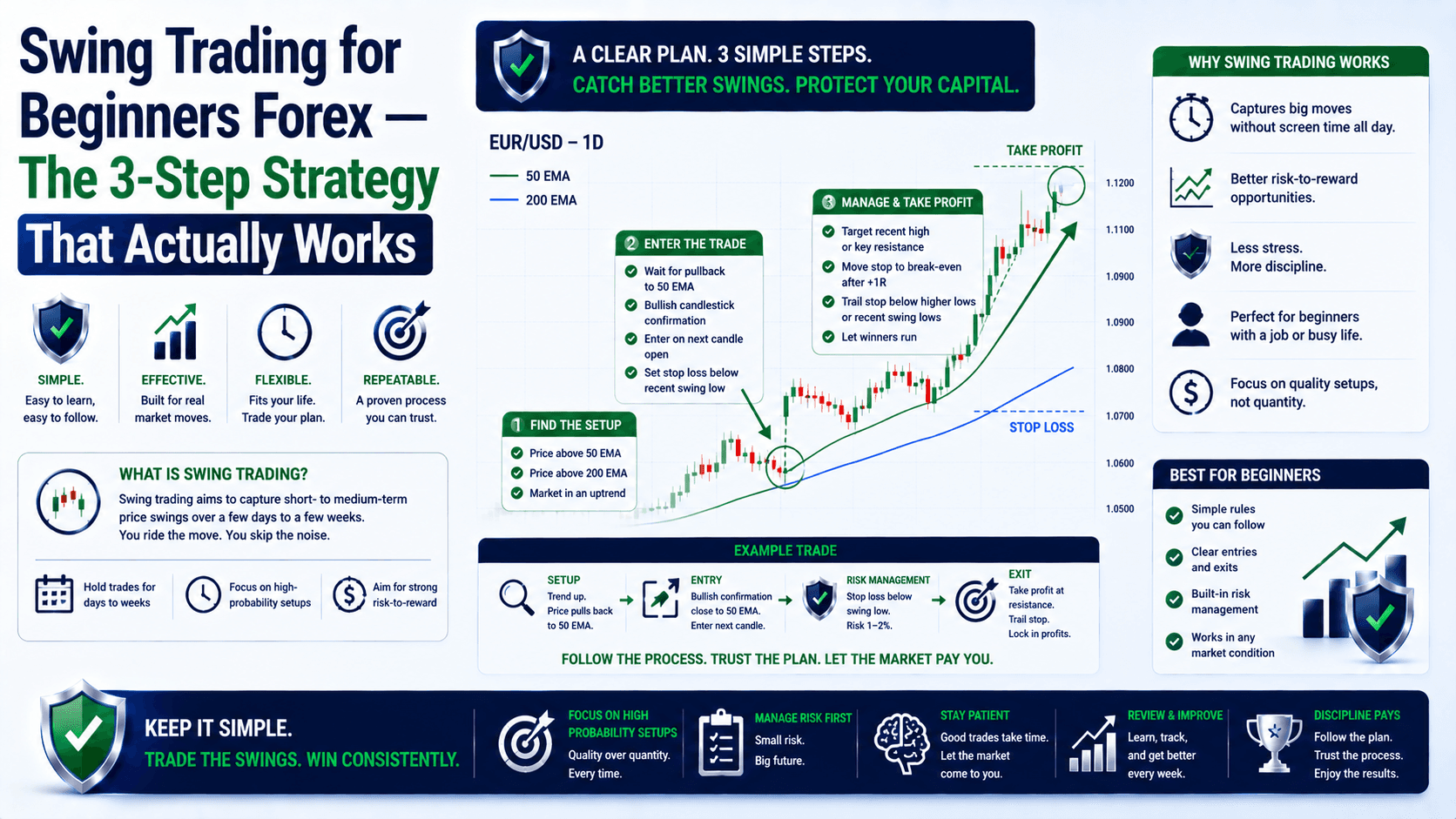

Here's the Real Problem with Most Swing Trading Guides
You've probably read a dozen articles about swing trading for beginners forex that all say the same thing: "Identify the trend, use moving averages, set your stop loss."
Great. But what happens when you actually open a chart?
You stare at EUR/USD at 1.0850 and have no idea where to enter. You see a dozen conflicting signals. You take a trade, it moves against you by 30 pips, you panic-close — then it reverses and hits your target 2 days later.
I've been there. I blew my first account doing exactly this.
Here's what nobody tells you about swing trading for beginners forex: it's not about catching every move. It's about waiting for the right setup — and knowing exactly what that setup looks like.
What Is Swing Trading in Forex? (The Simple Version)
Swing trading means holding a trade for a few days to a few weeks. You're not trying to scalp 5 pips. You're aiming for 50-200 pips per trade.
The idea: capture a chunk of a price move between two "swing points" — a low and a high (or vice versa).
Here's the key difference that matters:
| Trading Style | Hold Time | Profit Target | Screen Time Needed |
|---|---|---|---|
| Scalping | Seconds to minutes | 5-15 pips | Full-time |
| Day Trading | Minutes to hours | 15-50 pips | Full-time |
| Swing Trading | Days to weeks | 50-200+ pips | 1-2 hours/day |
| Position Trading | Weeks to months | 200+ pips | Minimal |
See the difference? Swing trading gives you the best of both worlds: meaningful profits without needing to stare at charts all day.
The #1 Mistake Beginners Make (And How to Avoid It)
The biggest mistake I see in swing trading for beginners forex? Entering too early.
You see a beautiful uptrend on EUR/USD. Price is at 1.0850, trending up from 1.0780. You think "I need to get in NOW or I'll miss it."
So you buy at 1.0850. Price drops to 1.0820. You panic. You sell at 1.0815. Price then goes to 1.0920 over the next 3 days.
You lost 35 pips. You could have made 70 pips.
The fix: Wait for a pullback within the trend. Don't chase. Let price come to you.
Here's what that looks like with real numbers:
EUR/USD is in an uptrend on the daily chart — higher highs, higher lows. Price pulls back to a key support level at 1.0820. You wait. You see a bullish candlestick pattern (like a hammer) at that support. That's your entry.
Entry: 1.0825
Stop loss: 1.0795 (30 pips below support)
Target: 1.0925 (100 pips above entry)
Risk:Reward = 1:3.3
On a 0.1 lot position:
Risk: $30 (30 pips × $1/pip)
Reward: $100 (100 pips × $1/pip)
That's a trade worth taking.
The 3-Step Swing Trading Strategy That Works
Here's the exact process I use. It's simple. It works across EUR/USD, GBP/USD, and Gold.

Step 1: Identify the Trend on the Daily Chart
Open the daily chart. Look at the last 20-30 candles.
- Uptrend: Higher highs and higher lows → look for BUY opportunities
- Downtrend: Lower highs and lower lows → look for SELL opportunities
- Sideways: No clear trend → don't trade
Add a 50-period moving average (SMA or EMA). If price is above the MA, the trend is up. Below? Trend is down.
Pro tip: Don't trade against the daily trend. It's the easiest way to lose money.
Step 2: Find a Pullback to a Key Level
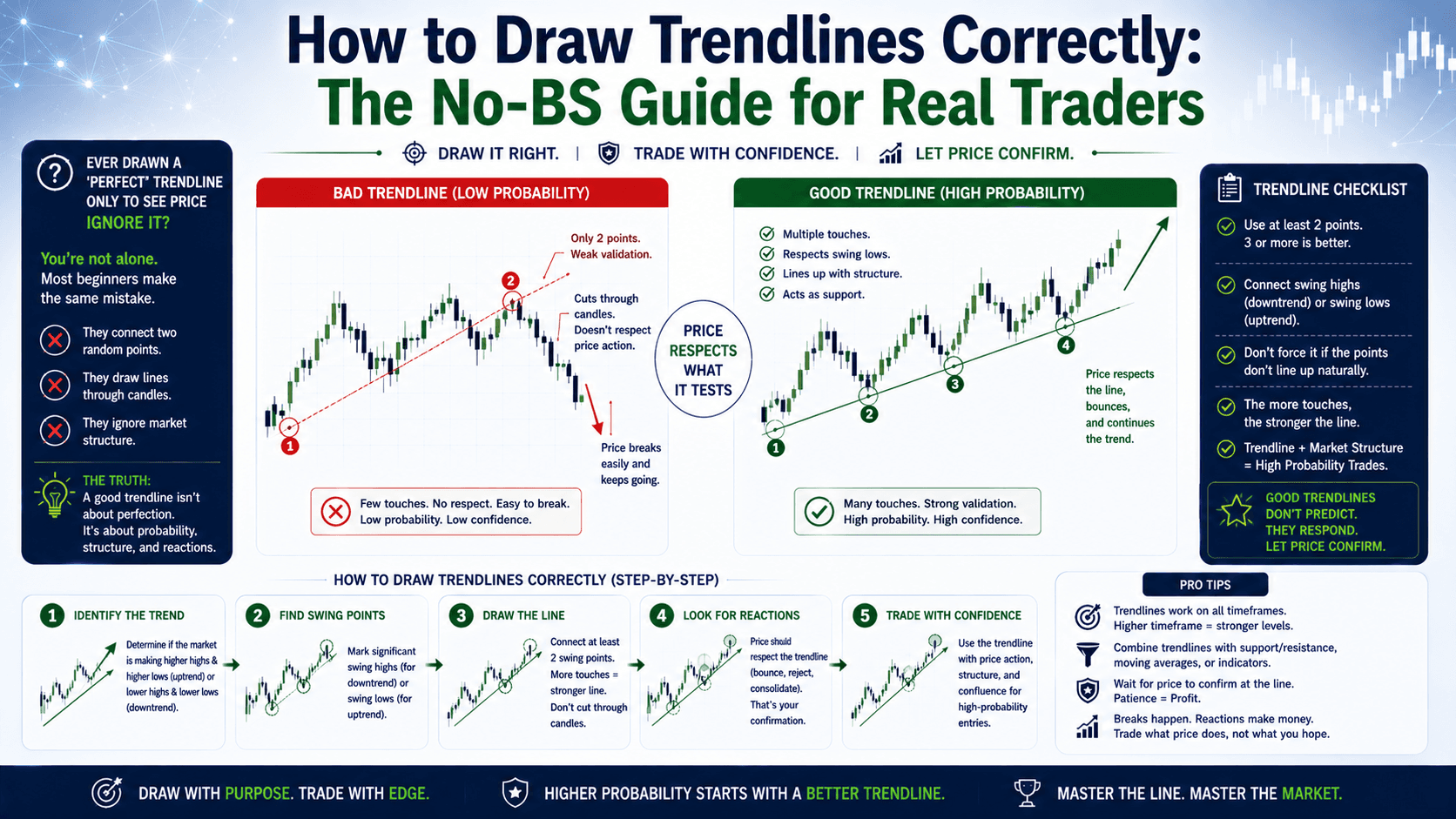
Once you know the trend direction, wait for price to pull back. Don't enter on the breakout — enter on the retracement.
Mark these levels on your chart:
- Support: Previous swing lows (in an uptrend)
- Resistance: Previous swing highs (in a downtrend)
- Moving average: The 50 or 100 MA often acts as dynamic support/resistance
Example: GBP/USD is in a daily uptrend. Price pulls back to the 50-day MA at 1.2650. You see a bullish engulfing candle form right at that level. That's your signal.
Step 3: Enter with Confirmation
Don't enter the moment price touches the level. Wait for confirmation.
Confirmation can be:
- A bullish/bearish candlestick pattern (hammer, engulfing, pin bar)
- RSI showing oversold (below 30) in an uptrend, or overbought (above 70) in a downtrend
- Price bouncing off the level by at least 10-15 pips
Once confirmed, here's your trade plan:
Entry: 5-10 pips past the confirmation candle's high (for buys) or low (for sells)
Stop loss: Below the swing low (buys) or above the swing high (sells) — give it 10-20 pips of breathing room
Target: The next significant swing high (buys) or low (sells) — or use a 1:2 or 1:3 risk:reward ratio
Wrong Way vs. Right Way — A Real Trade Example
Let's compare two approaches on the same setup.
Wrong Way (Most Beginners):
EUR/USD is at 1.0850. You see it's trending up. You buy immediately at 1.0850 without waiting for a pullback. Stop loss? You set it 10 pips below at 1.0840. Target? 1.0900.
Price drops to 1.0835, hits your stop. You lose 15 pips ($15 on 0.1 lots). Price then rallies to 1.0920 over 3 days.
Result: -15 pips. Frustration.
Right Way (Patient Trader):
Same uptrend. You wait. Price pulls back to 1.0820 (previous support). You see a hammer candle. You enter at 1.0825. Stop loss at 1.0790 (35 pips below). Target at 1.0920 (95 pips above).
Price bounces from 1.0820 and hits 1.0920 in 4 days.
Result: +95 pips ($95 on 0.1 lots). Confidence.
Same market. Same direction. Completely different outcome. The difference? Patience and a plan.
Which Forex Pairs Are Best for Swing Trading?
Not all pairs are created equal. Here's what I recommend for swing trading for beginners forex:
| Pair | Why It Works | Average Daily Range |
|---|---|---|
| EUR/USD | Highest liquidity, clean structure, predictable | 80-120 pips |
| GBP/USD | Good volatility, clear trends | 100-150 pips |
| AUD/USD | Smooth trends, reacts to risk sentiment | 70-100 pips |
| USD/JPY | Strong technical levels, responsive to yields | 80-120 pips |
| XAU/USD (Gold) | High volatility, strong trends, big moves | $20-$40 (200-400 pips) |
Stick with these. Avoid exotic pairs (USD/ZAR, EUR/TRY) — they have wide spreads and unpredictable movements.
Risk Management — The $20 Rule That Saved My Account
Here's a hard truth: you will lose trades. Lots of them. The difference between blowing your account and growing it is how you manage those losses.
The rule: Risk no more than 1-2% of your account on any single trade.
Let's math it out:
Account size: $1,000
Max risk per trade (2%): $20
You find a EUR/USD swing trade with a 40-pip stop loss. On 0.1 lots, 40 pips = $40 risk. That's 4% — too much.
So you drop to 0.05 lots: 40 pips × $0.50/pip = $20 risk. Now you're at 2%.
That's the math. Every time. Before you enter.
FAQ
Is swing trading suitable for beginners in forex?
Yes. Swing trading gives you time to analyze, plan, and execute without the pressure of day trading. You can learn technical analysis, risk management, and market structure at a manageable pace.

How much money do I need to start swing trading forex?
You can start with $500-$1,000. With $1,000 and proper risk management (1-2% per trade), you can trade micro lots (0.01) and still make meaningful gains. Start with a demo account first.
What timeframes should I use for swing trading?
Use the daily chart for trend direction, and the 4-hour or 1-hour chart for entry timing. This gives you a clear macro view while allowing precise entries.
How many swing trades should I take per month?
Quality over quantity. Most swing traders take 5-15 trades per month. Wait for high-probability setups instead of forcing trades. Patience is your edge.
Quick Recap
- Swing trading holds positions for days to weeks, targeting 50-200+ pips per trade
- Always trade WITH the daily trend — identify it first
- Wait for pullbacks to key support/resistance levels before entering
- Use confirmation (candlestick patterns, RSI) before pulling the trigger
- Risk 1-2% per trade — calculate position size before entering
- Stick to liquid pairs: EUR/USD, GBP/USD, AUD/USD, USD/JPY, Gold
Your Quick Win
Open your chart right now. Pull up EUR/USD on the daily timeframe. Find the last 3 clear swings — higher highs and higher lows (uptrend) or lower highs and lower lows (downtrend).
Mark the swing lows and swing highs with horizontal lines. Now drop to the 4-hour chart. See how price reacts at those levels?
That's your swing trading framework. You just built it in 5 minutes.
Next time price pulls back to one of those levels, you'll know exactly what to look for.