
Why Most Traders Lose Money — And How a Stop Loss Fixes It
Here's a scenario I see all the time:
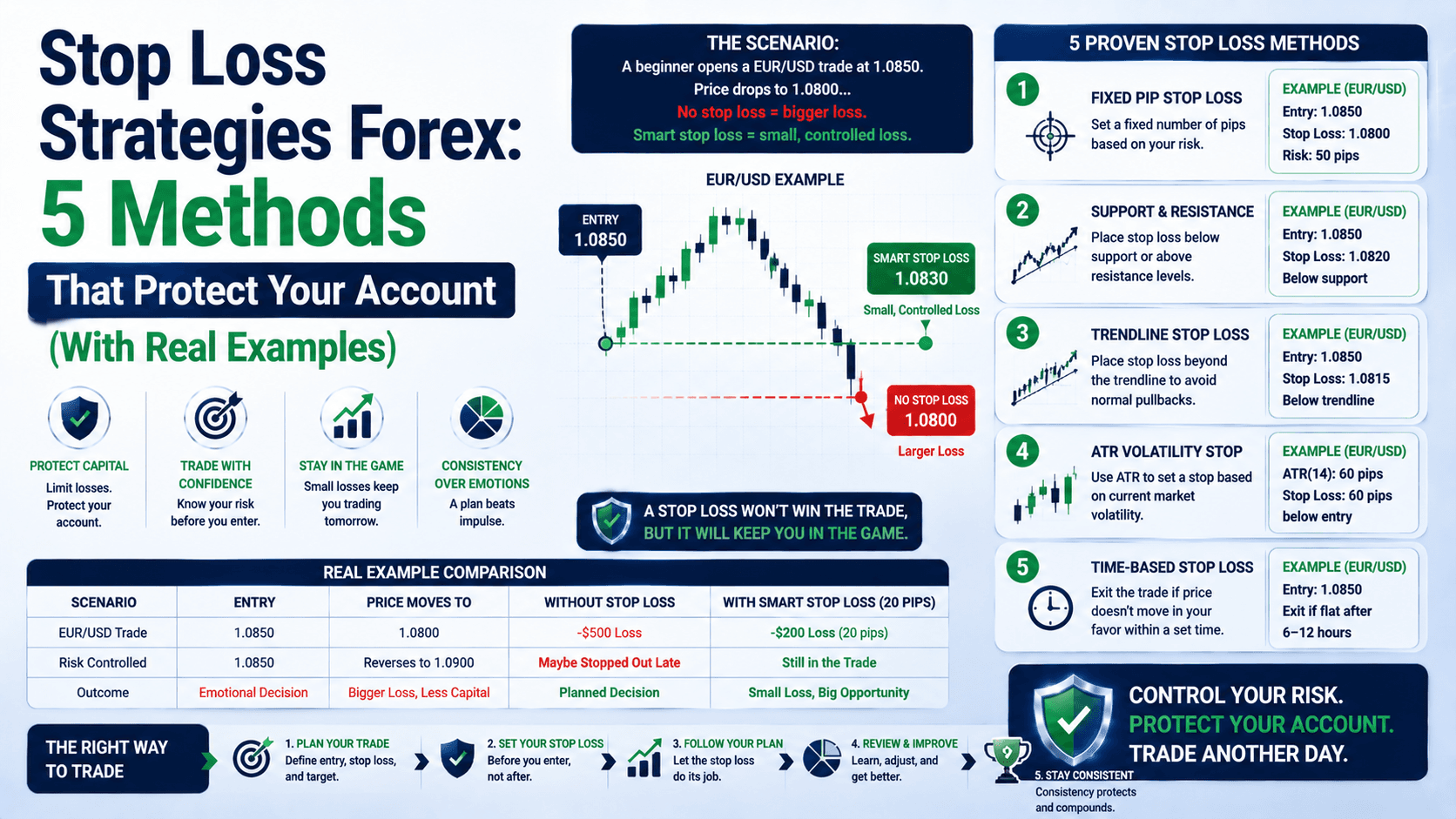
A beginner opens a EUR/USD trade at 1.0850. Price drops to 1.0820. They think: "It'll bounce back."
Price drops to 1.0780. Now they're down 70 pips. On 0.1 lots, that's $70 gone. On 0.5 lots? $350. Their $1,000 account is bleeding.
They hold. Price hits 1.0720. Now they're down 130 pips. The account is nearly halved. They finally panic-close — but the damage is done.
This is what happens when you trade without a stop loss.
A stop loss is simply a pre-set exit point that automatically closes your trade if the market moves against you. It's your safety net. Without it, one bad trade can wipe out weeks of gains — or your entire account.
In this lesson, I'll walk you through 5 stop loss strategies forex traders actually use. No theory. Just real methods with real numbers.
Stop Loss Strategy #1: The Static Stop (Simple and Effective)
The static stop is the most straightforward stop loss strategy. You set a fixed number of pips away from your entry — and that's it.
How it works:
- You enter EUR/USD at 1.0850
- You set your stop loss 20 pips below at 1.0830
- If price hits 1.0830, your trade closes automatically
Let's math it out. You have a $2,000 account. You risk 1% per trade = $20 max loss. On EUR/USD, 1 pip on 0.1 lots = $1. A 20-pip stop = $20 risk. Perfect — you're right at 1%.
Where beginners mess this up: They set the same 20-pip stop on every pair in every market condition. But EUR/USD moves differently than GBP/JPY. A quiet Monday morning is different from a Friday NFP news dump.
⚠️ Common trap: Static stops don't account for market volatility. In a quiet market, 20 pips is a big move. In a volatile market, 20 pips is noise — and you'll get stopped out before the trade even breathes.
Stop Loss Strategy #2: The ATR-Based Stop (Volatility-Adjusted)
This is where stop loss strategies get smarter. Instead of a fixed number, you use the Average True Range (ATR) indicator to set your stop based on current market volatility.
Here's how:
- Add ATR (14) to your chart — it shows the average price range over 14 periods
- If ATR on the 1-hour chart is 15 pips, a volatile market is moving 15 pips per hour
- Set your stop at 1x or 1.5x ATR from your entry
Real example: You're trading GBP/USD. The daily ATR is 110 pips. A swing trader might set a stop at 50% of ATR = 55 pips. A day trader might use 10% = 11 pips.
Why does this work? Because your stop adjusts to what the market is actually doing. In a quiet market, your stop is tighter. In a volatile market, it's wider — so you don't get shaken out by random price noise.
💡 Pro tip: I use 1.5x ATR on the 4-hour chart for Gold (XAU/USD). When ATR is $25, my stop is $37.50. That gives the trade room to breathe without risking too much.
Stop Loss Strategy #3: Support and Resistance Stops (Structural)
This is my favorite stop loss strategy because it's based on price action, not just math.

The idea: Place your stop just below a key support level (for long trades) or just above a key resistance level (for short trades).
Wrong way: EUR/USD is at 1.0850. Support is at 1.0800. You put your stop at 1.0800. Price dips to 1.0797, takes your stop, then bounces to 1.0880. Sound familiar?
Right way: Give your stop 5-10 pips of breathing room below support. Instead of 1.0800, set it at 1.0790. Yes, your risk is slightly bigger — but you actually stay in the trade.
How to find support and resistance:
- Look for price levels where the market has reversed multiple times
- Draw horizontal lines on your chart
- Place your stop 5-15 pips beyond these levels (depending on timeframe)
⚠️ Common mistake: Putting your stop exactly at support/resistance. Smart money knows this. They push price just past these levels to trigger stops before reversing. Give yourself room.
Stop Loss Strategy #4: The Trailing Stop (Let Winners Run)
A trailing stop automatically adjusts as the market moves in your favor. It locks in profits while still protecting you from reversals.
How it works with a fixed distance:
- You go long EUR/USD at 1.0850 with a 20-pip trailing stop
- Price moves to 1.0870 — your stop moves to 1.0850 (breakeven)
- Price moves to 1.0890 — your stop moves to 1.0870 (20 pips locked in)
- Price reverses to 1.0870 — you're stopped out with a 20-pip profit
How it works manually: Some traders prefer to adjust stops themselves. When price moves in your favor by a certain amount (say 30 pips), you manually move your stop to breakeven. Then every 20 pips, you move it up again.
💡 Pro tip: Don't trail too tight. A 10-pip trail on a volatile pair like GBP/JPY will get you stopped out on normal noise. Use 1x ATR as your trail distance.
Stop Loss Strategy #5: Time-Based Stops (Discipline Tool)
This one is less common but incredibly powerful. You set a time limit for your trade. If price hasn't moved in your favor by a certain time, you close it — regardless of profit or loss.
Why it works:
- Prevents you from sitting in losing trades for hours
- Frees up capital for better setups
- Builds discipline — you learn to cut losses fast
Example: You enter a EUR/USD trade at 8:00 AM London open. Your rule: if it's not profitable by 12:00 PM, close it. Price is flat at 11:55 AM. You close at breakeven. An hour later, price drops 30 pips. You dodged a bullet.
⚠️ Common trap: Time-based stops work best for day traders. Swing traders and position traders need more time for their setups to play out.
Comparison: Which Stop Loss Strategy Is Right for You?
| Strategy | Best For | Risk Level | Key Benefit |
|---|---|---|---|
| Static Stop | Beginners | Medium | Simple, easy to calculate |
| ATR-Based | All levels | Low-Medium | Adjusts to volatility |
| Support/Resistance | Intermediate+ | Medium | Structural, price-action based |
| Trailing Stop | All levels | Low | Locks in profits |
| Time-Based | Day traders | Medium | Builds discipline |
FAQ
What is the best stop loss strategy for forex beginners?
The static stop is the best starting point. Set a fixed number of pips (20-30 for day trading, 50-100 for swing trading) and always risk 1% or less of your account.

How do I calculate my stop loss distance?
Use the 1% rule: multiply your account balance by 0.01, divide by your pip value (e.g., $10 for 1 standard lot), and that's your stop distance in pips.
Should I use a guaranteed stop loss?
Only in extremely volatile markets or before major news events. Guaranteed stops cost a premium but ensure you get filled at your exact price, even during gaps.
Can I move my stop loss after entering a trade?
Yes, but only move it in the direction of profit — never widen it. Moving your stop further away increases your risk and defeats the purpose of risk management.
📝 Quick Recap
- Static stops — simple but don't account for volatility
- ATR stops — adjust to market conditions, smarter than static
- Support/resistance stops — structural, give room beyond key levels
- Trailing stops — lock in profits as the trade moves in your favor
- Time-based stops — build discipline and prevent sitting in bad trades
- Never trade without a stop loss — one bad trade can wipe out weeks of work
Your Quick Win (Do This Now)
Open your EUR/USD 1-hour chart. Find the last 3 support and resistance levels. Now calculate: if you entered at current price, where would you place your stop using the support/resistance method? Give it 10 pips of breathing room. Write it down. That's your stop for the next trade. Do this for every trade you consider today.