
What is the Stochastic Oscillator? (And Why It Matters)
Ever jump into a trade because an indicator screamed "overbought!" or "oversold!" only to watch price keep rocketing in the original direction, taking your stop loss with it? Yeah, I've been there. It's frustrating, right?
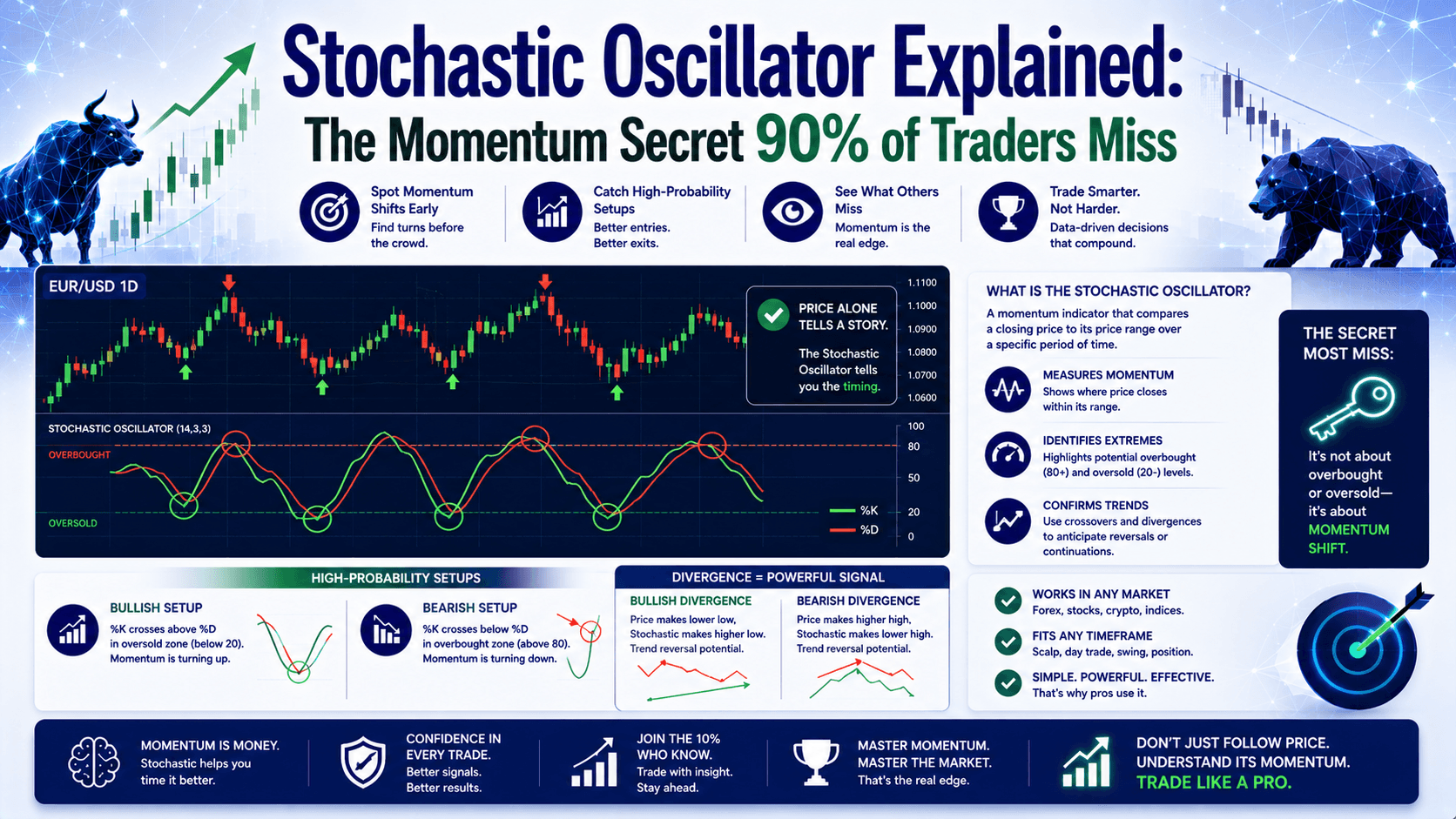
That's where the **Stochastic Oscillator** comes in. It's a momentum indicator, developed by George Lane in the 1950s, that helps you figure out if price is getting tired, or if a move is about to pick up steam. Forget what you think you know about "overbought" and "oversold" signals for a second. The real power is in understanding momentum.
Think of it like this: Imagine you're watching a runner. The Stochastic Oscillator doesn't just tell you how fast they're running (that's more like RSI). It tells you where their *current* speed is compared to their speed range over the last few minutes. Are they closing near their fastest speed or their slowest? That's the core idea.
The Stochastic Oscillator plots two lines:
- %K Line (Fast Stochastic): This is the current reading, comparing the latest closing price to the highest and lowest prices over a specific period (usually 14 periods). It's the "here and now" of momentum.
- %D Line (Slow Stochastic): This is a 3-period Simple Moving Average (SMA) of the %K line. It smooths out the %K line, making it less erratic and easier to read. Think of it as the trend of the momentum.
Both lines oscillate between 0 and 100. This range-bound nature is what makes it great for spotting extremes.
The Overbought/Oversold Trap (And How to Actually Use It)
Here's the common trap: Many beginners see the Stochastic Oscillator above 80 and instantly think, "Sell!" Or below 20 and yell, "Buy!"
WEAK APPROACH: Blindly Selling at 80
Let's say EUR/USD is in a strong uptrend. You're watching the 1-hour chart. The Stochastic Oscillator hits 85. You think, "Aha! Overbought, time to sell!" So you short 0.1 lots at 1.0850, placing a tight 15-pip stop loss at 1.0865. What happens? Price keeps pushing up to 1.0890, and your stop loss gets hit. You're out -$15, and EUR/USD is still "overbought." Sound familiar?
STRONG APPROACH: Wait for the Turn
The fact is, in a strong trend, the Stochastic Oscillator can stay "overbought" (above 80) or "oversold" (below 20) for a long time. It simply means price is consistently closing near its highs (in an uptrend) or lows (in a downtrend) for that period. It's a sign of strength, not necessarily an imminent reversal.
The smarter play is to wait for the Stochastic to *leave* these extreme zones. A potential sell signal isn't when the Stochastic hits 80, but when the %K line *crosses back below* 80, confirming that momentum is actually shifting down. Similarly, a buy signal is when %K *crosses back above* 20.
Example Scenario: Selling EUR/USD with Confirmation
EUR/USD is in an uptrend on the 4-hour chart, but it's now stalling. On your 1-hour chart, the Stochastic Oscillator has been above 80 for a while. Then, you see a bearish engulfing candle form. Crucially, the %K line (fast) then crosses below the %D line (slow), and *both* lines drop below the 80 mark.
- Entry: Short 0.1 lots EUR/USD at 1.0870 (after %K/%D cross below 80 and bearish candle close).
- Stop Loss: Place it above the recent swing high, say 1.0885 (15 pips).
- Take Profit: Aim for the next support level, perhaps 1.0830 (40 pips).
- Potential P&L: Risk $15, Target $40. That's a 1:2.6 risk:reward.
By waiting for confirmation and price action, you avoid the false signals that trap most beginners.
Stochastic Crossovers: When Fast Meets Slow
The interaction between the %K and %D lines is a powerful signal. Think of it like a race: the %K line is the faster runner, and the %D line is the slower, more stable average.

- Bullish Crossover: When the faster %K line crosses *above* the slower %D line, especially when both are in the oversold zone (below 20), it suggests a surge in upward momentum. This can be a buy signal.
- Bearish Crossover: When the faster %K line crosses *below* the slower %D line, especially when both are in the overbought zone (above 80), it signals a shift in downward momentum. This can be a sell signal.
Remember, the *location* of the crossover matters. A bullish crossover at 50 in a strong uptrend might indicate a continuation after a pullback, rather than a full reversal. This is where combining indicators helps.
Trade Example: Gold (XAU/USD) Bullish Crossover
It's a volatile morning for Gold (XAU/USD). Price has been pulling back, and the 15-minute Stochastic Oscillator is dipping into the oversold region (below 20). You see a hammer candlestick at a key support level of $2,385. Just as this candle closes, the %K line crosses above the %D line around the 18-mark on the Stochastic.
- Entry: Buy 0.05 lots XAU/USD at $2,388 (confirming bullish crossover and hammer).
- Stop Loss: Below the hammer's wick and support, say $2,382 ($6/ounce, which on 0.05 lots is $30 risk).
- Take Profit: Next resistance at $2,403 ($15/ounce, $75 target).
- Potential P&L: Risk $30, Target $75. A 1:2.5 risk:reward.
This is a high-conviction trade because multiple signals are aligning: support, candlestick, and Stochastic crossover.
Spotting Hidden Shifts: The Power of Divergence
This is where the Stochastic Oscillator truly shines. **Divergence** occurs when the price of an asset and the Stochastic Oscillator are telling you different stories. It's often an early warning sign of a trend reversal or exhaustion.
- Bullish Divergence: Price makes a lower low, but the Stochastic Oscillator makes a higher low. This means that even though sellers are pushing price lower, the *momentum* of the selling is actually weakening. It hints that an upward reversal could be brewing.
- Bearish Divergence: Price makes a higher high, but the Stochastic Oscillator makes a lower high. Here, buyers are pushing price up, but the *momentum* of the buying is fading. A downward reversal might be on its way.
Divergence doesn't guarantee a reversal, but it tells you to pay attention. It's a "heads up" from the market.
Scenario Breakdown: Bearish Divergence on USD/JPY
USD/JPY is in an uptrend on the daily chart. Price has just pushed to a new high of 154.80. However, when you look at your Stochastic Oscillator, its peak for this new high is *lower* than the previous peak, even though price itself made a higher high. This is bearish divergence.
- Action: You don't necessarily sell immediately. You wait for additional confirmation: perhaps a bearish engulfing candle, or a break of a short-term trendline on a lower timeframe.
- Confirmation: If USD/JPY then breaks a minor support level at 154.50, you might consider a short entry.
- Entry: Short 0.1 lots USD/JPY at 154.45.
- Stop Loss: Above the recent high, say 154.90 (45 pips).
- Take Profit: Aim for a previous support zone, like 153.80 (65 pips).
- Potential P&L: Risk $45, Target $65.
This approach combines the insight of divergence with the safety of confirmation. Don't chase. Wait for the market to prove your thesis.
Stochastic vs. RSI: Which Momentum Indicator Wins?
Both the Stochastic Oscillator and the **Relative Strength Index (RSI)** are momentum indicators, but they calculate momentum differently and have different strengths.
| Feature | Stochastic Oscillator | Relative Strength Index (RSI) |
|---|---|---|
| What it Measures | Closing price's position relative to its price range over time. | Speed and change of price movements. |
| Formula Focus | Price position | Magnitude of recent gains vs. losses |
| Key Levels | 0-100 (Overbought > 80, Oversold < 20) | 0-100 (Overbought > 70, Oversold < 30) |
| Sensitivity | Generally more sensitive, faster signals. | Smoother, slower signals. |
| Best For | Range-bound markets, identifying divergences. | Trending markets, confirming trend strength. |
| False Signals | Can be prone to more false signals in strong trends. | Can stay overbought/oversold longer in strong trends. |
So, which one should you use? Neither "wins." Professional traders often use them in combination. The Stochastic Oscillator gives you a quick read on where price is closing within its recent range, great for spotting quick turns or divergences. The RSI, on the other hand, tells you how fast price is moving and how strong the overall buying or selling pressure is. Using both can provide a more complete picture of momentum.
FAQ
What are the best settings for the Stochastic Oscillator?
The most common settings for the Stochastic Oscillator are (14, 3, 3). This means 14 periods for the %K line, and a 3-period SMA for both the %K and %D lines. These default settings are a good starting point for most traders.

Can you use the Stochastic Oscillator for scalping?
Yes, the Stochastic Oscillator's sensitivity makes it useful for scalping, especially on lower timeframes (1-minute, 5-minute). However, its signals can be very noisy, so it's crucial to combine it with price action and operate within a clear trend on a higher timeframe.
Is the Stochastic Oscillator a leading or lagging indicator?
The Stochastic Oscillator is generally considered a leading indicator, as it aims to predict future price movements by identifying momentum shifts before price itself turns. However, like all indicators, it's not foolproof and can still provide lagging signals or false positives.
What is "Fast Stochastic" versus "Slow Stochastic"?
The "Fast Stochastic" uses a 1-period smoothing for %K, making it very responsive but also very volatile. The "Slow Stochastic" (which is what we typically use) applies a 3-period smoothing to the %K line (making it the %K line you see) and then a 3-period smoothing to that %K line to create the %D line. This smoothing makes it less prone to false signals.
Quick Recap
- The Stochastic Oscillator is a momentum indicator with %K (fast) and %D (slow) lines, oscillating between 0-100.
- "Overbought" (above 80) and "oversold" (below 20) mean price is closing near its highs/lows, not necessarily that a reversal is immediate. Wait for the lines to *leave* these zones.
- Crossovers (%K above %D for buy, %K below %D for sell) are powerful signals, especially near extremes.
- Divergence (price and Stochastic telling different stories) is a high-probability reversal warning.
- Combine the Stochastic Oscillator with price action, trendlines, or other indicators like RSI for stronger confirmation and fewer false signals.
Your Quick Win Today
Open your trading chart right now. Add the Stochastic Oscillator (default 14,3,3 settings). Pull up EUR/USD on the 1-hour timeframe. Scroll back and find at least three instances of **bearish divergence** and three instances of **bullish divergence**. See how price reacted after those divergences. Did it reverse? Did it consolidate? This exercise will help you train your eye to spot these crucial early warnings.