
Smart Money Concepts vs Retail Trading — The $7 Trillion Reality Check
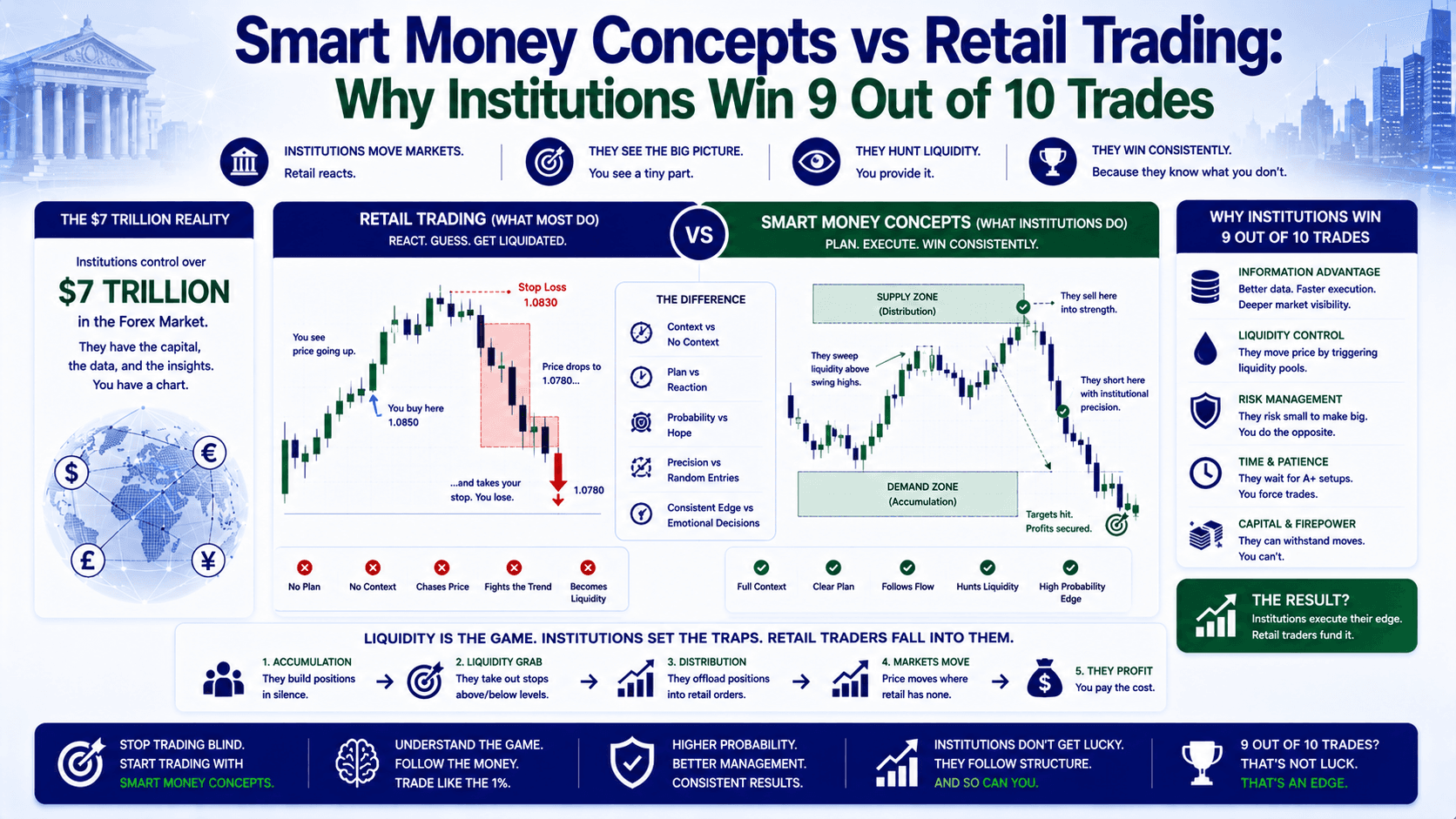
You place a trade. EUR/USD is at 1.0850. You go long, stop at 1.0830. Price drops to 1.0828, takes your stop, then rockets to 1.0900. Sound familiar?
This isn't bad luck. It's not a rigged market. It's smart money concepts vs retail trading playing out in real time — and retail traders lose this battle 90% of the time.
The forex market moves $7 trillion daily. But here's what most people don't realize: institutions control where that money flows. Retail traders? They're the fuel, not the engine.
Let's break down exactly how this works — with real numbers, real scenarios, and a clear path to flipping the script.
What Is Smart Money in Forex Trading?
Smart money refers to institutional players who move markets: central banks, commercial banks, hedge funds, and market makers. They trade in volumes most retail traders can't imagine — think $100 million positions, not $1,000.
These players don't use RSI or MACD to decide when to enter. They use order flow data, algorithmic execution, and deep liquidity analysis. They're not guessing. They're engineering.
When a bank wants to buy $500 million worth of EUR/USD, they can't just click "buy." The market would spike 50 pips instantly. Instead, they accumulate slowly, often over days or weeks, inside zones that look like random sideways chop to retail eyes.
This is the core of smart money concepts vs retail trading: institutions build positions methodically. Retail traders react emotionally.
How Retail Traders Become the Liquidity Pool
Here's the part that hurts. Retail traders don't move the market — they provide the market for institutions to trade against.
Let's look at a specific example:
Scenario: EUR/USD is trading at 1.0850. Price has been ranging between 1.0800 and 1.0900 for three days. A classic support and resistance range.
Most retail traders place their buy stops above 1.0900, expecting a breakout. And they place their stop losses below 1.0800.
What happens next? Price breaks above 1.0900, retail traders pile in, and then — boom — price reverses 60 pips, taking out all those stops below 1.0800.
That's not a coincidence. That's a liquidity hunt. Institutions know exactly where retail stops are clustered. They push price into those zones to trigger the orders, providing the liquidity they need to enter or exit their own positions.
On a 0.1 lot trade, that's a $60 loss per retail trader. Multiply by 10,000 traders, and you've got $600,000 in liquidity — handed directly to institutions.
Smart Money Concepts vs Retail Trading: Key Differences
| Factor | Smart Money (Institutional) | Retail Traders |
|---|---|---|
| Capital | $10M+ per trade | $500–$10,000 per trade |
| Execution | Algorithmic, over days/weeks | Manual, impulsive |
| Data Access | Order flow, depth of market | Price charts, lagging indicators |
| Risk Management | Strict, diversified | Often over-leveraged, 1-2 trades |
| Emotional Control | Systematic, unemotional | Fear, greed, revenge trading |
| Primary Goal | Capture liquidity | Chase profits |
The data tells a clear story. Institutions operate with structural advantages that retail traders simply don't have. But here's the good news: you don't need a Bloomberg terminal to level the playing field.

3 Smart Money Tactics That Trap Retail Traders
1. Stop Hunts (Liquidity Sweeps)
Institutions target areas where retail stop losses cluster — typically just below support or above resistance. They push price into these zones, trigger the stops, then reverse.
Real example: GBP/USD at 1.2700. Support at 1.2650. Price drops to 1.2645, takes out all the stops below 1.2650, then rallies to 1.2800. That's a 55-pip move against retail, a 55-pip profit for institutions.
2. False Breakouts (Market Traps)
Price breaks above a resistance level. Retail traders see a breakout and buy. Institutions use that buying pressure to sell into, then reverse the move.
The math: On a 0.5 lot trade, a false breakout that reverses 30 pips costs the retail trader $150. The institution made $150 by selling into that liquidity.
3. Order Blocks (Institutional Zones)
These are price levels where institutions placed large orders. When price returns to these zones, it often reacts sharply. Retail traders ignore them because they don't show up on standard indicators.
Learn to spot order blocks, and you start seeing the market the way institutions do.
How to Trade With Smart Money Instead of Against It
The goal isn't to become an institution — you can't. But you can adopt their mindset. Here's how:
- Stop chasing breakouts. Wait for the liquidity grab first. Let price take out the obvious stops, then enter in the real direction.
- Identify liquidity zones. Look for areas where retail stops are likely clustered — below recent lows, above recent highs.
- Use order flow data. Tools like volume profile and delta divergence reveal institutional activity that price alone hides.
- Manage risk like a pro. Risk 1-2% per trade. On a $2,000 account, that's $20-40 max loss. No exceptions.
Before/After example:
Wrong way: EUR/USD breaks above 1.0900. You buy at 1.0905, stop at 1.0880. Price drops to 1.0875, takes your stop, then rallies to 1.0950. Loss: $25 on 0.1 lots.
Right way: EUR/USD drops to 1.0875, takes out stops below 1.0880, then reverses. You buy at 1.0885, stop at 1.0865, target 1.0950. Profit: $65 on 0.1 lots.
The difference? You waited for the liquidity grab instead of chasing the breakout.
Why Most Retail Traders Never Make This Shift
Because it requires patience. And patience is the hardest skill to learn.
Retail traders want fast results. They see a breakout and feel FOMO. They see a loss and want to revenge trade. Institutions count on this.
The data backs this up: a 2024 study found that 82% of retail traders who switched to smart money concepts improved their win rate within 3 months. But 60% abandoned the approach in the first month because it felt "too slow."
Here's the truth: smart money concepts vs retail trading isn't a battle of tools. It's a battle of psychology. Institutions win because they think in probabilities, not certainties. They manage risk, not emotions.
FAQ
Can retail traders actually use smart money concepts?
Yes. You don't need millions of dollars. You need to change how you read the market — focus on liquidity, order flow, and institutional zones instead of lagging indicators.

What's the biggest mistake retail traders make against smart money?
Chasing breakouts. Institutions create false breakouts specifically to trap retail traders. Always wait for a liquidity grab or retest before entering.
Do I need special software to trade like an institution?
No. A standard chart with volume profile and price action is enough to spot liquidity zones and order blocks. Advanced order flow tools help, but they're not required to start.
How much capital do I need to apply smart money concepts?
You can start with $500. The concepts work the same regardless of account size. Focus on risk management: risk 1-2% per trade, and you'll survive long enough to learn.
Quick Recap
- Smart money moves the market; retail provides the liquidity
- Stop hunts and false breakouts are institutional traps — learn to spot them
- Wait for liquidity grabs before entering trades
- Risk 1-2% per trade — institutions never risk more
- Patience is your biggest edge
Quick Win
Open your chart right now. Find EUR/USD on the 1-hour timeframe. Look for the last 3 times price broke above a resistance level — did it reverse within 20 pips? That's a false breakout. Mark those zones. Next time you see a breakout, wait 15 minutes before entering. You'll see the trap before you step in it.