
You've Got 30 Minutes. Which One Makes You Money?
Let me paint you a picture.
It's 9:30 AM. The New York market just opened. You're staring at your screen. EUR/USD is at 1.0850. You see a move coming.
Do you:
- Option A: Jump in, grab 5 pips, get out in 30 seconds, and repeat 20 times?
- Option B: Wait for the perfect setup, enter at 1.0845, hold for 3 hours, and aim for 50 pips?
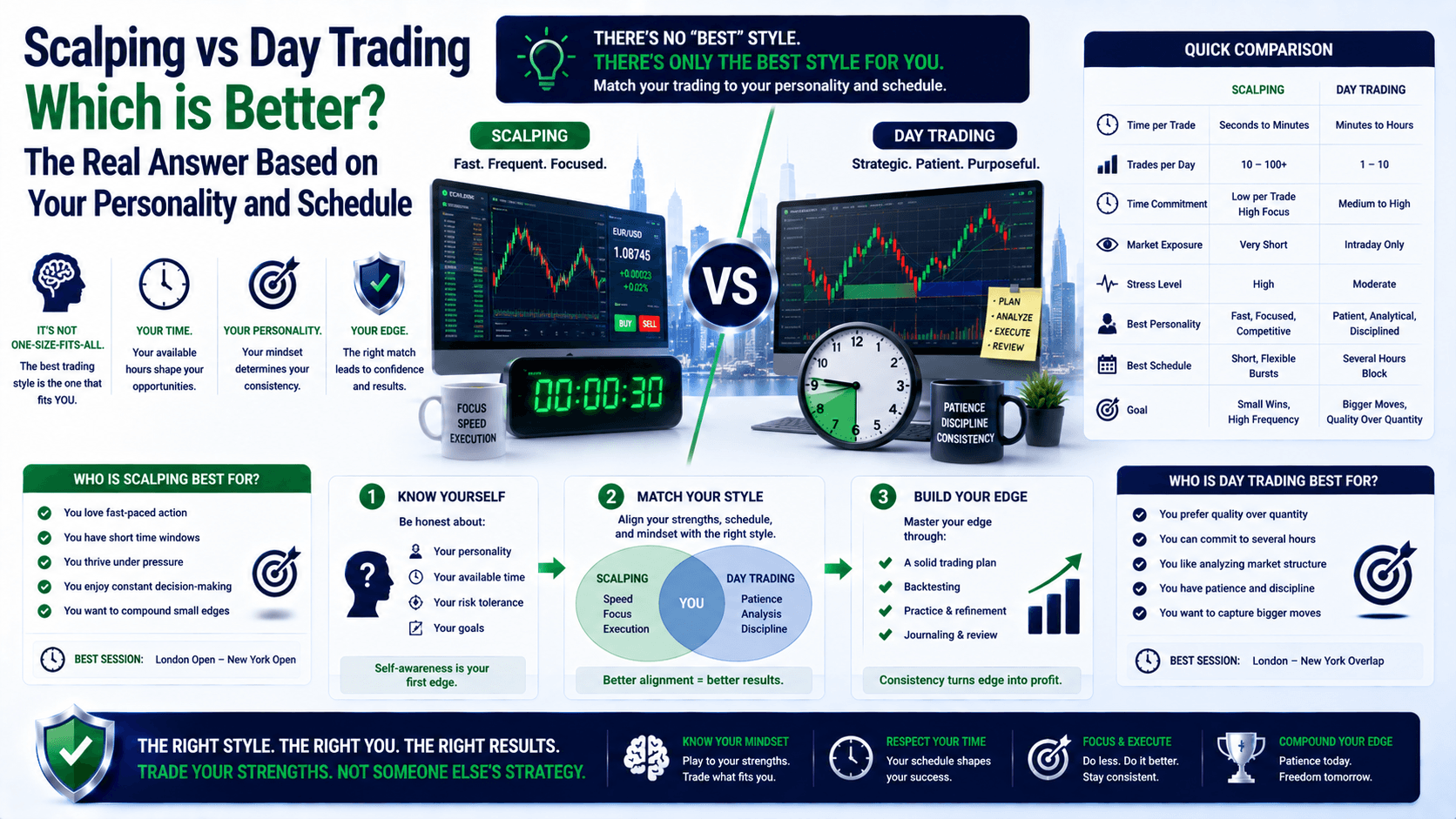
If you said "it depends," you're already ahead of most beginners. The scalping vs day trading which is better question isn't about which strategy is "better" in general. It's about which one fits you.
Here's the thing: 90% of new traders pick a style because someone on YouTube told them it's profitable. Then they blow up their account because they're forcing a square peg into a round hole.
I've been trading for over a decade. I've done both. I've lost money doing both wrong. Here's what I learned — and what you need to know before you pick a lane.
What is Scalping? (The 5-Second Attention Span Method)
Scalping is the fastest trading style. You open and close trades in seconds or minutes. Your goal? Grab tiny profits — 5 to 10 pips at a time — and do it dozens of times a day.
Think of it like this: A scalper is a fisherman with a net, catching hundreds of tiny fish. A day trader is a spear fisherman, waiting for one big catch.
Here's a real example:
- You see EUR/USD at 1.0850. You buy 0.5 lots.
- Price moves to 1.0855. That's 5 pips.
- On 0.5 lots, 5 pips = $25.
- You do this 20 times in a session. That's $500.
Sounds easy, right? It's not. Here's why:
- You need lightning-fast reactions. Miss a second, and your 5-pip profit becomes a 10-pip loss.
- Commissions eat you alive. At $7 per round turn on 0.5 lots, 20 trades = $140 in fees.
- One bad trade wipes out 10 good ones. Lose 20 pips on one trade, and you just gave back $100.
Scalpers live on the 1-minute and 5-minute charts. They use tight stop losses — usually 5-10 pips. They trade during the most volatile hours: London open (3 AM EST) and New York open (8 AM EST).
What is Day Trading? (The Patient Hunter's Method)
Day trading means opening and closing trades within the same day — but holding for minutes to hours. You're looking for bigger moves: 30 to 100 pips per trade.

Here's a real day trade scenario:
- It's 8:30 AM. EUR/USD is at 1.0850.
- You see a bullish engulfing candle on the 1-hour chart at a support level of 1.0830.
- You buy 0.2 lots at 1.0835. Stop loss at 1.0810 (25 pips). Target at 1.0885 (50 pips).
- Risk: $50 (25 pips × $2/pip on 0.2 lots). Reward: $100 (50 pips × $2/pip).
- You hold for 2 hours. Price hits your target at 1:30 PM.
- Profit: $100. One trade. Done for the day.
Day trading requires patience. You watch the trade develop. You fight the urge to close early. You sit through noise and mini pullbacks.
Day traders use 15-minute to 1-hour charts. They combine technical analysis (support/resistance, moving averages, RSI) with price action patterns (pin bars, engulfing candles, inside bars).
Scalping vs Day Trading Which is Better? The Brutal Truth
Here's the short answer: Neither is better. They're different tools for different people.
Let's compare them side by side so you can see which one fits your life:
| Factor | Scalping | Day Trading |
|---|---|---|
| Time commitment | 2-3 hours of 100% focus | 4-6 hours of monitoring |
| Number of trades per day | 20-100+ | 1-5 |
| Profit per trade | 5-15 pips | 30-100 pips |
| Stop loss distance | 5-10 pips | 20-40 pips |
| Mindset required | Hyper-focused, quick decisions | Patient, analytical |
| Risk of overtrading | Very high | Low |
| Commission cost impact | High (eats into profits) | Low |
| Best for beginners? | No — too fast, too expensive | Yes — learn discipline first |
The Wrong Way Most Beginners Choose (And Why It Costs Them)
Here's the pattern I see every single time:
A beginner watches a scalping video. The trader makes $500 in 20 minutes. The beginner thinks, "I can do that." So they open a $500 account, risk $50 per trade, and try to scalp.
What happens?
- They enter a trade late because they hesitated.
- Price reverses 10 pips. They freeze. They don't cut the loss.
- Price goes 30 pips against them. They panic-close at a $150 loss.
- That's 30% of their account. Gone in 3 minutes.
Here's the right way:
Start with day trading. Why? Because it teaches you the fundamentals without the pressure of split-second decisions.
- You learn to identify support and resistance.
- You learn to wait for confirmation.
- You learn risk management — because you have time to think.
Once you're consistently profitable day trading for 3-6 months, then you can try scalping if you want.
Which Trading Style Fits Your Personality? Take the Quiz
Answer these 5 questions honestly:
- Can you sit still and watch a trade for 3 hours without touching it?
Yes → Day trading. No → Scalping. - Do you get bored easily?
Yes → Scalping. No → Day trading. - Do you have a full-time job?
Yes → Day trading (you can check charts during breaks). No → Either. - Are you comfortable losing small amounts 10 times in a row?
Yes → Scalping. No → Day trading. - Do you prefer quality over quantity?
Yes → Day trading. No → Scalping.
If you answered "Yes" to more than 3 questions for one style, that's your starting point.
FAQ
Is scalping more profitable than day trading?
Not necessarily. Scalping has a higher win rate (60-70%) but smaller profits per trade. Day trading has a lower win rate (40-50%) but larger profits. Your profitability depends on your risk management, not the style itself.

Can I do both scalping and day trading?
Yes, but not at the same time. Many traders start with day trading, become profitable, then add scalping during high-volatility sessions. Just make sure you have separate rules for each style.
How much money do I need to start scalping?
At least $1,000. With a $200 account, one bad trade wipes you out. With $1,000, you can risk 1% per trade ($10) and survive the learning curve. Day trading can start with $500 if you trade micro lots (0.01).
Which style is better for beginners?
Day trading. It gives you time to think, learn, and correct mistakes. Scalping is like learning to drive in a Formula 1 race — possible, but you'll crash a lot.
Quick Recap
- Scalping = fast trades, small profits, high frequency, intense focus
- Day trading = longer holds, bigger profits, patience, fewer trades
- Neither is better — it depends on your personality, schedule, and risk tolerance
- Start with day trading as a beginner. Graduate to scalping later.
Your Quick Win (Do This Today)
Open your demo account. Pull up EUR/USD on the 1-hour chart. Look at the last 5 days of price action.
Now answer this: If you had to take ONE trade today, where would you enter, where would you put your stop, and where would you take profit?
Write it down. Don't execute it. Just practice the mental process.
Do this for 5 days. If you can consistently identify good setups with clear risk:reward ratios, you're ready to day trade with real money. If you can't, keep practicing.
That's how you start. Not by chasing 5-pip moves. By learning to see the market clearly.