
What Is the Rounding Bottom Pattern?
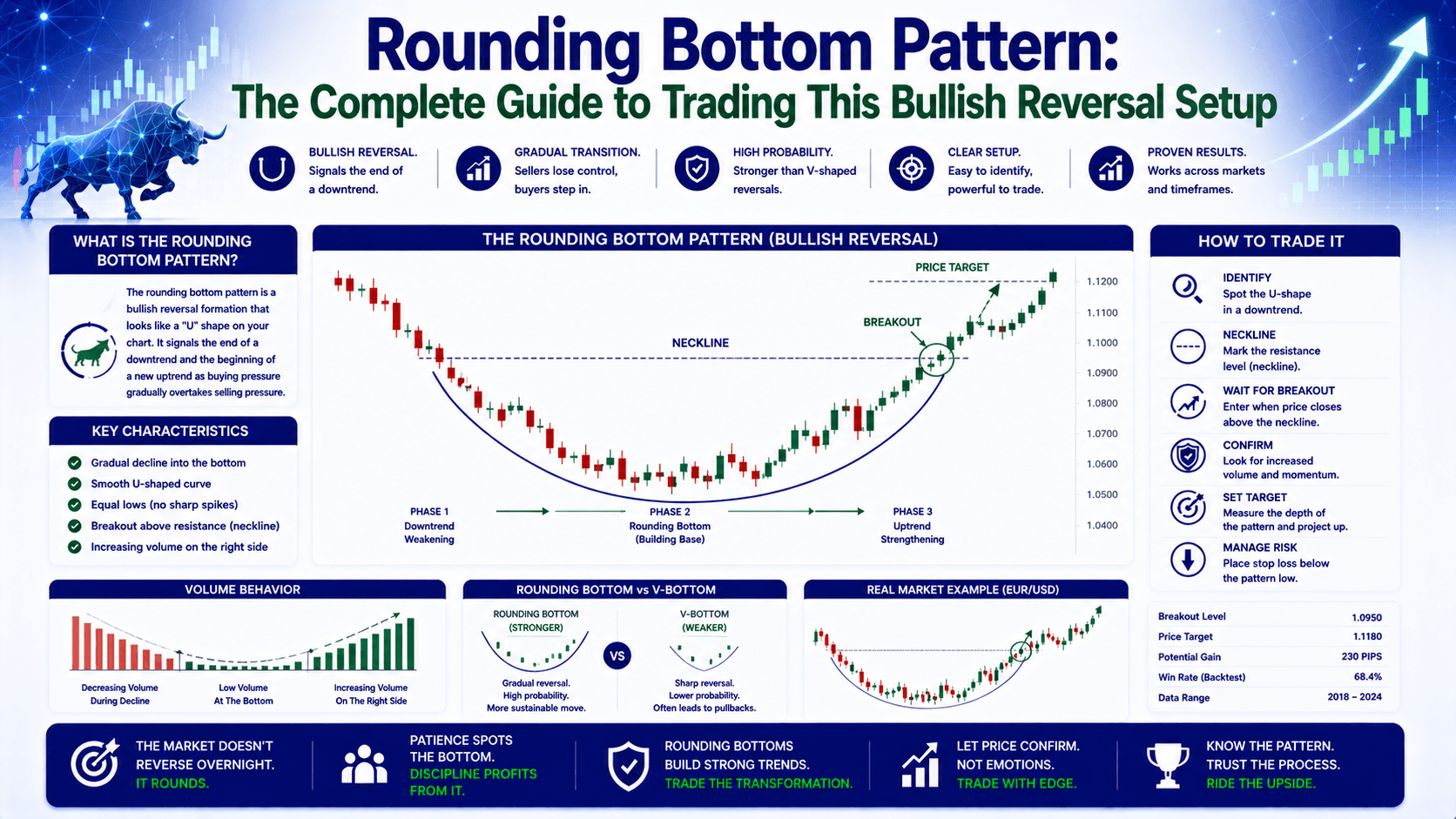
The rounding bottom pattern is a bullish reversal formation that looks like a "U" shape on your chart. It signals the end of a downtrend and the beginning of an uptrend. Think of it as the market taking a deep breath after a long decline, then deciding to go back up.
This pattern is rare — you won't see it every day. But when it forms, it can be extremely reliable. The extended formation time means the market has thoroughly shaken out weak hands and built a strong base for the next move up.
Let's compare it to something you already know: the cup and handle pattern. The rounding bottom is similar but without the handle. It's a clean, smooth transition from selling to buying pressure.
| Feature | Rounding Bottom | Cup and Handle |
|---|---|---|
| Shape | "U" shape, smooth curve | "U" shape + small pullback (handle) |
| Signal type | Bullish reversal | Bullish continuation |
| Handle present? | No | Yes |
| Typical timeframe | Weeks to months | Weeks to months |
| Volume pattern | Low at bottom, high at breakout | Low at bottom, high at breakout |
How to Identify a Rounding Bottom Pattern
You need to spot three distinct phases. Let's break them down with real numbers.
Phase 1: The Left Side (Decline)
Price is in a downtrend. Selling pressure is strong. But here's the key — the momentum starts to slow down.
Example: EUR/USD drops from 1.1000 to 1.0800 over 3 weeks. The first week, it drops 80 pips. The second week, 40 pips. The third week, only 20 pips. The selling is exhausting itself.
Volume is high at the start, then gradually decreases. This tells you sellers are running out of steam.
Phase 2: The Bottom (Consolidation)
Price stabilizes. It moves sideways in a narrow range, forming the curved bottom of the "U".
Example: EUR/USD trades between 1.0800 and 1.0820 for 2 weeks. Volume is low. Nobody is excited about this market. It's boring — and that's exactly what you want.
This is where smart money starts accumulating positions. They're buying while everyone else is asleep.
Phase 3: The Right Side (Breakout)
Price starts climbing. The curve goes up. The neckline — the resistance level at the start of the pattern — is the target.
Example: EUR/USD breaks above the neckline at 1.1000. Volume spikes. This is your confirmation.
The breakout should be decisive. A close above the neckline with strong volume is your green light.
How to Trade the Rounding Bottom Pattern
Here's the step-by-step process. No guesswork.

Step 1: Identify the Pattern
Look for a clear "U" shape on a daily or weekly chart. The left and right sides should be roughly symmetrical. The bottom should be a smooth curve, not a sharp V.
Step 2: Draw the Neckline
The neckline is a horizontal line connecting the highest points on the left and right sides of the pattern. This is your resistance level.
Example: If the left side peaked at 1.1000 and the right side peaks at 1.0980, your neckline is at 1.1000 (the higher of the two).
Step 3: Wait for the Breakout
Don't enter early. Wait for price to close above the neckline. A false breakout can happen — but a close above with high volume is your confirmation.
Example: EUR/USD breaks above 1.1000 intraday but closes at 1.0995. That's not a breakout. Wait for a daily close above 1.1000.
Step 4: Set Your Stop Loss
Place your stop loss below the neckline or below the most recent swing low within the pattern. The distance depends on your risk tolerance.
Example: If the neckline is at 1.1000 and the most recent low is at 1.0950, you might place your stop at 1.0940 (10 pips below the low).
Step 5: Set Your Profit Target
Measure the distance from the bottom of the pattern to the neckline. Project that same distance upward from the neckline.
Example: Bottom of pattern = 1.0800. Neckline = 1.1000. Distance = 200 pips. Profit target = 1.1000 + 200 pips = 1.1200.
Volume Confirmation: The Missing Piece
Most beginners ignore volume. Don't be one of them. Volume is your best friend for confirming the rounding bottom pattern.
Here's the ideal volume pattern:
- Left side: Volume starts high, then decreases as the decline slows
- Bottom: Volume is at its lowest — nobody cares about this market
- Right side: Volume starts increasing as buyers return
- Breakout: Volume spikes — this confirms the move is real
Example: EUR/USD breaks above the neckline with 1.5x the average daily volume. That's strong confirmation. If volume is below average, the breakout might fail.
Common Mistakes (And How to Avoid Them)
Here's what goes wrong for most traders:
Mistake 1: Entering Too Early
You see the "U" shape forming and jump in. Then price drops back down. You're stuck in a losing trade.
Fix: Wait for the breakout above the neckline. Patience pays.
Mistake 2: Ignoring Volume
Price breaks the neckline, but volume is low. You enter. Price reverses. You lose.
Fix: Only trade breakouts with above-average volume.
Mistake 3: Setting Stop Loss Too Tight
You place your stop 10 pips below the neckline. Price dips 11 pips, takes your stop, then rallies 200 pips. Painful.
Fix: Give your stop some breathing room. Use the most recent swing low, not the neckline itself.
Mistake 4: Not Waiting for a Daily Close
Price breaks the neckline intraday. You enter. Price closes below the neckline. You're in a losing position.
Fix: Wait for a daily close above the neckline. This filters out false breakouts.
Rounding Bottom vs. Rounding Top
The rounding bottom has an opposite cousin: the rounding top. Here's how they compare:
| Feature | Rounding Bottom | Rounding Top |
|---|---|---|
| Shape | "U" shape | Inverted "U" shape |
| Signal | Bullish reversal | Bearish reversal |
| Formation | End of downtrend | End of uptrend |
| Volume | Low at bottom, high at breakout | High at top, low at breakdown |
| Neckline | Resistance (above) | Support (below) |
The rounding top signals a shift from bullish to bearish. It's the mirror image — and just as rare.
FAQ
How long does a rounding bottom pattern take to form?
It varies from weeks to months. On daily charts, 3-6 months is common. On weekly charts, it can take over a year. The longer the formation, the more reliable the breakout.

Can you trade the rounding bottom pattern on any timeframe?
Yes — but it's most reliable on higher timeframes (daily, weekly). On lower timeframes (15-minute, 1-hour), the pattern is less reliable because noise increases.
What happens if the breakout fails?
A failed breakout happens when price breaks above the neckline but then reverses and closes below it again. This is called a "false breakout." Your stop loss should protect you. If it happens, wait for a new setup — don't force the trade.
Is the rounding bottom pattern the same as the cup and handle?
No. The rounding bottom is a bullish reversal pattern with no handle. The cup and handle is a bullish continuation pattern that has a small pullback (the handle) before the breakout. The rounding bottom is rarer and signals a more gradual shift in sentiment.
Quick Recap
- The rounding bottom pattern is a "U" shaped bullish reversal that forms over weeks to months
- Identify it by three phases: decline, consolidation, and breakout
- Volume is critical — low at the bottom, high at the breakout
- Wait for a close above the neckline before entering
- Set your stop below the most recent low and target the measured move
- Common mistakes: entering too early, ignoring volume, tight stops
Quick Win
Open your chart right now. Pull up EUR/USD on the daily timeframe. Scroll back 6 months. Can you find a "U" shape anywhere? Look for a period where price declined, consolidated, then rallied back up. That's a rounding bottom. Practice identifying it on 3 different pairs. Do this for 5 minutes — it'll train your eye to spot this pattern in real-time.