
Here's the Problem Most Traders Never See Coming
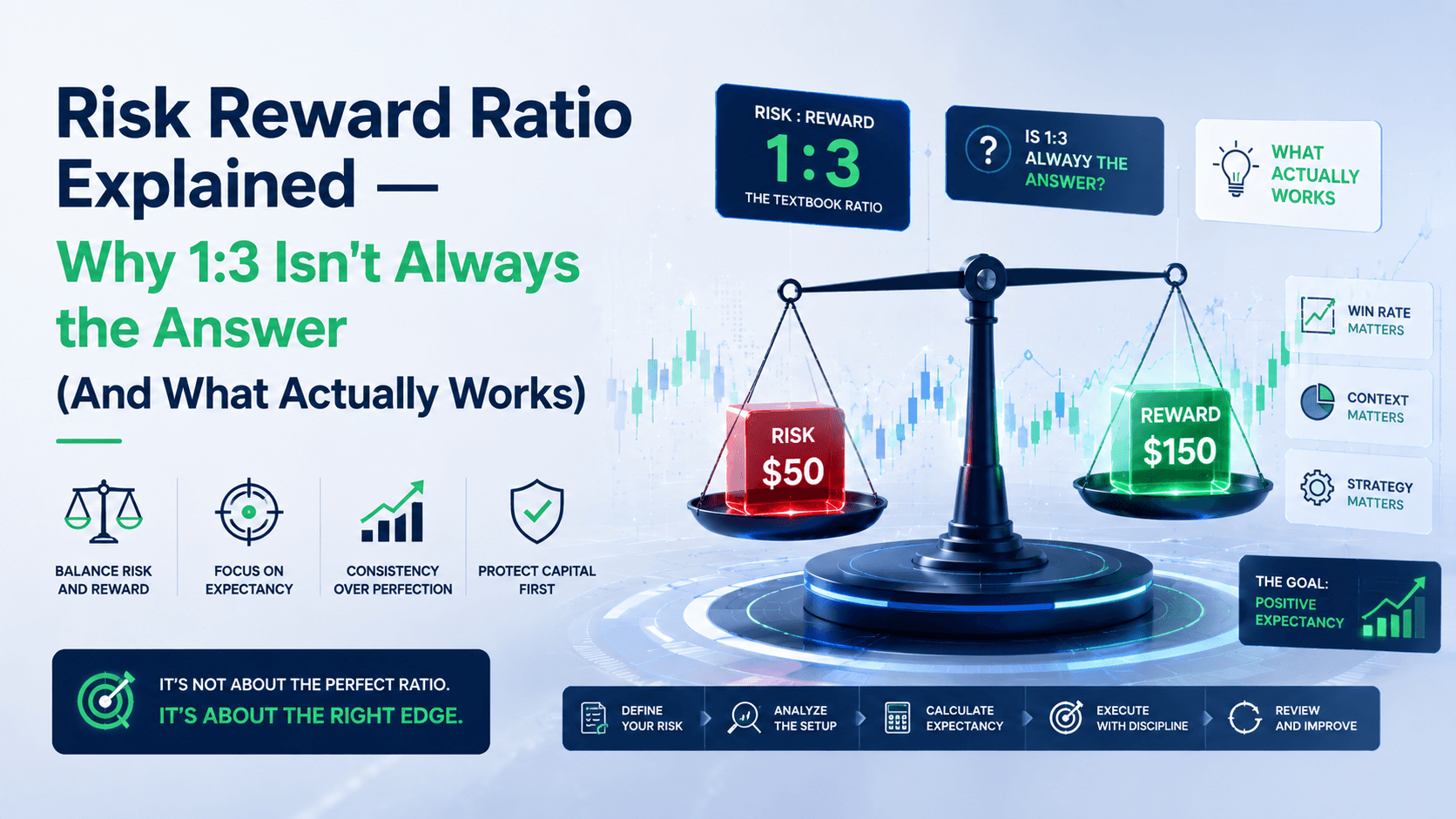
You take a trade. You risk $50 to make $150. A perfect 1:3 risk-reward ratio. Textbook stuff.
Price hits your stop loss. You lose $50.
Next trade. Same setup. Same 1:3 ratio. Price hits your stop again. You're down $100.
Third trade. Finally, price goes your way. Hits your take profit. You make $150.
Net result after three trades: $0. You broke even with a 33% win rate. That's the math working for you.
But here's what nobody tells you: most beginners chase a 1:3 ratio on every single trade without understanding if the market structure actually supports it. They end up with a 20% win rate and a blown account.
The risk reward ratio explained properly isn't about picking a number and sticking to it. It's about matching the ratio to your strategy, your win rate, and the actual market conditions.
What Is the Risk Reward Ratio? (The Simple Breakdown)
The risk reward ratio compares how much you stand to lose on a trade versus how much you stand to gain.
Formula:
Risk Reward Ratio = Potential Profit ÷ Potential Loss
Let's make this real with numbers you'd actually see on a chart.
Example: EUR/USD is trading at 1.0850. You see a setup to go long. You set your stop loss at 1.0830 (20 pips risk). You set your take profit at 1.0890 (40 pips reward).
Your risk reward ratio = 40 ÷ 20 = 2:1 (or 1:2 depending on how you write it).
On 0.1 lots, that's $20 risk for $40 reward. On 1.0 lots, it's $200 risk for $400 reward.
The ratio itself doesn't change with position size. Only the dollar amounts do.
Why Win Rate and Risk Reward Ratio Are Inseparable
This is where most explanations fall short. They tell you to use a 1:3 ratio but don't explain what win rate you need to make it work.

Here's the math you actually need:
| Risk Reward Ratio | Win Rate Needed to Break Even | Realistic for Most Traders? |
|---|---|---|
| 1:1 | 50% | Yes — achievable with good setups |
| 1:2 | 33.3% | Yes — the sweet spot for many strategies |
| 1:3 | 25% | Possible — but harder to hit consistently |
| 1:5 | 16.7% | Tough — only works with trend-following strategies |
Let's test this with a real scenario.
You have a $2,000 account. You risk 1% per trade ($20). You use a 1:3 ratio, so your target is $60 profit per winning trade.
After 20 trades with a 25% win rate:
- 5 wins × $60 = $300 profit
- 15 losses × $20 = $300 loss
- Net result: $0
Now imagine your win rate drops to 20%. After 20 trades:
- 4 wins × $60 = $240 profit
- 16 losses × $20 = $320 loss
- Net result: -$80 (4% of your account gone)
That's why the risk reward ratio explained in isolation is dangerous. You need to know your strategy's win rate first.
The Wrong Way vs. The Right Way to Use Risk Reward Ratios
The Wrong Way: "I'll only take trades with a 1:3 risk reward ratio."
You spot a setup on GBP/USD. The nearest resistance is 80 pips away, but you force a 1:3 ratio anyway. You set your take profit 90 pips away — beyond the resistance level. Price hits resistance, reverses, and hits your stop. You missed a perfectly good trade because you forced an unrealistic target.
The Right Way: Let the market structure determine your ratio.
GBP/USD is at 1.2650. Support is at 1.2620 (30 pips below). Resistance is at 1.2710 (60 pips above).
Your risk = 30 pips. Your reward = 60 pips. Your ratio = 1:2.
That's a 1:2 ratio based on actual support and resistance levels — not a random number you picked.
If the resistance was only 30 pips away, your ratio would be 1:1. That's fine too. A 1:1 ratio with a 60% win rate is more profitable than a 1:3 ratio with a 15% win rate.
How to Choose the Right Risk Reward Ratio for Your Trading Style
Your trading style determines which ratio works best:
| Trading Style | Typical Risk Reward Ratio | Why |
|---|---|---|
| Scalping | 1:1 to 1:1.5 | Small moves, high win rate (60-70%) |
| Day Trading | 1:1.5 to 1:3 | Medium moves, moderate win rate (40-50%) |
| Swing Trading | 1:2 to 1:5 | Larger moves, lower win rate (30-40%) |
| Position Trading | 1:3 to 1:10+ | Big trends, lowest win rate (20-30%) |
Real example: I trade Gold (XAU/USD) during London and New York sessions. My typical setup has a 1:1.5 ratio. I risk 20 pips to make 30 pips. My win rate is around 55%. After 100 trades:
- 55 wins × $30 = $1,650 profit
- 45 losses × $20 = $900 loss
- Net profit: $750 on 0.1 lots
That's a consistent, profitable system. Not because I chase big ratios, but because I match the ratio to my style.
The One Tool You Need to Calculate Position Size with Risk Reward Ratios
Here's a step-by-step process to calculate your position size based on your risk reward ratio:
Step 1: Determine your account risk per trade (e.g., 1% of $2,000 = $20)
Step 2: Measure your stop loss in pips (e.g., 25 pips)
Step 3: Calculate position size: $20 ÷ 25 pips = $0.80 per pip
Step 4: Convert to lots: $0.80 per pip = 0.08 lots (standard lot = $10 per pip)
Step 5: Set your take profit based on your ratio (e.g., 1:2 = 50 pips target = $40 profit)
Pro tip: Most trading platforms have a position size calculator built in. Use it before every trade.
FAQ
What is a good risk reward ratio for beginners?
A 1:1.5 to 1:2 ratio is ideal for beginners. It gives you room to be wrong 40% of the time and still be profitable. Don't chase 1:3 or higher until you have a proven strategy.

Is a 1:1 risk reward ratio worth taking?
Yes — if your win rate is above 50%. A 1:1 ratio with a 60% win rate produces consistent profits. The ratio alone doesn't determine profitability. Your win rate matters just as much.
Can you be profitable with a 1:2 risk reward ratio?
Absolutely. You only need a 33.3% win rate to break even with a 1:2 ratio. Most retail traders have win rates between 30-50%, making this the most practical ratio for most strategies.
What happens if I use a 1:3 ratio but my win rate is only 20%?
You'll lose money over time. With a 1:3 ratio and 20% win rate, you lose $1 for every $3 you make on wins — but you only win 2 out of 10 trades. Your net result is negative. You need at least a 25% win rate to break even.
Quick Recap
- The risk reward ratio compares potential profit to potential loss on a trade
- Your win rate determines what ratio you need to be profitable
- Let market structure (support/resistance) set your ratio — don't force it
- Match your ratio to your trading style: scalpers use 1:1, swing traders use 1:3
- Use a position size calculator to ensure your dollar risk stays within your account limits
Your Quick Win
Open your trading platform right now. Pull up EUR/USD on the 1-hour chart. Find the last trade you took or a setup you're watching. Measure the distance from entry to your stop loss in pips. Then measure the distance from entry to the next support or resistance level. Divide the reward by the risk. That's your actual risk reward ratio based on market structure — not a number you pulled out of thin air. Do this for 3 setups today.