
Why 90% of Traders Blow Up — And the 1% Rule That Saves the Rest
Look, I've been there. You open your chart, see a beautiful setup on EUR/USD, and think: "This is the one. I'll risk a bit more this time."
Then price reverses. Your $500 trade turns into a $300 loss. Then you revenge trade. And suddenly your $2,000 account is down to $800.
Sound familiar?
I blew my first account doing exactly this. Lost $3,500 in two weeks. Not because my analysis was wrong — but because I had zero risk management.
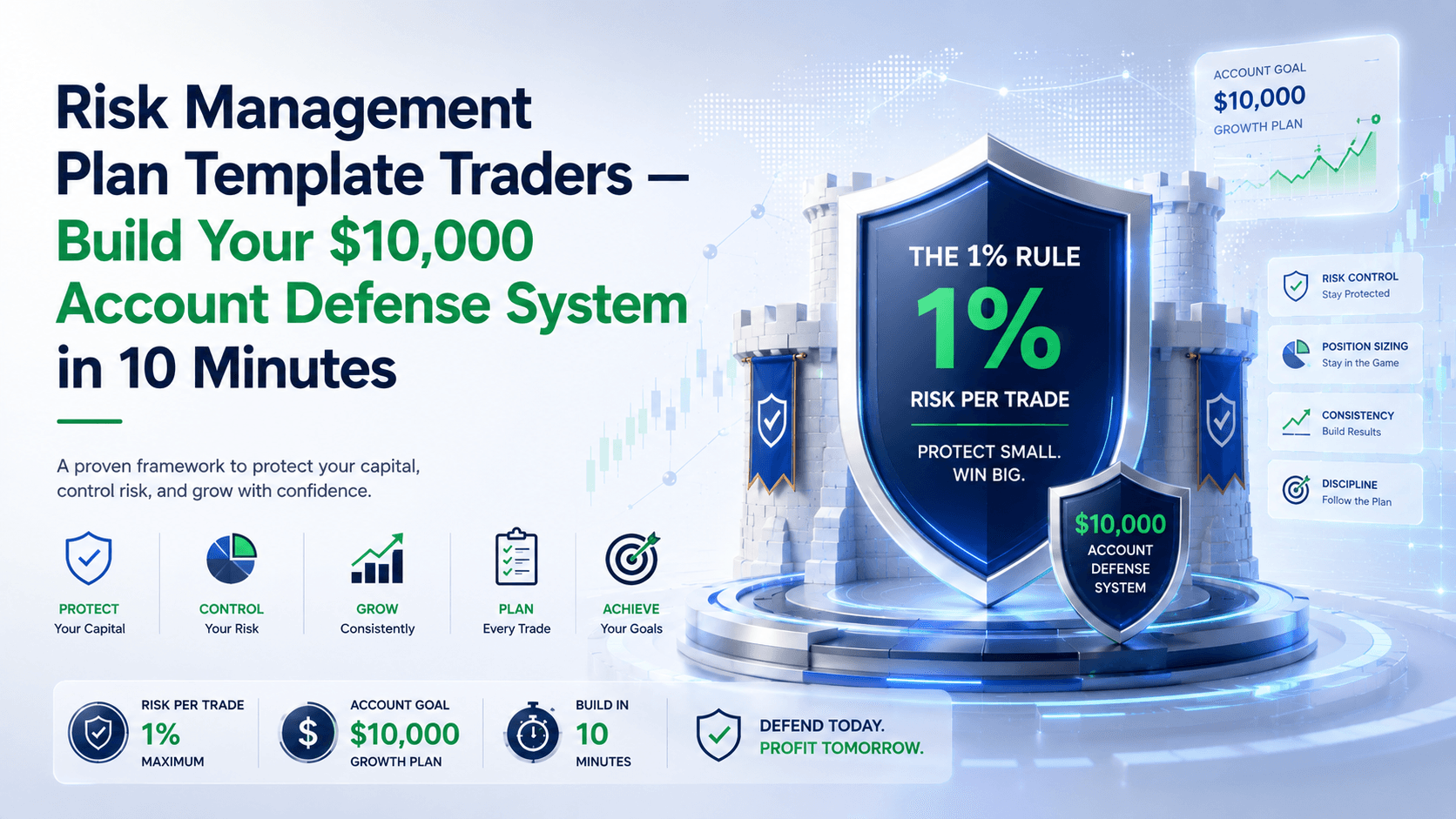
Here's the truth: the difference between a professional trader and a gambler isn't prediction skill. It's a risk management plan template traders use religiously. And I'm going to give you mine.
What a Risk Management Plan Actually Protects
Most traders think risk management is about "not losing money." Wrong. It's about surviving long enough for your edge to work.
Let me show you with real numbers:
Trader A risks 1% per trade. $10,000 account. Loses 10 trades in a row. Account goes to $9,044. Still trading.
Trader B risks 5% per trade. Same $10,000. Loses 5 trades in a row. Account goes to $7,738. Panic sets in.
Trader C risks 10% per trade. Same account. Loses 3 trades. Account drops to $7,290. They're done.
The math is brutal. A 50% loss requires a 100% gain to recover. A 10% loss requires only 11% gain. Small losses keep you in the game.
The Risk Management Plan Template Traders Actually Use
Here's the exact template I've used for 10+ years. Print it. Stick it on your wall.

| Component | Your Rule | Example ($10,000 Account) |
|---|---|---|
| Risk per trade | 1% max | $100 max loss per trade |
| Daily loss limit | 3% max | Stop trading after losing $300 |
| Weekly loss limit | 6% max | Stop trading after losing $600 |
| Monthly drawdown | 15% max | Stop trading at $8,500 balance |
| Risk:Reward minimum | 1:2 | Risk $100 to make $200 |
| Stop loss | Always on every trade | Set before entry |
| Take profit | Always set | Based on R:R ratio |
Step 1: Calculate Your Position Size (The Math That Saves You)
Most beginners pick a lot size first. Wrong. Your position size should be determined by your stop loss distance — not the other way around.
Here's the formula:
Position Size = (Account Balance × Risk %) ÷ (Stop Loss in Pips × Pip Value)
Let's run it with real numbers:
- Account: $10,000
- Risk: 1% = $100
- Trade: Buy EUR/USD at 1.0850
- Stop loss: 1.0820 (30 pips)
- Pip value for 0.1 lots: $1
Position Size = $100 ÷ (30 pips × $1) = 3.3 mini lots (0.33 standard lots)
So you buy 0.33 lots. If stop loss hits, you lose exactly $99. Under 1%. Perfect.
⚠️ Common mistake: Don't round up. Round down. 0.33 lots? Trade 0.3. That extra 0.03 lots could be the difference between discipline and disaster.
Step 2: Set Your Stop Loss — Not Where You Hope, But Where You Know
Your stop loss isn't a suggestion. It's a contract with yourself.
Place it at logical levels based on your strategy:
- Support/Resistance: 5-10 pips below/above the level
- ATR-based: 1.5× the ATR below your entry
- Swing low/high: Below the most recent swing low (for buys)
Example: GBP/USD at 1.2650. Recent swing low at 1.2620. You place your stop at 1.2615 — 5 pips below the swing low to avoid being stopped out by a wick.
Your risk: 35 pips. On 0.2 lots, that's $70. Perfectly within your 1% rule.
Step 3: Set Your Take Profit — Lock In the Win
Never enter a trade without knowing where you'll exit for profit. Use a minimum 1:2 risk-to-reward ratio.
From the GBP/USD example:
- Entry: 1.2650
- Stop: 1.2615 (35 pip risk)
- Target: 1.2720 (70 pip reward)
- R:R = 1:2
If price hits target: $140 profit on 0.2 lots. If stop hits: $70 loss. Win 1 out of 3 trades like this and you're profitable.
The Wrong Way vs. The Right Way
Wrong Way (90% of beginners):
- See a setup on XAU/USD at $2,350
- Think: "I'll make $500 on this trade"
- Buy 1.0 lots (way too big)
- No stop loss set
- Price drops to $2,320
- Hold and hope
- Price drops to $2,280
- Account down $700
Right Way (what professionals do):
- See same setup on XAU/USD at $2,350
- Calculate: 1% of $10,000 = $100 max risk
- Stop loss at $2,335 (15 points away)
- Position size: $100 ÷ (15 × $10) = 0.67 lots
- Target: $2,380 (30 points, 1:2 R:R)
- If stop hits: lose $100. Move on.
- If target hits: make $200. Good trade.
See the difference? The outcome isn't random. It's calculated.
How to Handle Drawdowns — The Part Nobody Talks About
Every trader hits a losing streak. The question isn't if — it's when.
Here's my drawdown protocol:
- Hit 3% daily loss? Close all trades. Walk away. No exceptions.
- Hit 6% weekly loss? Stop trading for the week. Review your journal.
- Hit 15% monthly drawdown? Stop trading completely. Go back to demo.
This saved my account multiple times. When you're losing, your judgment is clouded. The daily loss limit protects you from yourself.
Common Mistakes That Kill Accounts
Let me save you the pain I went through:
Mistake 1: Moving your stop loss further away — "It'll come back, I just need more room." No. You're gambling. Respect your stop.
Mistake 2: Revenge trading after a loss — You lose $100. You immediately take a $200 risk trade to "get it back." You lose again. Now you're down $300. Stop.
Mistake 3: Ignoring correlation risk — You're long EUR/USD and long GBP/USD. Both are dollar pairs. If the dollar strengthens, both lose. Your actual risk is 2%, not 1%. Account for this.
Mistake 4: Using too much leverage — 100:1 leverage means a 1% move wipes out your entire account. Use 10:1 or less. Professional traders do.
FAQ
What's the best risk management plan template for traders?
The best template includes: 1% risk per trade, 3% daily loss limit, 6% weekly loss limit, 1:2 minimum risk-to-reward ratio, and a stop loss on every trade. Stick to these rules and you'll survive long enough to profit.

How much should I risk per trade as a beginner?
Risk 0.5% to 1% per trade. With a $5,000 account, that's $25-$50 max loss per trade. This gives you room to learn without blowing up.
What's the difference between gambling and trading?
Gambling has no risk management. Trading does. If you can't answer "exactly how much will I lose if this trade goes against me?" before entering, you're gambling.
How do I calculate position size manually?
Formula: (Account × Risk %) ÷ (Stop Loss in pips × Pip value). Example: ($10,000 × 1%) ÷ (30 pips × $1) = 3.3 mini lots. Use a position size calculator if you don't want to do the math.
📝 Quick Recap
- Risk 1% per trade max — never more
- Set stop loss and take profit before entering
- Use minimum 1:2 risk-to-reward ratio
- Set daily (3%) and weekly (6%) loss limits
- Account for correlation when trading multiple pairs
- Use low leverage (10:1 or less)
Your Quick Win — Do This Now
Open your trading platform. Go to your account settings. Find the "maximum daily loss" setting. Set it to 3% of your current balance.
Then open a blank document and write down your 5 risk management rules. Print it. Tape it next to your monitor.
That's it. You now have a risk management plan template traders actually use. Follow it. Your account will thank you.