
I Still Remember the Day I Blew $1,200 in 20 Minutes
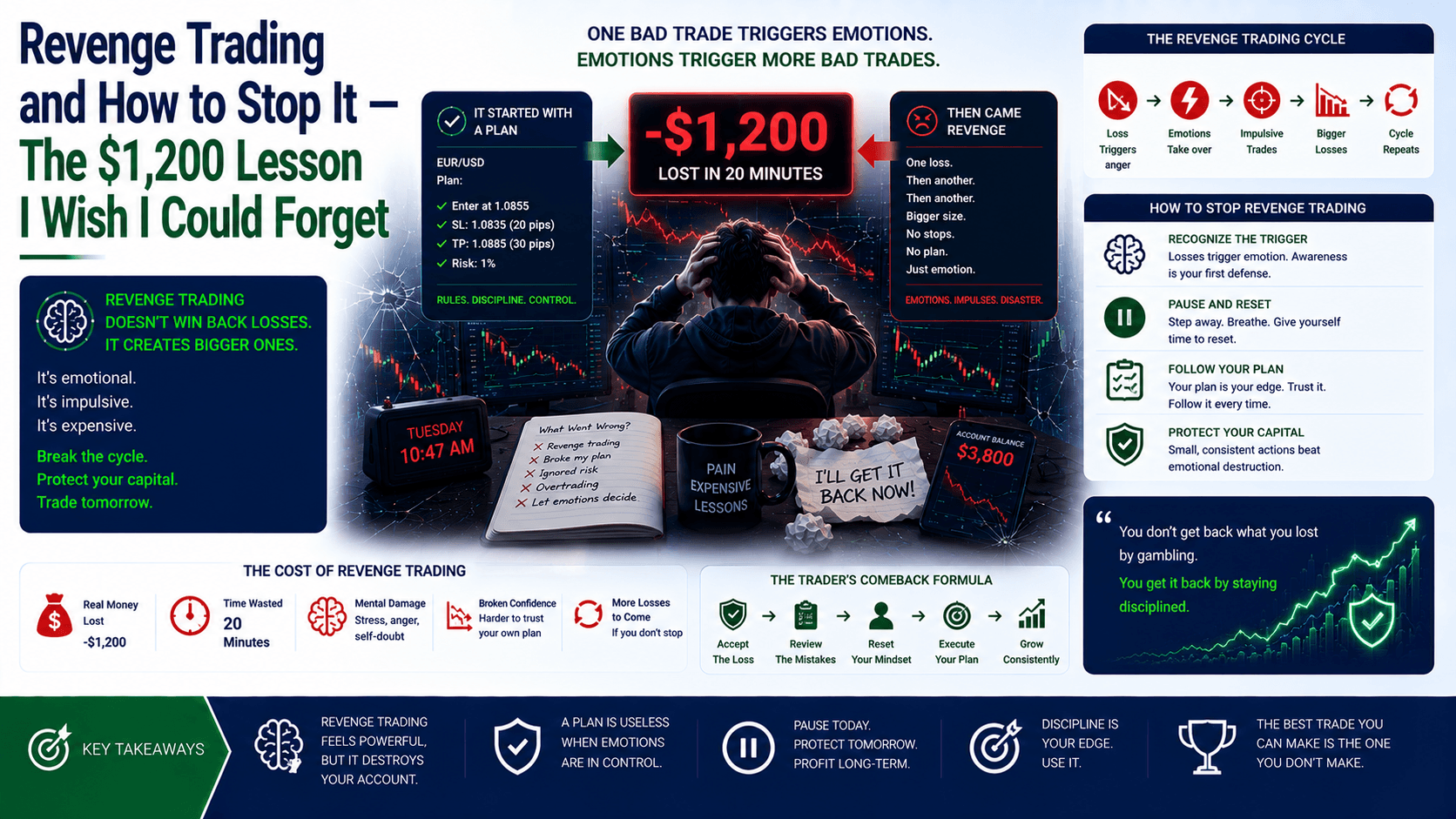
It was a Tuesday. EUR/USD was ranging between 1.0850 and 1.0880. I had a solid plan — enter at 1.0855, stop at 1.0840, target 1.0875. A clean 1:2 risk-to-reward setup.
Price hit my stop at 1.0838. Two pips below my level. I was furious.
So I did what most beginners do. I clicked "Sell" at 1.0838 with double the size. No analysis. No plan. Just pure anger.
Price reversed 40 pips in 10 minutes. I lost $800 on that trade. Then I tried again — and lost another $400.
That's revenge trading. And it's the fastest way to destroy your account.
Let me show you exactly what revenge trading is, why it happens, and — most importantly — how to stop it before it costs you everything.
What Is Revenge Trading? (And Why It's Different From Normal Trading)
Revenge trading is when you enter a trade not because your strategy tells you to — but because you're angry, frustrated, or desperate to recover a loss.
Here's how it works:
- You take a loss (or miss a big move)
- Your emotions spike — anger, fear, shame
- You skip your rules and jump into the next trade
- You increase your position size to "make it back fast"
- The trade goes against you — and you lose even more
The difference between normal trading and revenge trading is simple: Normal trading follows a plan. Revenge trading follows emotion.
| Normal Trading | Revenge Trading |
|---|---|
| You have a predefined entry, stop, and target | You enter impulsively after a loss |
| You risk 1-2% of your account per trade | You risk 5-10% (or more) to "get even" |
| You accept losses as part of the process | You see losses as personal failures |
| You walk away after 3 consecutive losses | You keep trading until you "feel better" |
| You trade your edge | You trade your ego |
Why Do Traders Fall Into Revenge Trading? (The Psychology Behind It)
I'll be honest with you — revenge trading isn't a strategy problem. It's a psychology problem. And it affects traders at every level, from complete beginners to professionals with 10+ years of experience.

Here are the main psychological drivers:
1. Loss Aversion — The Pain of Losing Hurts Twice as Much
Behavioral economists have proven it: losing $100 hurts about twice as much as winning $100 feels good. This is called loss aversion.
When you take a loss, your brain doesn't just register a financial setback. It registers a threat. And your amygdala — the part of your brain that handles fear — kicks into gear.
The result? You feel an urgent need to "fix" the loss immediately. That urgency overrides your rational thinking. And that's exactly when revenge trading takes over.
2. Ego — The "I Need to Be Right" Trap
Let's be real. Most of us trade because we want to be right. We want to prove that we can predict the market.
When a trade goes against us, it feels personal. Like the market is attacking us. So we fight back — by doubling down, increasing risk, and trying to "win" the next trade.
But here's the truth: The market doesn't care about your ego. It doesn't know you exist. And it will punish you every time you trade out of pride instead of strategy.
3. The "Make It Back Fast" Mentality
After a loss, your brain goes into "recovery mode." You think: "If I just hit one good trade, I'll be back to even."
That's when you increase your position size. Instead of your normal 0.1 lots, you jump to 0.5 lots. Or 1.0 lots. Because you want to recover faster.
Here's the math on why that's dangerous:
- You have a $2,000 account. You risk 2% per trade = $40 max loss
- You lose $80 on your first trade (because you didn't stick to your stop)
- Now you're down $80. You want to make it back in one trade
- You risk $80 on the next trade = 4% of your account
- That trade loses too. Now you're down $160
- You risk $160 on the next trade = 8% of your account
In three trades, you've gone from disciplined risk management to gambling. And it all started with one emotional decision.
The Wrong Way vs. The Right Way — A Real Trade Example
Let me show you the contrast using a real scenario.
The Wrong Way (Revenge Trading)
You're trading Gold (XAU/USD). Price is at $2,340. You see a breakout above $2,345 and enter long at $2,346 with a stop at $2,335. Target: $2,360.
Price hits your stop at $2,335. You lose $110 on 0.1 lots.
You're angry. You think: "That was a fakeout. The real breakout is coming. I'm going to double down."
You enter another long at $2,335 — this time with 0.3 lots. No stop loss because "it's going to bounce."
Price drops to $2,320. You're now down $450 on that trade. Total loss: $560 in 30 minutes.
The Right Way (Disciplined Trading)
Same scenario. You enter at $2,346, stop at $2,335, target $2,360. Price hits your stop at $2,335. You lose $110.
You close your charts. You take a 30-minute break. You go for a walk.
When you come back, you review what happened. The breakout failed. There's no trade setup right now. You wait.
Two hours later, price forms a clear support level at $2,325 with a hammer candle. You enter long at $2,326 with a stop at $2,318 and target $2,345.
Price hits your target. You make $190.
Net result: +$80 for the day. Not a home run, but you protected your account and stayed in the game.
5 Practical Steps to Stop Revenge Trading
Based on what I've learned (the hard way) and what trading coaches like Brett Steenbarger and Steve Ward teach, here are the most effective ways to break the cycle.
Step 1: Set a Hard Daily Loss Limit — and Walk Away
This is non-negotiable. Before you start trading, decide how much you're willing to lose in a single day. When you hit that number, you stop. No exceptions.
For example:
- Account size: $2,000
- Daily loss limit: $60 (3% of account)
- If you lose $60 in any session, you close all charts and walk away
This rule saved my account more times than I can count. It stops the spiral before it starts.
Step 2: Create a "Post-Loss Ritual"
Trading coach Steve Ward recommends a 4-step post-loss ritual. Here's my version:
- Acknowledge it: "That trade didn't work. It's okay."
- Learn from it: "What did I miss? Was the setup valid?"
- Let it go: Close the chart. Step away from the screen.
- Reset: Do something non-trading for 15-30 minutes. Walk, stretch, drink water.
The key is to interrupt the emotional chain reaction. Once you step away, the urgency fades.
Step 3: Use "If-Then" Rules
Instead of relying on willpower, build rules into your trading plan. For example:
- "If I lose 2 consecutive trades, I stop trading for the day."
- "If I feel angry after a loss, I close my platform and take a 30-minute break."
- "If I increase my position size out of frustration, I'm done for the week."
These rules remove the need for decision-making when you're emotional. You just follow the script.
Step 4: Journal Your Emotional Triggers
Start tracking not just your trades — but how you feel before, during, and after each trade. Over time, you'll spot patterns.
Here's what to write down:
- Trade number and setup
- Emotional state before entering (calm, excited, anxious, angry)
- Result (win or loss)
- Emotional state after the trade
- Did I stick to my plan? (Yes/No)
When you see that 80% of your revenge trades happen after a loss on Tuesday mornings, you can adjust your schedule accordingly.
Step 5: Reframe "Missed Trades" as "Saved Capital"
This is a mindset shift that changed everything for me.
Instead of thinking "I missed a 50-pip move" — think "I saved my capital by not chasing."
A missed trade costs you nothing. A forced trade can cost you everything. Which one would you rather have?
FAQ
Is revenge trading common among professional traders?
Yes. Even experienced traders can fall into revenge trading after a big loss. The difference is that professionals have systems in place (daily loss limits, post-loss rituals) to catch themselves before it spirals.

How long does it take to recover from revenge trading?
It depends on how deep you are in the cycle. For most traders, implementing a daily loss limit and a post-loss ritual shows results within 2-3 weeks. The key is consistency — not perfection.
Can revenge trading be completely eliminated?
Probably not. You're human. You'll have emotional reactions to losses. The goal isn't to eliminate the urge — it's to build systems that prevent you from acting on it. Think of it like an alcoholic who stays sober by avoiding bars.
What's the difference between revenge trading and averaging down?
Averaging down (adding to a losing position) can be part of a valid strategy if you have a plan for it. Revenge trading is adding to a losing position out of anger or desperation, without any plan. If you can't explain why you're adding to the trade, it's revenge trading.
📝 Quick Recap
- Revenge trading is entering trades out of anger or desperation after a loss — not because your strategy tells you to
- It's driven by loss aversion, ego, and the "make it back fast" mentality
- Set a hard daily loss limit (3% max) and walk away when you hit it
- Create a post-loss ritual to interrupt the emotional chain reaction
- Use "if-then" rules so you don't have to make decisions when you're emotional
- Journal your emotional triggers to spot patterns over time
- Reframe missed trades as saved capital — not lost opportunities
Your Quick Win Today
Open your trading journal (or a blank notebook). Write down the last 3 times you felt the urge to revenge trade. For each one, answer: What was the trigger? What did you do? What would you do differently now?
That's it. Five minutes. And you've already started building awareness — which is the first step to breaking the cycle.
The market will be there tomorrow. Your account might not be if you trade out of anger today. Choose discipline. Every single time.