
Why Most Beginners Get Price Action Wrong
You've heard it before: "Just trade price action. It's the purest form of analysis."
So you strip your charts clean. Remove every indicator. And stare at a naked candlestick chart, waiting for it to whisper its secrets.
Nothing happens. You feel lost. The price moves up, down, sideways — and you have no idea what to do next.
Sound familiar? It's not your fault. Most explanations of price action trading for beginners skip the most important step: how to actually read what the market is telling you. They just tell you to "look at the price" and hope for the best.
Let's fix that. Right now.
What is Price Action Trading? (The Simple Definition)
Price action trading is the discipline of making trading decisions based solely on a "naked" price chart — no lagging indicators, no oscillators, no fancy tools. Just the raw movement of price over time.
Here's the logic: All information about a market — every news event, every economic report, every trader's fear and greed — is already reflected in the price. The price chart is the collective footprint of every participant who bought or sold.
Think of it this way: If you're trying to understand a conversation, you don't need to interview every person in the room. You just need to listen to what's being said. Price action is the market's conversation. Indicators are someone else's interpretation of that conversation.
Let's compare the two approaches:
| Feature | Price Action Trading | Indicator-Based Trading |
|---|---|---|
| Data source | Raw price movement | Mathematical formulas derived from price |
| Lag | Real-time (price moves, you see it) | Lagging (indicators calculate after price moves) |
| Clarity | Clean chart, one story | Cluttered chart, conflicting signals |
| Subjectivity | Requires interpretation skill | Rules-based, but can mislead |
| Learning curve | Steeper initially, but pays off | Easier to start, harder to master |
Here's the truth: Every indicator you've ever used — RSI, MACD, Bollinger Bands, Stochastic — is derived from price action. They're just re-packaged versions of the same data. Why use a map when you can read the territory itself?
The 3 Tools You Actually Need for Price Action Trading
Forget the 50-indicator dashboard. Here's what you need:

1. A Candlestick Chart
Candlestick charts show you four pieces of information per time period: open, high, low, and close. The body shows the open-to-close range. The wicks (shadows) show the high and low.
A long lower wick means buyers stepped in at the bottom. A long upper wick means sellers rejected the top. This is the market's body language.
2. Support and Resistance Levels
These are price zones where the market has historically reversed or paused. Support is where buying pressure exceeds selling pressure. Resistance is where selling pressure exceeds buying pressure.
Draw them as horizontal lines on your chart. They're the walls of the market's room. Price bounces off them — until it doesn't.
3. Trend Structure
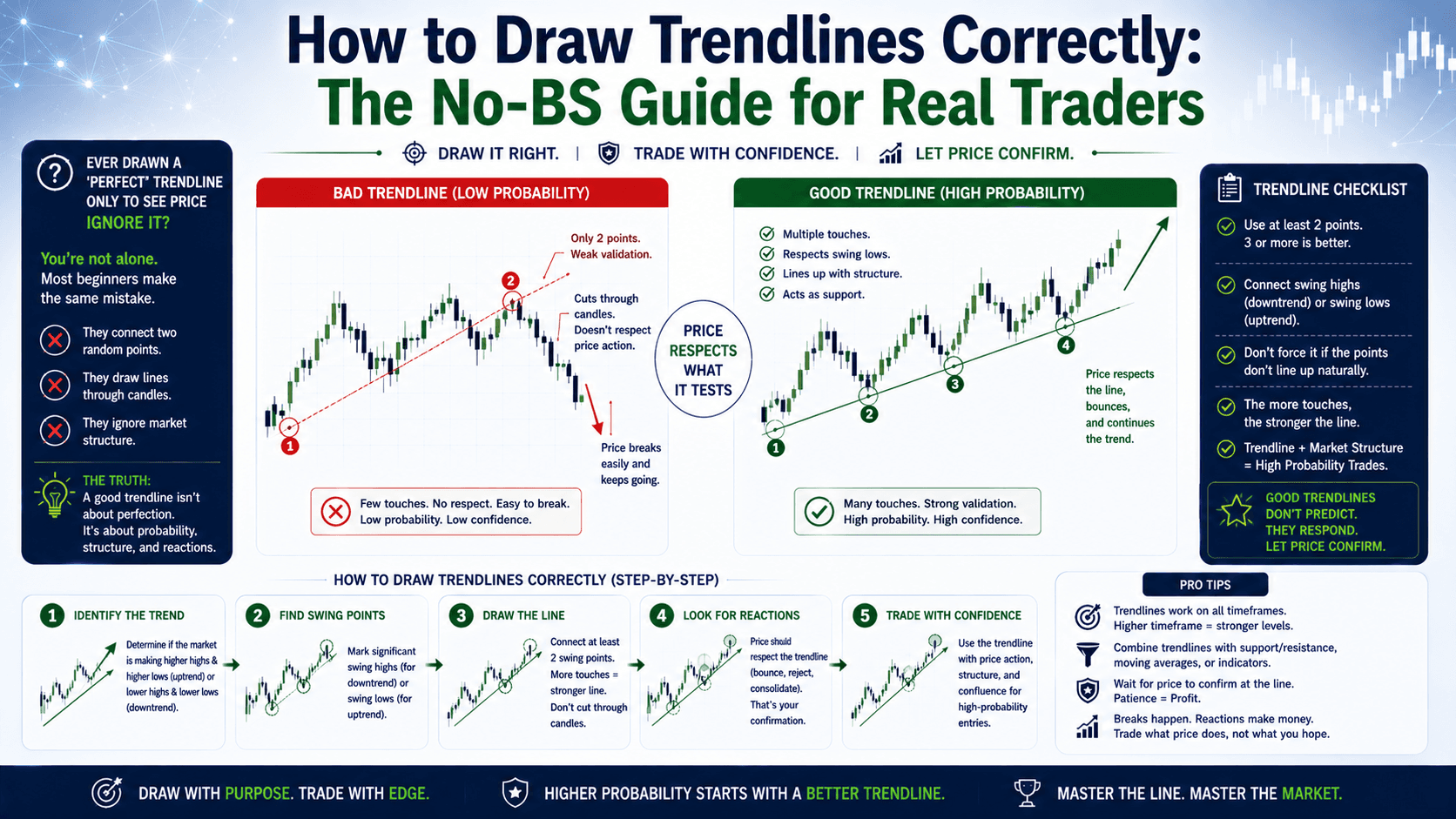
A market trends when it makes higher highs and higher lows (uptrend) or lower highs and lower lows (downtrend). When it does neither, it's consolidating.
Trading with the trend gives you a statistical edge. Trading against it is like swimming against a current — possible, but exhausting and dangerous.
The "Wrong Way → Right Way" Pattern That Changes Everything
Most beginners do this:
EUR/USD is at 1.0850. They see a long lower wick at support (1.0800). They think: "Buyers stepped in! Let's go long!" They enter at 1.0810, set a stop at 1.0790, and target 1.0880.
Price drops to 1.0795, takes their stop, then rockets to 1.0880. They got stopped out by 5 pips. Sound familiar?
Here's the fix: Don't enter at the exact support level. Wait for confirmation. Let the candle close. If you see a bullish engulfing pattern or a hammer at support, wait for the next candle to break above the high of that signal candle. That's your entry.
In our example: The hammer closes at 1.0815. You wait for the next candle to break above 1.0815. It does. You enter at 1.0818. Stop at 1.0795 (23 pips). Target at 1.0880 (62 pips). Risk:reward = 1:2.7.
This one change — waiting for confirmation — can save you from 50% of false signals.
3 Price Action Patterns Every Beginner Must Know
These are the patterns that tell you what the market is about to do. Master these three, and you'll have a solid foundation.
1. The Pin Bar (Rejection Candle)
A pin bar has a small body and a long wick on one side. It looks like a lollipop. The long wick shows that price was rejected at that level.
How to trade it: A pin bar at support with a long lower wick = bullish signal. Enter on a break above the pin bar's high. Stop below the wick's low. Target the next resistance level.
Example: Gold (XAU/USD) is at $2,350. A pin bar forms with a low of $2,340 and a close at $2,348. The long lower wick shows buyers rejected $2,340. You enter at $2,349. Stop at $2,338 (11 points risk). Target $2,370 (21 points gain). Risk:reward = 1:1.9.
2. The Engulfing Candle
An engulfing candle completely "swallows" the previous candle's body. A bullish engulfing candle closes higher than the previous candle's open, and its body covers the previous candle's body entirely.
How to trade it: A bullish engulfing candle at support = strong reversal signal. Enter on a break above its high. Stop below its low.
3. The Inside Bar (Consolidation)
An inside bar forms when a candle's high is lower than the previous candle's high, and its low is higher than the previous candle's low. It's a period of compression — like a coiled spring.
How to trade it: Enter on a break above the mother candle's high (bullish) or below its low (bearish). The breakout direction tells you which way the spring is releasing.
| Pattern | What It Tells You | Best Used At | Risk Management |
|---|---|---|---|
| Pin Bar | Price rejected at a level | Support/Resistance | Stop below wick's low |
| Engulfing | Strong momentum shift | Trend reversals | Stop below candle's low |
| Inside Bar | Compression before breakout | Consolidations | Stop outside mother candle |
The Math That Protects You
Let's say you have a $1,000 account. You want to trade price action patterns. Here's how the numbers work:
You risk 2% per trade = $20 max loss.
You see a pin bar on EUR/USD at 1.0850. Your stop is 25 pips away. On a 0.1 lot, each pip is worth $1. So 25 pips × $1 = $25 risk. That's 2.5% — too much.
Drop to 0.08 lots: 25 pips × $0.80 = $20 risk. Now you're at 2%. The math protects you.
Always calculate your position size before entering a trade. The best pattern in the world won't save you from a blown account.
FAQ
Is price action trading better than using indicators?
It depends on your style. Price action gives you real-time data and a cleaner chart. Indicators can help filter noise. Most professional traders use a combination — but they start with price action as their foundation.

How long does it take to learn price action trading?
You can learn the basics in a week. But developing the skill to read patterns consistently takes 3-6 months of daily practice. Start with higher timeframes (1-hour and above) — they have less noise.
Can I trade price action on any market?
Yes. Price action works on forex, stocks, commodities, crypto — any market with liquidity and price data. The patterns are universal because human psychology is universal.
What's the biggest mistake beginners make with price action?
Entering at support or resistance without waiting for confirmation. A long wick at support doesn't mean "buy now." It means "buyers are interested." Wait for the next candle to confirm the move before entering.
Quick Recap
- Price action trading means making decisions from a naked chart — no indicators needed
- Every indicator is derived from price action — you're just reading the source
- Master 3 patterns: Pin bars (rejection), engulfing candles (momentum shift), inside bars (compression)
- Always wait for confirmation — don't enter at the exact support/resistance level
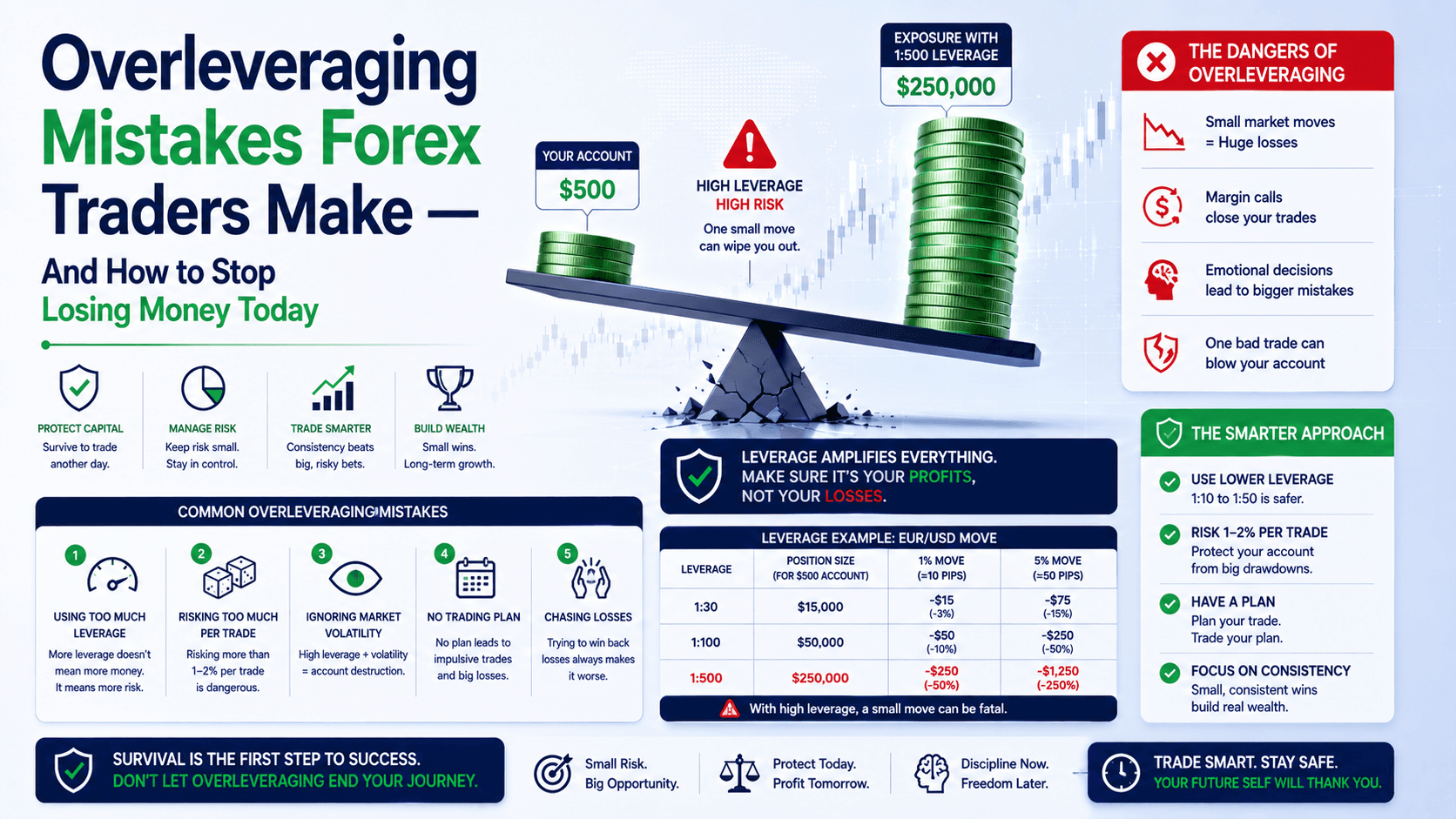
- Risk management is non-negotiable: 1-2% per trade, calculate position size first
Your 5-Minute Quick Win
Open your chart right now. Pick EUR/USD on the 1-hour timeframe. Scroll back 48 hours. Find the last 3 pin bars (candles with a wick at least 2x the body length). Note where they formed — at support, resistance, or in the middle of nowhere.
Now look at what happened next. Did price reverse? Or did it break through? This 5-minute exercise will teach you more about price action than reading 10 articles. Start doing it daily, and you'll develop an eye for patterns that most traders miss.