
What Exactly Is a Pin Bar?
Let's start with the obvious question. You've seen these candles on your chart. A long wick. A tiny body. Looks like a pin. That's where the name comes from.
A pin bar is a single candlestick pattern that shows a clear rejection of a price level. The market tried to push one direction — and got smacked down. Hard.
Here's the anatomy:
- The tail (wick): Should be at least 2/3 of the entire candle's range. The longer, the better.
- The body: The open and close are close together. Ideally, they're at the extreme end of the candle.
- The nose: The opposite end of the tail. Can be tiny or even non-existent if the open or close happens at the extreme.
Think of a pin bar as the market taking a swing, missing, and stumbling back. That's the story it tells.
Here's the data: On a bullish pin bar, the tail points down — price tried to go lower, failed, and closed near the high. On a bearish pin bar, the tail points up — price tried to rally, got rejected, and closed near the low.
Simple, right? But here's where most beginners get it wrong.
Why Most Traders Fail With the Pin Bar Trading Strategy
The biggest mistake? They trade every pin bar they see. That's a recipe for blowing up your account.
Let me show you why.
You're scanning EUR/USD on the daily chart. You see a beautiful bearish pin bar with a long upper wick. You short it immediately. Price drops 20 pips, then reverses and takes out your stop loss. What happened?
You missed the most important factor: confluence.
A pin bar in the middle of nowhere is just a random candle. It has no weight. No significance. It's noise.
Here's the contrast:
| Weak Pin Bar | Strong Pin Bar |
|---|---|
| Forms in the middle of a range | Forms at a key support or resistance level |
| Against the dominant trend | In the direction of the trend |
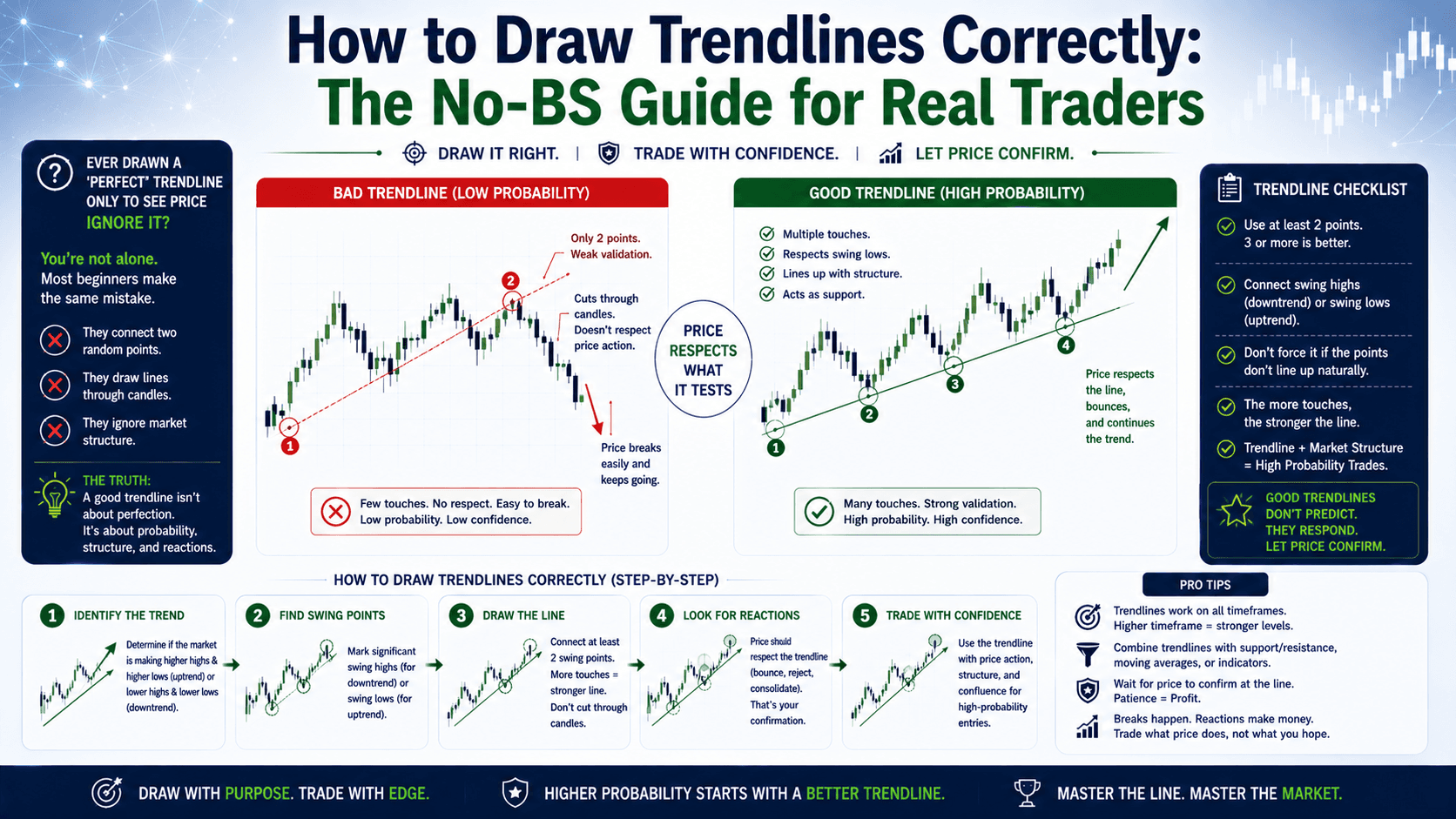
| Short tail, large body | Long tail, tiny body |
| No other confirmation | Confluence with EMA, Fib, or other levels |
The data suggests that pin bars with at least two factors of confluence have a significantly higher win rate. Let's break down what confluence actually means.
The 3 Factors That Make a Pin Bar Trade-Worthy
1. Key Support or Resistance Level
This is non-negotiable. A pin bar must form at a clearly identifiable level on the chart.
Let's say GBP/USD is at 1.2650, and there's a resistance level at 1.2680 that's held three times before. A bearish pin bar forms right at 1.2680 with a long upper wick. That's a high-probability setup because the market has already proven this level matters.
Without a level, you're guessing. And guessing is not a strategy.
2. Trend Direction
Pin bars taken with the trend are more reliable than counter-trend setups.
Here's the math: In a strong uptrend, the market has momentum. A bullish pin bar at a support level within that trend is like catching a falling knife — in a good way. The trend is your friend, remember?
Counter-trend pin bars can work, but they require more confluence. A massive pin bar at a major resistance level in a downtrend? That's a different story. But a small pin bar against a strong trend? Skip it.
3. Fibonacci Retracement or Moving Average
Add a dynamic level to the mix. A pin bar that forms at the 50% Fibonacci retracement and at a horizontal support level? That's a powerful combination.
Or a pin bar that rejects the 8-period EMA on the daily chart. The EMA acts as dynamic support or resistance, giving you an extra layer of confirmation.
The more factors align, the higher the probability the trade works.
How to Enter a Pin Bar Trade: 3 Methods Compared
Once you've identified a valid setup, you need to decide how to enter. Here are the three most common methods:

| Entry Method | How It Works | Pros | Cons |
|---|---|---|---|
| Market Order | Enter immediately after the pin bar closes | Fast execution, no missed trades | Wider stop loss, lower R:R |
| Break of Nose | Enter on a break of the pin bar's high (bullish) or low (bearish) | Confirmation of momentum | Can miss the move if price doesn't retrace |
| 50% Retrace | Enter on a retrace to the 50% level of the pin bar's range | Best R:R, tight stop | Order may not get filled |
Let's look at a real example using the 50% retrace method on a bullish pin bar in EUR/USD.
EUR/USD is at 1.0850. A bullish pin bar forms with a low of 1.0820 and a high of 1.0860. The total range is 40 pips. The 50% level is at 1.0840.
You place a buy limit at 1.0840. Your stop loss goes 1 pip below the pin bar's low at 1.0819. That's a 21-pip stop.
Your target is the next resistance level at 1.0900. That's a 60-pip profit.
Risk:Reward = 21:60 = roughly 1:3. That's a solid setup.
Now compare that to entering at market at 1.0855 with a stop at 1.0819 (36-pip stop) and the same target of 1.0900 (45-pip profit). That's only a 1:1.25 R:R. Not great.
The 50% retrace method gives you a much better risk-to-reward ratio. The trade-off? About half the time, price won't retrace that far, and you'll miss the trade.
On the flip side, when it does retrace, you're getting a much better entry. Over time, that makes a massive difference to your bottom line.
Where to Place Your Stop Loss
This is straightforward. Your stop loss goes 1-2 pips beyond the pin bar's tail.
For a bullish pin bar: stop loss 1 pip below the tail's low.
For a bearish pin bar: stop loss 1 pip above the tail's high.
Why 1-2 pips? To give the market a tiny bit of breathing room. If your stop is right at the tail's extreme, a single spike can take you out before the trade moves in your favor.
Here's a common trap: Don't move your stop loss closer just to improve your R:R. The tail is where the rejection happened. If price breaks past it, the rejection is invalid. Let the trade go.
How to Set Your Take Profit
Your profit target should be the next key support or resistance level.
This is where most beginners mess up. They set arbitrary targets based on a fixed pip count. Instead, look at the chart. Where's the next level that could stop price?
Let's say you're short EUR/USD from a bearish pin bar at 1.0880. The next support level is at 1.0800. That's 80 pips away. Your stop loss is 30 pips above the pin bar's tail at 1.0910.
R:R = 30:80 = 1:2.67. That's a good trade.
But what if the next support is at 1.0850, only 30 pips away? Then your R:R is 30:30 = 1:1. Not worth it. Skip the trade.
Always know your exit before you enter. If the target isn't far enough away to give you at least a 1:2 R:R, walk away.
The Inside Bar + Pin Bar Combo (High Win Rate)
Here's a pattern that combines two powerful setups: the inside bar and the pin bar.
An inside bar is a candle that forms entirely within the range of the previous candle. It shows consolidation, a pause in the market.
When a pin bar forms immediately after an inside bar at a key level, you have a powerful confluence of signals.
Here's how it works:
- Identify a key support or resistance level.
- Look for an inside bar forming at that level (consolidation).
- The next candle is a pin bar that rejects the level.
- Enter on a break of the pin bar's nose or on a 50% retrace.
This pattern has a higher win rate than either signal alone. Why? Because the inside bar shows the market is pausing and deciding. The pin bar shows the decision — rejection. Together, they tell a complete story.
FAQ
What time frame is best for trading pin bars?
The 4-hour and daily time frames are the most reliable. Lower time frames (5-minute, 15-minute) have too much noise and produce many false signals.

Can I trade pin bars against the trend?
Yes, but only with strong confluence. A massive pin bar at a major resistance level in a downtrend can work. But generally, trading with the trend gives you a higher probability of success.
What's the difference between a pin bar and a hammer?
A hammer is a specific bullish reversal candle that forms at the bottom of a downtrend. A pin bar is a broader term that includes both bullish and bearish rejection candles. All hammers are pin bars, but not all pin bars are hammers.
How much should I risk per pin bar trade?
Risk 1-2% of your account per trade. If you have a $1,000 account, that's $10-$20 max risk. Use position sizing to match your stop loss distance.
Quick Recap
- A pin bar shows price rejection at a key level. The tail must be at least 2/3 of the candle's range.
- Confluence is everything. Trade pin bars at support/resistance, with the trend, and near dynamic levels (EMA, Fib).
- The 50% retrace entry method gives you the best risk-to-reward ratio.
- Place your stop loss beyond the pin bar's tail. Set your target at the next key level.
- The inside bar + pin bar combo has a higher win rate than either pattern alone.
Quick Win: Your 5-Minute Action Plan
Open your chart right now. Pull up EUR/USD on the daily timeframe. Scroll back through the last 50 candles. Find every candle where the wick is at least twice the length of the body. Mark them. Now look at where they formed — at support, resistance, or in the middle of nowhere?
This 5-minute exercise will train your eye to spot high-probability pin bars. Do it for one pair every day for a week. You'll start seeing them everywhere — and more importantly, you'll learn which ones are actually worth trading.