
You Don't Have a Strategy Problem. You Have a Patience Problem.
Let's get something straight right now.
You know what a good trade looks like. You've studied the patterns. You've drawn your support and resistance lines. You've got a system that, on paper, should make you money.
So why does your account keep going down?
Here's the truth nobody wants to tell you: your strategy isn't the problem. Your lack of patience is.
I've been there. I blew through three accounts in my first year because I couldn't sit still. I'd see EUR/USD move 10 pips and think "I'm missing out!" So I'd jump in, get stopped out, and watch it reverse perfectly without me.
Sound familiar?
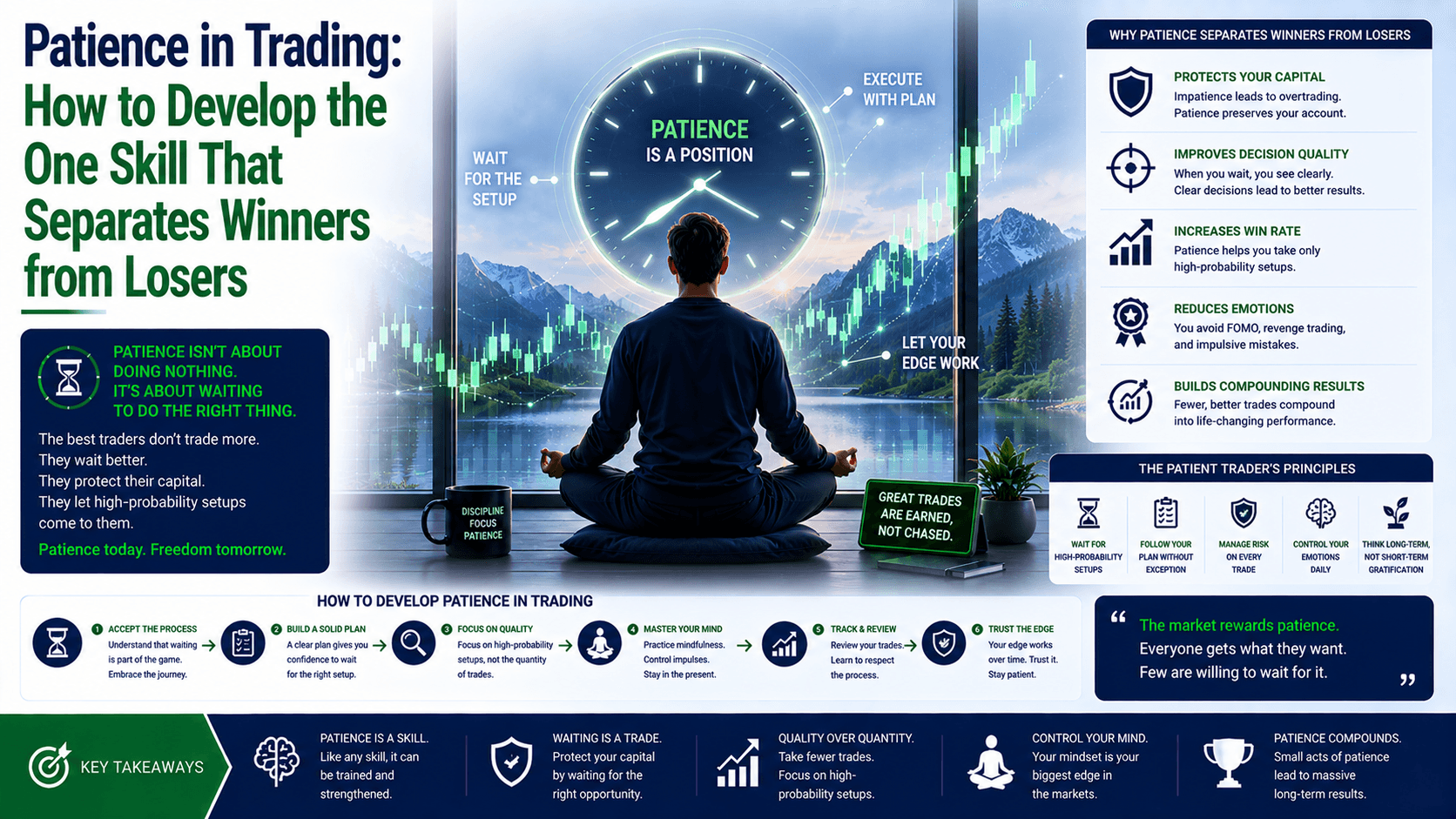
The market is a master at making you feel like you're missing the boat. Every candle that moves without you feels like a personal attack. But the reality? Patience in trading is the single biggest edge you can develop. And the good news? It's a skill you can train, just like any other.
In this article, I'm going to show you exactly how to develop patience in trading. Not with vague advice like "just be more disciplined." No. We're going to get practical. We're going to use real numbers, real scenarios, and real exercises that will rewire how you approach the markets.
Why Is Patience in Trading So Hard? (The $18 Mistake)
Let's start with why this is so difficult. It's not because you're weak. It's because your brain is wired to avoid missing out.
Imagine this: You have a $1,000 account. You see EUR/USD at 1.0850. It's been consolidating for hours, and you're bored. You think, "It's gotta break soon. I'll get in now."
You buy 0.1 lots. Stop loss at 1.0830 (20 pips). Target at 1.0880 (30 pips).
Price drops to 1.0828. Your stop gets hit. You lose $20.
Then, 30 minutes later, price rockets to 1.0885. Exactly where you thought it would go.
You just lost $20 because you couldn't wait for the actual breakout. That's $20 you didn't need to lose. Over a month of doing this 3-4 times? That's $60-$80 gone. On a $1,000 account, that's 6-8% of your capital. Wasted.
The cost of impatience isn't just missed profits. It's the gradual, painful erosion of your account.
Here's the thing: the market isn't going anywhere. It will be there tomorrow, next week, and next year. The only thing you're racing against is your own ego.
The "Observer" Exercise: Your First Step to Developing Patience
Most traders sit in front of their charts and feel this overwhelming pressure to do something. The screen is moving. You should be in a trade, right?
Wrong.
Here's the first exercise. I want you to try this tomorrow.
Step 1: Open your trading platform. Set a timer for 2 hours.
Step 2: You are not allowed to take a single trade. Zero. Nada. You can only watch.
Step 3: Write down every time you felt the urge to enter. What was happening on the chart? What were you feeling?
This is the "Observer" exercise. It sounds simple, but it's brutally hard. Your brain will scream at you to act. That's the point. You're training your brain to sit with the discomfort of doing nothing.
After two hours, look back at your notes. You'll probably see a pattern. Most of those "urgent" entry signals were actually terrible setups. You were just feeling FOMO.
Do this for 5 trading days. On day 6, you can take one trade. But only one. And only if it meets ALL your criteria.
The "One Trade Per Day" Rule: Kill Overtrading Forever
Overtrading is the biggest symptom of impatience. You take 15 trades a day, hoping one will stick. But each trade has a cost. Spreads. Commissions. And most importantly, emotional fatigue.

Here's a comparison that might change how you think:
| Trader | Trades Per Day | Win Rate | Avg. Risk Per Trade | Daily P&L (0.1 lots) |
|---|---|---|---|---|
| Impulsive Trader | 15 | 40% (6 winners, 9 losers) | $20 (20 pips) | 6 × $30 (wins) - 9 × $20 (losses) = $180 - $180 = $0 (before costs) |
| Patient Trader | 2 | 60% (1.2 winners, 0.8 losers) | $20 (20 pips) | 1.2 × $30 - 0.8 × $20 = $36 - $16 = +$20 |
The impulsive trader is spinning their wheels. They're paying spreads on 15 trades, dealing with the emotional rollercoaster of 15 entries and exits, and ending up at zero. The patient trader takes fewer trades, makes better decisions, and walks away with money in their pocket.
Your new rule: You are allowed a maximum of 2 trades per day. No exceptions. If you take a loss, you're done for the day. This forces you to be selective. You stop looking for "any" trade and start looking for the right trade.
The "Decision Timer": Stop Impulsive Entries Cold
Here's a scenario that used to kill me.
I'd be watching GBP/USD at 1.2650. Suddenly, it drops 15 pips in 2 minutes. My heart starts racing. "It's breaking down! I need to short it NOW!"
I'd enter at 1.2635. Stop at 1.2660 (25 pips). Target at 1.2600 (35 pips).
Price bounces 10 pips. I'm already in pain. I move my stop to breakeven at 1.2635. Price hits it. I'm out for nothing. Then it drops to 1.2590.
I just let a 45-pip move slip through my fingers because I entered on impulse.
The fix: The "Decision Timer."
When you feel that urge to enter a trade, set a timer for 30 minutes. Walk away from your screen. Go make a coffee. Read a book. Do anything but look at the chart.
After 30 minutes, come back. Ask yourself: "Is this trade still valid? Does it still meet my criteria?"
90% of the time, the answer will be no. The impulse will have passed. You'll see the market has moved on, and that "perfect" setup is gone.
This exercise is gold because it breaks the emotional feedback loop. The market moves, you feel fear/greed, you act. By inserting a 30-minute delay, you force your rational brain to catch up.
Why Being on the Sideline Is a Winning Position
Here's a mindset shift that changed everything for me.
Most traders think being out of the market means they're losing. They feel like they're not "in the game." So they jump into any trade just to feel like they're participating.
But here's the truth: cash is a position.
When you're in cash, you have zero risk. Zero exposure. Zero emotional baggage. You can see the market clearly, without the distortion of an open trade clouding your judgment.
Think about it. When you have an open position that's losing $50, are you really thinking clearly? No. You're hoping. You're praying. You're making decisions based on fear, not logic.
Being on the sideline is the most powerful position in trading. It's where you find the best setups. It's where you protect your capital. It's where you win.
The goal is not to be in a trade. The goal is to be in the right trade. And the right trades don't come every hour. They come a few times a week, maybe even a few times a month.
The "Frustration Tolerance" Drill: Train Yourself to Miss Opportunities
This one is going to hurt. But it's essential.
Pick one day this week where you deliberately let a good trade setup pass you by. You see it. You know it's valid. But you don't take it.
Watch it play out without you. Feel the frustration. Write it down in your journal. "I missed a 30-pip move on EUR/USD because I chose not to take it."
Why do this? Because it builds resilience. It teaches you that missing one trade is not the end of the world. There will be another one. And another one.
Most traders chase because they think every opportunity is the last one. It's not. The market creates thousands of opportunities every year. You only need a handful of good ones to build a career.
After doing this drill 3-4 times, you'll notice something. The fear of missing out starts to fade. You become calmer. You stop chasing. And ironically, you start catching more of the good trades because you're waiting for them.
FAQ
How long does it take to develop patience in trading?
It depends on how consistently you practice. Most traders see noticeable improvement after 2-3 weeks of doing exercises like the Observer and Decision Timer daily. Full mastery can take months, but the key is to start today.

What if I miss a good trade because I was being patient?
Good. Missing trades is part of the process. There will always be another opportunity. The goal is not to catch every move, but to catch the moves that fit your plan. Missing a trade is cheaper than taking a bad one.
Is patience the same as being slow?
No. Patience means waiting for the right setup. Being slow means hesitating when the setup appears. A patient trader acts decisively when their criteria are met. A slow trader hesitates out of fear.
Can I trade lower timeframes and still be patient?
Yes, but it's harder. Lower timeframes (1-minute, 5-minute) have more noise and require faster decisions. If you struggle with patience, start with higher timeframes (1-hour, 4-hour) where setups are fewer but more reliable.
Quick Recap
- Patience is the biggest edge you can develop. It separates profitable traders from those who blow accounts.
- Cost of impatience: losing $20-$80 per month on a $1,000 account through unnecessary trades.
- Exercise 1: The Observer — 2 hours of no-trade observation daily for 5 days.
- Exercise 2: One Trade Per Day — Forces selectivity and kills overtrading.
- Exercise 3: The Decision Timer — 30-minute delay before any entry.
- Cash is a position. Being on the sideline is winning.
- Drill: Deliberately miss a good trade to build frustration tolerance.
Quick Win: Your 5-Minute Action Step
Open your trading journal right now. Write down the last 3 trades you took that you regretted. Next to each one, write what would have happened if you had waited 30 minutes before entering.
Then, set a reminder on your phone for tomorrow morning: "Today, I am an observer. No trades. Only watch."
Do this one thing tomorrow. It's the first step to developing the patience that will save your account and transform your trading.
Now it's your turn. Start tomorrow. Don't miss this opportunity to change your approach.