
I remember my third month of trading like it was yesterday.
I had just blown a decent chunk of my account. Not because my analysis was wrong — but because I couldn't stop hitting the "buy" button.
EUR/USD moved 5 pips, I was in. Gold dropped $3, I was short. GBP/USD barely twitched, I had a position. By 2 PM, I'd taken 12 trades. By 5 PM, I'd lost $340 in commissions and bad entries.
That's overtrading. And if you've ever felt like you're "working hard" but your account keeps going down, you're probably doing it too.
What Is Overtrading?
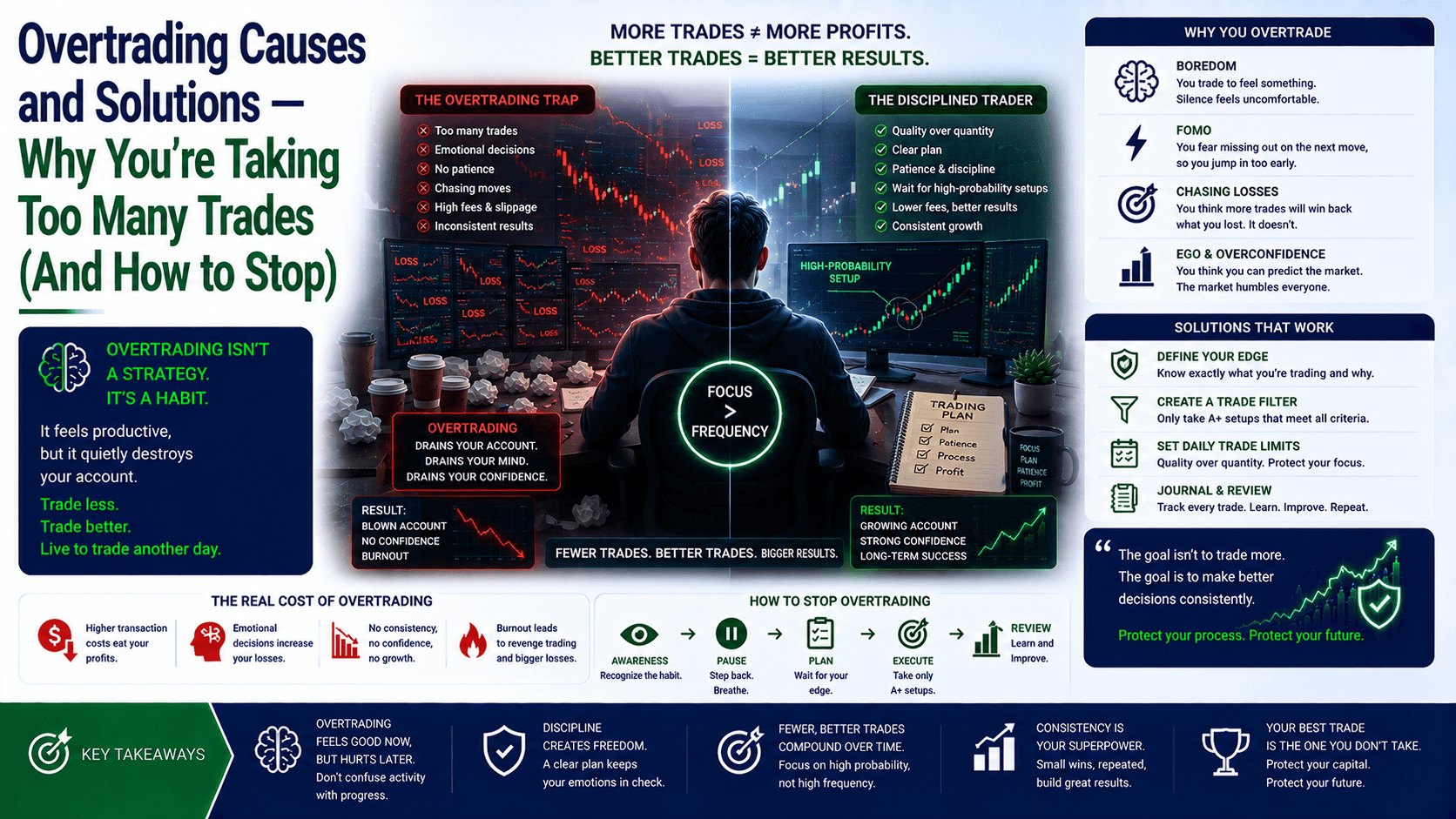
Overtrading is when you take trades that aren't justified by your strategy. It's not about the number of trades — it's about the reason behind each one.
If you enter a trade because your plan says "buy at support with a 1:2 risk-reward," that's trading. If you enter because "the chart is moving and I don't want to miss out," that's overtrading.
The scary part? Your brain rewards you for taking action. Every time you click "buy," you get a tiny dopamine hit — regardless of whether the trade works out. It's the same mechanism that keeps people glued to slot machines.
And just like a slot machine, it will drain your account if you don't stop.
3 Types of Overtrading (And Which One Is Killing Your Account)
Overtrading isn't one-size-fits-all. Let me show you the three most common types I see in TheNextTrade Academy students:
| Type | What It Looks Like | Real Example |
|---|---|---|
| Frequency Overtrading | Taking 10-20 trades a day without a valid setup for most of them | You take 15 trades in a day. 12 are losers. You lost $200 in spreads and commissions alone. |
| Volume Overtrading | Increasing position size beyond your risk rules | You normally risk $20 per trade. After a loss, you risk $80 to "get it back fast." |
| Emotional Overtrading | Trading because of boredom, anger, or FOMO — not strategy | You see Gold spike $15 in 10 minutes. You buy at the top. It reverses. You lose $150 in 5 minutes. |
Here's the thing: most traders have a mix of all three. The key is figuring out which one hits you hardest so you can fix it.
The Real Causes of Overtrading (It's Not What You Think)
Most articles will tell you overtrading is caused by "lack of discipline." That's like saying a car crash is caused by "bad driving." Technically true, but not helpful.

Let's get specific about the psychological causes that actually drive overtrading:
1. FOMO — The Silent Account Killer
You're watching GBP/USD rally 40 pips. You didn't catch the move. Your brain screams: "GET IN NOW OR YOU'LL MISS EVERYTHING."
So you enter at the top. Price reverses 30 pips. You're down $60 on a 0.1 lot trade. And you didn't even have a plan for the trade.
That's FOMO-driven overtrading. And it's the single biggest cause I see in beginners.
2. Revenge Trading After a Loss
You lose $50 on a bad trade. You're angry. You want to "get it back." So you take the next trade with triple your normal size — and no plan.
Now you're down $200 instead of $50. And the cycle repeats.
I've been there. I lost $800 in one afternoon doing exactly this. It took me weeks to recover — not just financially, but mentally.
3. Boredom and the "Need to Be in the Market"
The market is quiet. Nothing's happening. You feel like you're wasting time. So you take a trade just to feel like you're doing something.
This is the most deceptive form of overtrading. You don't even realize you're doing it. You think you're "staying active." In reality, you're slowly bleeding your account.
How Overtrading Destroys Your Performance (The Math)
Let me show you what overtrading actually costs you — in real numbers.
Scenario A (Smart Trading):
- You take 3 trades per day
- Each trade has a 1:2 risk-reward ratio
- You risk $20 per trade
- Win rate: 50%
- Daily result: 1.5 wins × $40 = $60, 1.5 losses × $20 = $30. Net: +$30
- Monthly (20 days): +$600
Scenario B (Overtrading):
- You take 12 trades per day
- Most trades have no clear risk-reward
- You risk $20 per trade (but sometimes more when emotional)
- Win rate: 35% (because you're taking low-quality setups)
- Daily result: 4.2 wins × $20 = $84, 7.8 losses × $20 = $156. Net: -$72
- Monthly (20 days): -$1,440
See the difference? The overtrading scenario doesn't just lose money — it loses more money every single day. And that's before you factor in the emotional damage.
Overtrading vs Active Trading: What's the Difference?
Not all frequent trading is bad. Scalpers and day traders take many trades — but they do it with a plan. Here's how to tell the difference:
| Criteria | Overtrading | Active Trading |
|---|---|---|
| Reason for trade | Emotion, FOMO, boredom | Clear setup from a strategy |
| Risk management | Inconsistent, often ignored | Fixed position sizes, always used |
| Trade frequency | Random, uncontrolled | Controlled, based on opportunities |
| Emotional state | Stressed, anxious, frustrated | Calm, focused |
| Long-term result | Account erosion, burnout | Consistent growth |
5 Practical Solutions to Stop Overtrading Today
Enough theory. Here's what actually works — and I've tested every single one of these myself.
1. Set a Daily Trade Limit — and Stick to It
Decide how many trades you're allowed to take per day. Write it down. Put it on a sticky note on your monitor.
For most beginners, 3-5 trades per day is plenty. If you're scalping, maybe 8-10. But set a hard limit and stop trading once you hit it — even if you're winning.
Why this works: It forces you to be selective. You won't waste your limited trades on garbage setups.
2. Use a Daily Loss Limit
Decide how much you're willing to lose in a single day. For most traders, 2-3% of your account is reasonable.
If you hit that limit, you're done for the day. Close the charts. Go for a walk. Come back tomorrow.
Real example: You have a $2,000 account. Your daily loss limit is $60 (3%). You lose $60 on your first two trades. Done. Close the platform. No more trading.
This saved me from blowing my account more times than I can count.
Most traders only log entry, exit, and P&L. That's not enough.
You need to answer these questions for every trade:
- Why did I take this trade?
- Was I calm or emotional?
- Did I follow my plan?
- What was I feeling before entering?
After a week, review your journal. You'll see patterns: "I always overtrade after a loss" or "I take bad trades when I'm bored."
Once you see the pattern, you can fix it.
4. Take Breaks — Real Breaks
Don't stare at charts for 8 hours straight. You'll see "opportunities" everywhere — even when there are none.
Set a timer. Trade for 30 minutes, then step away for 10. Walk around. Drink water. Look at something 20 feet away (your eyes need a break too).
When you come back, you'll see the market differently. You'll spot the garbage setups you would have taken when you were tired.
5. Create a Pre-Trade Checklist
Before every single trade, ask yourself these 3 questions:
- Does this trade match my strategy?
- Is my risk acceptable (1-2% of account)?
- Am I trading because of strategy or emotion?
If the answer to any question is "no," don't take the trade. It's that simple.
FAQ
What is the main cause of overtrading?
The main cause is emotional triggers — especially FOMO (fear of missing out) and revenge trading after a loss. These override your trading plan and lead to impulsive, unplanned trades.

How do I know if I'm overtrading?
If you're taking more than 5-10 trades a day without a clear strategy, or if you feel anxious when you're not in a trade, you're probably overtrading. Check your journal: if most trades lack a valid setup, that's the sign.
Can overtrading be fixed?
Yes. Set daily trade and loss limits, use a trading journal to track emotions, and take regular breaks. The key is self-awareness — once you see the pattern, you can break it.
Is it bad to trade every day?
Not necessarily. Professional traders trade daily, but they only take high-probability setups. The problem is trading every day without a plan or taking low-quality trades just to stay active.
Quick Recap
- Overtrading is taking trades based on emotion, not strategy
- The main causes are FOMO, revenge trading, and boredom
- Set a daily trade limit (3-5 for most beginners)
- Use a daily loss limit (2-3% of account)
- Keep a journal that tracks emotions, not just numbers
- Take breaks every 30 minutes to reset your focus
Quick Win
Open your trading journal right now. Find the last 10 trades you took. For each one, write down: "Did I have a clear, pre-defined setup for this trade?" If more than 3 trades were taken without a setup, you have an overtrading problem. Your first fix: tomorrow, take no more than 3 trades — and only take them if your exact setup appears. That's it. Start there.