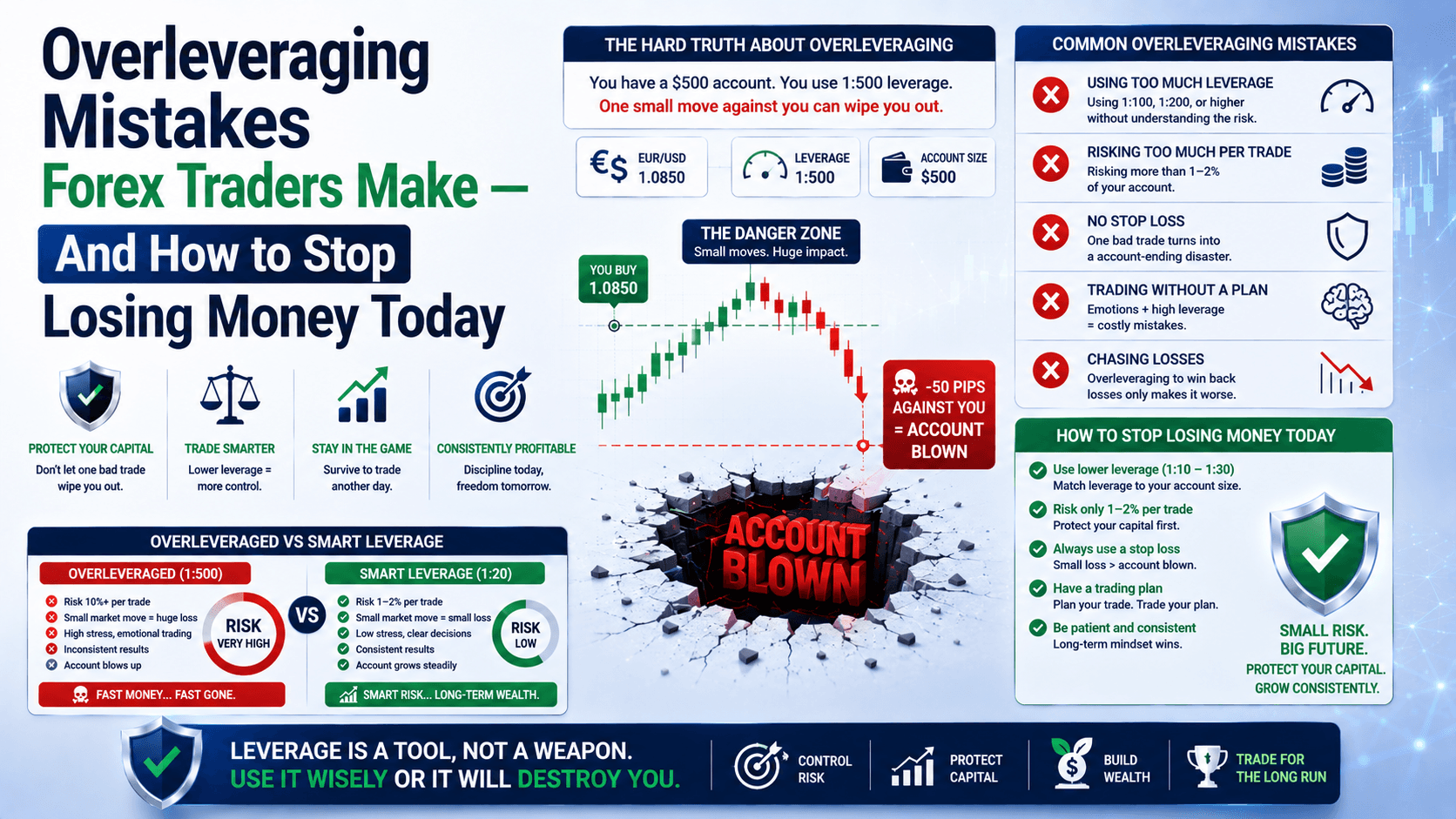

Here's the Hard Truth About Overleveraging
You open your trading platform. You see EUR/USD at 1.0850. Your $500 account feels small. But with 1:500 leverage, you can control $250,000 worth of currency. That's a full 2.5 standard lots.
One 20-pip move against you? That's a $500 loss. Your entire account. Gone.
This is the reality of overleveraging mistakes forex traders make every single day. And it's the #1 reason 90% of beginners blow their accounts within the first 3 months.
I know because I did it myself. Blew a $2,000 account in 2 days trading Gold with 1:200 leverage. Thought I was smart. Turns out I was just fast at losing money.
Let's fix that. Right now.
What Actually Is Overleveraging? (The Simple Version)
Overleveraging means you're controlling a position size that's way bigger than your account can handle. It's like borrowing $100,000 to bet on a horse when you only have $500 in your pocket.
Here's how it works with real numbers:
- You have a $1,000 account
- Your broker offers 1:500 leverage
- You open a 1.0 lot position on EUR/USD (that's $100,000 notional value)
- Each pip = $10
- A 20-pip loss = -$200 = 20% of your account
- A 50-pip loss = -$500 = half your account
One normal Tuesday movement. And you're down 50%.
That's overleveraging. And it's the fastest way to get a margin call.
The 3 Most Common Overleveraging Mistakes Forex Traders Make
After teaching thousands of students, I see the same three patterns over and over. Here they are — with the fix for each.

Mistake #1: Using Max Leverage Because "More Is Better"
Your broker offers 1:500 leverage. You think: "Great, I can make 500x more profit!"
Wrong. Leverage is a magnifying glass — for losses too.
The fix: Use leverage like a scalpel, not a sledgehammer. For a $1,000 account, treat 1:30 as your maximum. Here's why:
| Leverage | Max Lot Size (Per Trade) | 20-Pip Loss | % of $1,000 Account |
|---|---|---|---|
| 1:500 | 1.0 lot | -$200 | 20% |
| 1:100 | 0.2 lots | -$40 | 4% |
| 1:30 | 0.06 lots | -$12 | 1.2% |
See the difference? Same market move. But the 1:30 trader survives to trade another day.
Mistake #2: Ignoring Stop-Losses Because "It Will Come Back"
You're in a trade. It goes against you by 10 pips. Then 20. Then 30. You tell yourself: "It'll reverse. I'll wait."
This is how $50 losses become $500 losses.
The fix: Set your stop-loss BEFORE you enter the trade. Not after. Not "in your head." On the platform.
Here's a simple rule: Risk no more than 2% of your account per trade. For a $1,000 account, that's $20 max. Calculate your lot size so your stop-loss distance equals $20 risk.
Example: EUR/USD at 1.0850. Stop at 1.0830 (20 pips). $20 risk / 20 pips = $1 per pip = 0.1 lots. Done. Simple.
Mistake #3: Revenge Trading After a Loss
You just lost $100. Your heart is pounding. You want it back. Now. So you double your position size to "recover fast."
This is the revenge trading trap. And it's the most dangerous overleveraging mistake of all.
The fix: After any losing trade, walk away for 30 minutes. No charts. No trading. Go make coffee. Take a walk. Do anything except trade.
Your emotions are at their worst after a loss. And emotional traders make expensive decisions.
The Right Way to Use Leverage — Step by Step
Ready to actually use leverage safely? Here's your checklist:
Step 1: Know your account size. Write it down. For this example: $1,000.
Step 2: Decide your max risk per trade. I recommend 1-2%. Let's use 2% = $20.
Step 3: Find your stop-loss distance. Say you're trading EUR/USD and your analysis says support is 20 pips below entry. That's your stop.
Step 4: Calculate your lot size: $20 risk ÷ 20 pips = $1 per pip = 0.1 lots.
Step 5: Enter the trade. Set your stop-loss and take-profit immediately.
That's it. No complicated math. No guessing. Just disciplined risk management.
Overleveraging vs. Smart Leveraging — The Comparison
| Overleveraging Trader | Smart Leveraging Trader | |
|---|---|---|
| Account Size | $1,000 | $1,000 |
| Leverage Used | 1:500 | 1:30 |
| Lot Size | 1.0 lot | 0.1 lots |
| Stop-Loss | None ("I'll watch it") | 20 pips (set on platform) |
| Risk Per Trade | Unlimited | $20 (2%) |
| After 10 Consecutive Losses | Account blown | Account at $800 (still trading) |
| Emotional State | Panic, fear, revenge | Calm, disciplined, learning |
Which trader do you want to be?
FAQ
What is overleveraging in forex?
Overleveraging is when you control a position size much larger than your account can handle. For example, a $1,000 account trading 1.0 lots on EUR/USD is overleveraged because a 20-pip move can wipe out 20% of your account.

How much leverage should a beginner use?
Beginners should use low leverage — ideally 1:10 to 1:30. Focus on smaller lot sizes (0.01 to 0.1 lots) so you can survive normal market moves while you learn.
Can you trade forex without leverage?
Yes. Trading without leverage means you only trade with your own capital. For example, a $1,000 account can only control $1,000 worth of currency. Profits and losses are smaller, but so is the risk.
What happens if I get a margin call?
A margin call happens when your account equity drops below the required margin. Your broker will close your losing positions automatically to prevent further losses. This can wipe out your account in minutes if you're overleveraged.
Quick Recap — 5 Rules to Avoid Overleveraging Mistakes
- Risk 1-2% per trade — never more
- Use low leverage — 1:30 or less for beginners
- Always set a stop-loss — before you enter
- Calculate lot size based on your risk, not your greed
- Walk away after losses — revenge trading kills accounts
Your Quick Win (Do This Now)
Open your trading platform right now. Look at your current open positions. Calculate the total risk if all of them hit your stop-loss. If that number is more than 5% of your account, close some positions immediately.
Then go to your account settings and lower your maximum leverage to 1:30. Most brokers let you do this in 30 seconds.
This one change will save you thousands of dollars. Trust me.