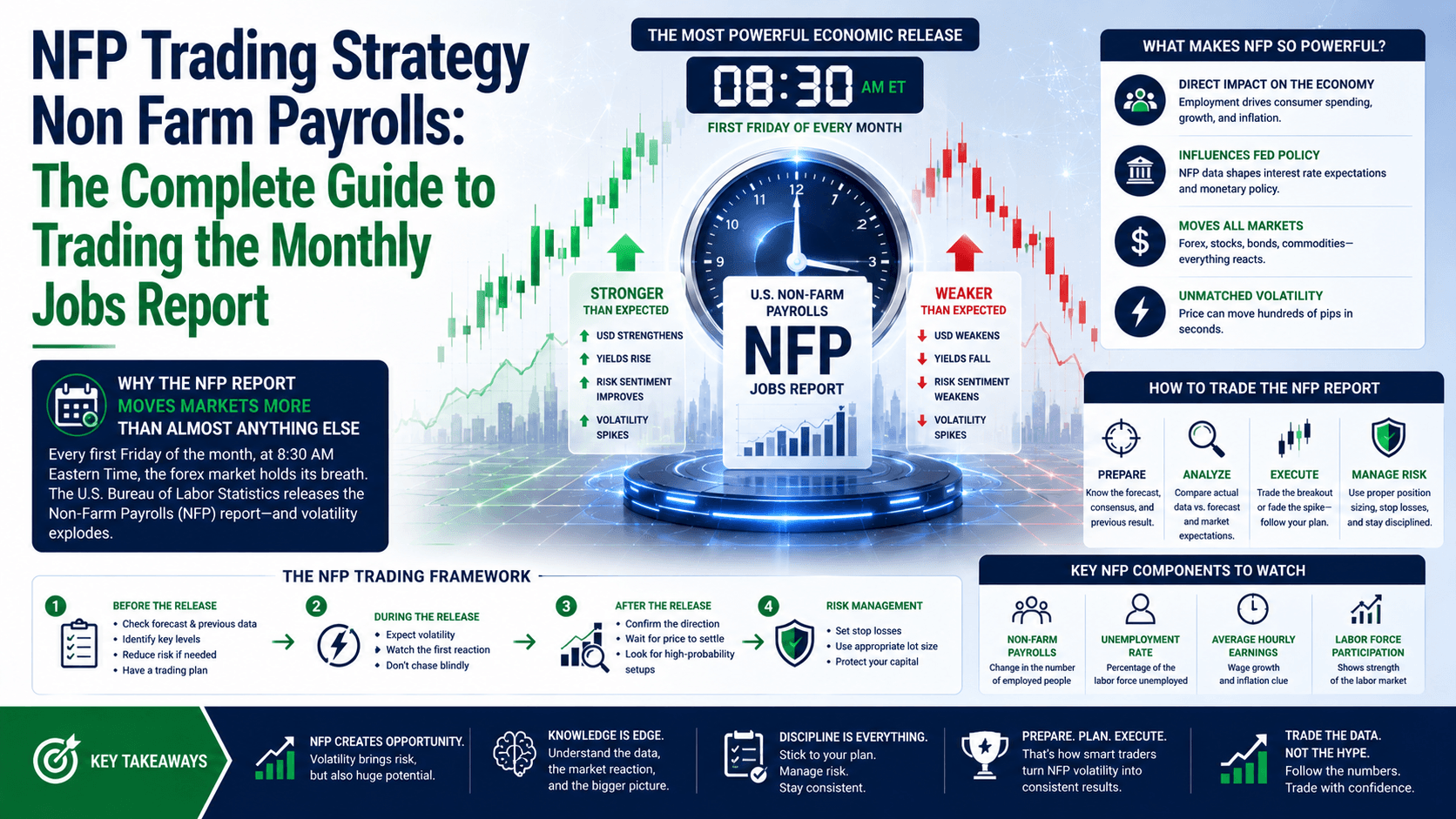

Why the NFP Report Moves Markets More Than Almost Anything Else
Every first Friday of the month, at 8:30 AM Eastern Time, the forex market holds its breath. The U.S. Bureau of Labor Statistics releases the Non-Farm Payrolls (NFP) report, and within seconds, currency pairs can swing 50, 80, even 120 pips in a single direction.
For context: on a normal day, EUR/USD might move 60-80 pips total. On NFP Friday, that entire move can happen in the first 15 minutes. The reason is straightforward — employment data directly influences Federal Reserve interest rate decisions, and rate expectations drive currency flows.
But here's the problem most traders face: the initial reaction is often a trap. The market spikes one way, reverses violently, and retail traders get stopped out before they can blink. This guide will show you a proven NFP trading strategy non farm payrolls that professional traders use to navigate this volatility — not fight it.
What Is Non-Farm Payrolls and Why Does It Matter?
The NFP report measures the total number of paid workers in the U.S. economy, excluding farm workers, government employees, private household staff, and nonprofit organization workers. It's published monthly by the Bureau of Labor Statistics, typically on the first Friday at 8:30 AM ET (13:30 GMT).
The headline number — jobs added or lost — gets all the attention. But the report contains three critical components:
- Headline NFP figure: Month-over-month change in non-farm employment
- Unemployment rate: Percentage of the labor force actively seeking work
- Average hourly earnings: Wage growth data, which signals inflation pressure
Data from the Federal Reserve shows that employment is one of the two pillars of its dual mandate (alongside price stability). A strong job market gives the Fed room to keep rates higher. A weakening job market increases pressure to cut rates. This direct line to monetary policy is why NFP consistently ranks as one of the most market-moving events in the forex calendar.
How to Read the NFP Report: The Three Scenarios
Before the release, analysts survey economists and publish a consensus forecast. The market has already priced in this expectation. What matters is the deviation between the actual number and the forecast.
| Scenario | Typical USD Reaction | Why It Happens |
|---|---|---|
| Actual > Forecast (beat) | USD strengthens | Strong job growth suggests economic expansion, supporting higher rates |
| Actual ≈ Forecast (in line) | Mixed / muted | Market has already priced in expectations; focus shifts to subcomponents |
| Actual < Forecast (miss) | USD weakens | Weak hiring signals economic slowdown, increasing rate cut expectations |
⚠️ Critical nuance: The market doesn't always react as expected. A strong NFP beat can sometimes trigger USD weakness if wage growth is weak, because traders focus on the inflation implications. Always check the full report — not just the headline.
The Wrong Way to Trade NFP (And Why Most Beginners Lose)
Let's walk through a realistic scenario. It's 8:28 AM ET. EUR/USD is trading at 1.0850. The forecast is for 200,000 new jobs.

A beginner sees the price consolidating in a tight 10-pip range. They think: "I'll place a buy stop at 1.0860 and a sell stop at 1.0840. Whichever direction breaks, I'll catch the move."
The report drops: 285,000 jobs — a massive beat. EUR/USD spikes down to 1.0800 in 30 seconds. The sell stop triggers at 1.0840. But by the time the order fills, price has already moved to 1.0820 due to slippage. The trader is now short from 1.0820.
Then, 10 minutes later, EUR/USD reverses to 1.0860. The trader's stop loss (placed 20 pips away) gets hit. Loss: $40 on 0.1 lots.
What went wrong? Three things:
- They traded during the initial volatility spike (highest risk)
- They didn't account for slippage and spread widening
- They had no plan for the reversal that often follows the initial move
The Professional NFP Trading Strategy Non Farm Payrolls
Experienced traders use a different approach. Instead of trying to catch the initial move, they wait for what's called the NFP drift — the more sustainable price movement that develops 2-3 hours after the release.
Here's the step-by-step process:
Step 1: Pre-Release Preparation (1-2 Days Before)
- Check the economic calendar for the exact release time and consensus forecast
- Identify key support and resistance levels on the 1-hour chart for your chosen pair (EUR/USD is the most liquid)
- Note the previous month's NFP figure and any revisions
- Reduce position sizes — plan to trade half your normal lot size
Step 2: The First 30 Minutes — Do Nothing
This is the hardest part for most traders. The initial spike is driven by algorithms and knee-jerk reactions. Spreads can widen from 1 pip to 5-10 pips. Slippage is common. The odds of getting a good fill are terrible.
Instead, open a 15-minute chart and simply watch. Note where price spikes to, where it finds resistance, and how it behaves around the pre-release range.
Step 3: Identify the Drift (2-3 Hours After Release)
By 10:30-11:00 AM ET, the market has typically settled into a clearer direction. Look for:
- A defined trend on the 15-minute or 1-hour chart
- Pullbacks to key levels (previous support/resistance, Fibonacci retracements)
- Confirmation from the NFP subcomponents (wage growth, unemployment rate)
Step 4: Execute With Proper Risk Management
Example trade: Let's say NFP beat expectations by 85,000 jobs. EUR/USD initially dropped to 1.0780, then settled into a downtrend. By 11:00 AM, it's trading at 1.0760 and has pulled back to a resistance level at 1.0775.
- Entry: Short at 1.0775 (after confirming the pullback holds)
- Stop loss: 1.0805 (30 pips above entry — wider than normal due to volatility)
- Take profit: 1.0725 (50 pips)
- Position size: 0.05 lots (half your normal size on a $2,000 account)
- Risk: 30 pips × $0.50/pip = $15 (0.75% of account)
- Reward: 50 pips × $0.50/pip = $25 (1.25% of account)
- Risk:Reward: 1:1.67
By waiting for the drift, you avoid the initial chaos while still capturing a meaningful portion of the NFP-driven move.
Comparison: NFP Trading Strategies
| Strategy | When to Use | Risk Level | Success Rate (Historical) |
|---|---|---|---|
| Fade the Initial Spike | When initial move seems overdone (e.g., 80+ pip move in 5 minutes) | High | ~40-50% (timing is critical) |
| Breakout with Pending Orders | When pre-NFP range is tight and clear | Medium-High | ~50-60% (but slippage hurts) |
| Wait for the Drift (Recommended) | Always — this is the most reliable approach | Medium | ~65-75% (lower risk, consistent results) |
| Post-Market Trend (Monday) | When you want to avoid all NFP volatility | Low-Medium | ~60-70% (misses Friday moves) |
Risk Management During NFP: Non-Negotiable Rules
The volatility that makes NFP profitable also makes it dangerous. Here are the rules that protect your account:
- Halve your position size: If you normally trade 0.1 lots, trade 0.05 lots on NFP day
- Widen your stops: Add 10-15 pips to your normal stop distance to account for volatility
- No trading during the first 15 minutes: Spreads are widest, slippage is highest
- Use limit orders, not market orders: Market orders during NFP can fill at terrible prices
- Know your max loss for the day: If you lose 3% of your account, stop trading
FAQ
What is the best NFP trading strategy non farm payrolls for beginners?
The safest approach is to wait 2-3 hours after the release for the market to settle, then trade in the direction of the established trend with half your normal position size and wider stops.

How much does EUR/USD typically move on NFP day?
EUR/USD averages 80-120 pips of total range on NFP Friday, compared to 50-70 pips on a normal day. The initial 15-minute spike alone can be 30-50 pips.
Should I trade NFP with a small account?
Yes, but reduce your risk. On a $500 account, trade 0.01 lots (10 cents per pip). A 50-pip move costs you $5. Keep risk per trade under 2% of your account.
What pairs are most affected by NFP?
EUR/USD, GBP/USD, USD/JPY, and USD/CHF are the most responsive. Gold (XAU/USD) also moves significantly due to its inverse correlation with the dollar.
Quick Recap
- NFP is released on the first Friday of each month at 8:30 AM ET
- The market reaction depends on the deviation between actual and forecast numbers
- Don't trade the first 15-30 minutes — spreads widen and slippage is common
- The most reliable NFP trading strategy non farm payrolls is to wait for the drift (2-3 hours post-release)
- Halve your position size, widen your stops, and always use stop-loss orders
Quick Win: Your 5-Minute NFP Prep
Open your economic calendar right now. Find the next NFP release date. Write down the forecast and previous month's number. Mark 8:30 AM ET on your calendar. Then open EUR/USD on the 1-hour chart and identify the key support and resistance levels from the past week. That's your framework. Everything else is execution.