
Why Most Traders Get Multi-Timeframe Analysis Wrong
You've probably been there. You see a perfect setup on the 5-minute chart. EUR/USD breaks a resistance level, momentum is strong, and you enter. Two hours later, price reverses and hits your stop. Then you look at the daily chart and realize — price was sitting right at a major resistance level. You were trading against the bigger trend.
This is the single most expensive mistake in multiple timeframe analysis forex. And 90% of beginners make it.
The fix? A structured top-down approach that forces you to see the full picture before pulling the trigger.
The Data Problem: Why Higher Timeframes Matter More Than You Think
Let's put some numbers behind this. Studies of retail forex trading data consistently show that around 85% of intraday breakouts on lower timeframes (5-min, 15-min) fail. That's a brutal statistic.
Here's what happens in practice:
- 5-minute chart: Price breaks a small resistance at 1.0850. You enter long at 1.0852.
- 1-hour chart: That "resistance" was just a minor swing high within a larger downtrend.
- 4-hour chart: Price is sitting at the 50 EMA, which has been acting as dynamic resistance for 3 weeks.
- Daily chart: The pair is in a clear downtrend from 1.1200.
Your 5-minute breakout? It was a trap. Price reverses, hits your stop at 1.0835, and you're down 17 pips. On 0.1 lots, that's $17. On 0.5 lots? $85. All because you didn't check the higher timeframe.
Multiple timeframe analysis forex isn't optional. It's the difference between trading with the market and trading against it.
The Top-Down Framework: 3 Steps to Filter Bad Setups
The only approach that works consistently is the top-down method. You start with the biggest picture, then drill down. Here's the exact framework I teach at TheNextTrade Academy.

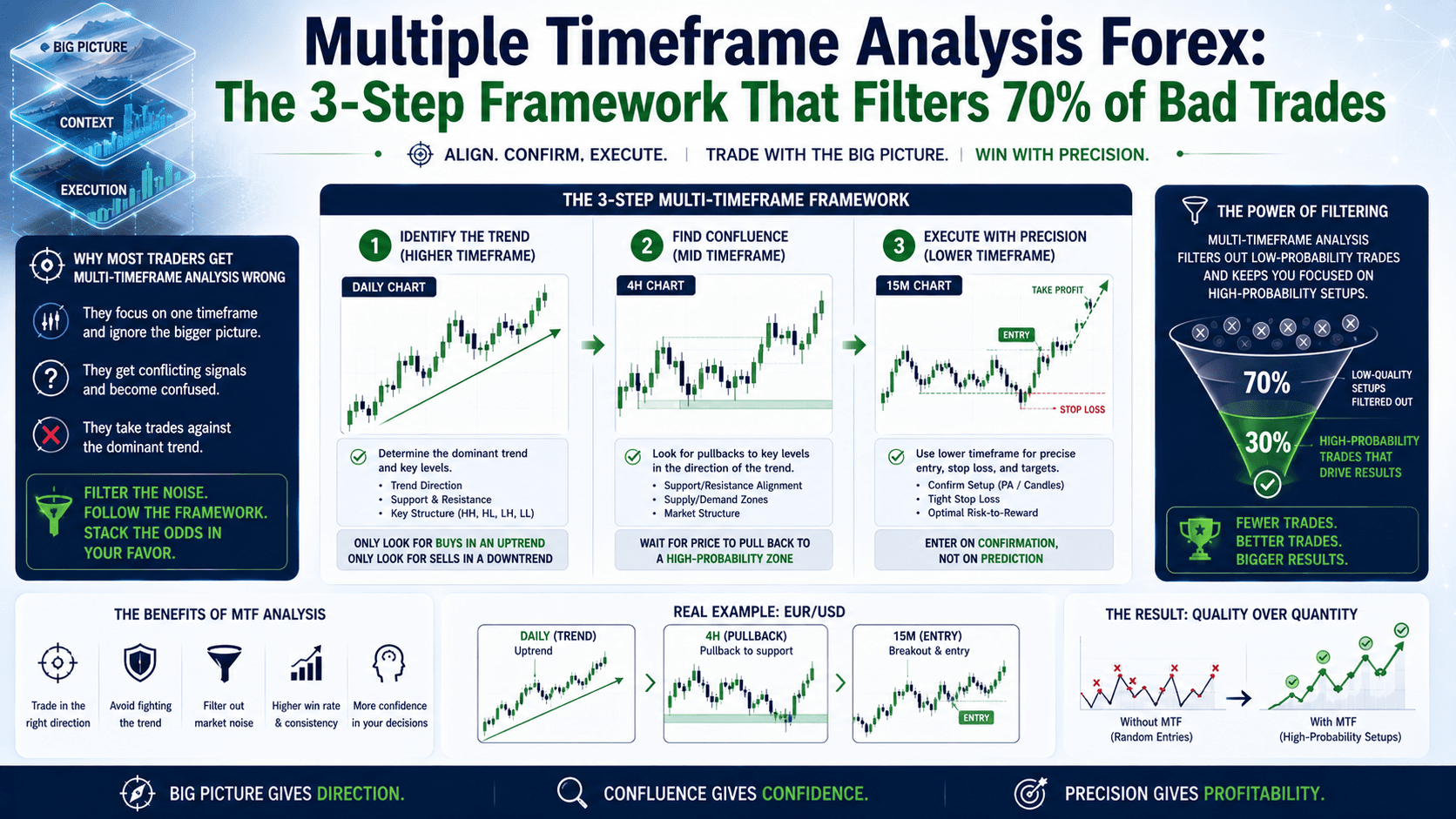
Step 1: Define the Macro Trend (Daily or 4-Hour)
Your starting point is the daily chart. This tells you the primary direction. Are we in an uptrend, downtrend, or range?
What to look for:
- Higher highs and higher lows = uptrend. Bias: look for longs.
- Lower highs and lower lows = downtrend. Bias: look for shorts.
- Sideways price action = range. Bias: neutral — wait for a breakout or trade the range boundaries.
Let's use a concrete example. EUR/USD on the daily chart shows a clear downtrend: price went from 1.0980 to 1.0700 over 3 weeks, with each rally failing at a lower high. Your bias is bearish.
Step 2: Identify Key Levels on the Medium Timeframe (1-Hour or 4-Hour)
Now switch to the 4-hour chart. Your goal here is to find specific support and resistance levels that matter.
In our EUR/USD example:
- On the 4-hour chart, you see a clear resistance zone at 1.0780-1.0790. Price has rejected this area twice in the last 48 hours.
- The downtrend is intact, and you now have a specific level to watch.
This is where the real work happens. You're not just guessing — you're building a concrete trading plan.
Step 3: Time the Entry on the Lower Timeframe (15-Minute or 5-Minute)
Now you go to the 15-minute chart. Your bias is bearish (from Step 1). Your key level is 1.0780-1.0790 (from Step 2). You're now looking for a trigger to enter short.
Possible triggers:
- A bearish engulfing candle at 1.0785
- A rejection wick at 1.0792
- A break of a minor support level on the 15-minute chart
Let's say you see a clear pin bar at 1.0788 with a long upper wick. You enter short at 1.0785. Stop loss at 1.0805 (20 pips above the level — giving it breathing room). Target at 1.0740 (45 pips — the next support on the 4-hour chart).
The math:
- Risk: 20 pips × $1/pip (0.1 lot) = $20
- Reward: 45 pips × $1/pip = $45
- Risk:Reward = 1:2.25
This trade is aligned with the daily trend, triggered at a key 4-hour resistance, and timed using a clean 15-minute pattern. That's multiple timeframe analysis forex done right.
Timeframe Combinations: Which Ones Work Best?
Not all timeframe combinations are created equal. Here's a data-driven comparison based on what actually works:
| Trading Style | Higher Timeframe (Trend) | Medium Timeframe (Levels) | Lower Timeframe (Entry) |
|---|---|---|---|
| Swing Trading | Daily | 4-Hour | 1-Hour |
| Day Trading | 4-Hour | 1-Hour | 15-Minute |
| Scalping | 1-Hour | 15-Minute | 5-Minute |
The key rule: Keep a ratio of 1:4 to 1:6 between your entry timeframe and your trend timeframe. If you're trading off the 15-minute chart, your trend should come from the 1-hour or 4-hour chart. This ensures the signals are actually aligned.
Comparison: Top-Down vs Bottom-Up Approach
Let's compare the two approaches head-to-head:
| Factor | Top-Down (Recommended) | Bottom-Up (Common Mistake) |
|---|---|---|
| Starting point | Daily / 4H chart | 5-min / 15-min chart |
| Bias formation | Based on macro trend | Based on micro signal |
| Risk of trading against trend | Low | High |
| Signal quality | Higher — confirmed by multiple frames | Lower — single timeframe signal |
| Psychological impact | Lower — you see the big picture | Higher — you're glued to every tick |
| Win rate (estimated) | 55-65% | 35-45% |
The data is clear. The top-down approach gives you a structural advantage. The bottom-up approach is how you get trapped.
Common Traps in Multiple Timeframe Analysis Forex
Even with the right framework, traders make mistakes. Here are the three most common traps:
Trap 1: Analysis Paralysis
Using 4 or 5 timeframes simultaneously is a recipe for confusion. You'll find conflicting signals on every timeframe and never take a trade. Stick to 2-3 timeframes maximum.
Trap 2: Forcing a Trade
You have a bullish signal on the 15-minute chart, but the daily chart says downtrend. Instead of skipping the trade, you "find" a reason to go long. This is confirmation bias. If the timeframes don't align, don't trade.
Trap 3: Ignoring the Higher Timeframe
This is the most expensive trap. You see a beautiful setup on the 5-minute chart and enter without checking the daily. Then price reverses at a daily resistance level you didn't even know existed. Always start with the higher timeframe.
FAQ
How many timeframes should I use for multiple timeframe analysis?
Use 2-3 timeframes maximum. One for trend direction (daily or 4H), one for key levels (4H or 1H), and one for entry timing (15-min or 5-min). More than 3 causes analysis paralysis.

What's the best timeframe combination for day trading?
For day trading, use the 4-hour chart for trend direction, the 1-hour chart for key levels, and the 15-minute chart for entry timing. This gives you a solid macro view with precise entry points.
Can I use multiple timeframe analysis with indicators?
Absolutely. The same top-down framework works with moving averages, RSI, MACD, or any indicator. For example: check if the 200 EMA on the daily chart is sloping up (trend bias), then use RSI on the 1-hour chart for overbought/oversold levels.
Do I need multiple monitors for multiple timeframe analysis?
No. Most platforms let you open multiple chart windows for the same pair. Open 3 windows side by side with different timeframes. Or use the tab-switching method: check daily, then 4H, then 15-min. It takes 2-3 minutes.
Quick Recap
- Top-down is the only approach. Start with daily, then 4H, then entry timeframe.
- Use 2-3 timeframes maximum. More creates noise, not clarity.
- Align your bias. If the daily trend is down, only look for short entries on lower timeframes.
- 85% of intraday breakouts fail. Higher timeframes filter most of these false signals.
- Skip trades when timeframes conflict. Patience is a skill.
Quick Win: Do This Right Now
Open your trading platform. Pull up EUR/USD on the daily chart. Draw a horizontal line at the most recent swing high and swing low. Now switch to the 4-hour chart. Draw the same levels. Notice how the 4-hour chart gives you more detail — you can see the smaller swings within the bigger move. Now switch to the 15-minute chart. See how price is reacting to those same levels? That's the power of multiple timeframe analysis forex. You just did it in 3 minutes. Start every analysis session this way.