
The Two Titans of Trading: A Decision That Matters
You're ready to start trading. You've chosen a broker. Now comes the question that stops most beginners cold: MT4 vs MT5 which is better?
It's a fair question. MetaTrader 4 (MT4) and MetaTrader 5 (MT5) are the two most popular trading platforms in the world, developed by MetaQuotes Software. Combined, they power millions of accounts globally. But they are not the same tool, and choosing incorrectly can cost you time, money, and opportunity.
Let's cut through the noise. This isn't about which platform is "newer" or "more popular." It's about which platform matches your specific trading goals. We'll examine the data, the features, and the real-world trade-offs so you can make an informed decision today.
What Is the MetaTrader Platform? Your Trading Command Center
Think of MetaTrader as the operating system for your trading activity. It's where you analyze charts, place trades, manage risk, and review your performance. Both MT4 and MT5 serve this core function, but they were built for different eras and different traders.
MetaTrader 4 launched in 2005. It was designed specifically for forex trading and became the industry standard. Its interface is clean, its system requirements are low, and its stability is legendary.
MetaTrader 5 launched in 2010. It was built as a multi-asset platform capable of handling forex, stocks, commodities, indices, futures, and even cryptocurrencies. It's more powerful, more complex, and demands more from your hardware.
The key distinction: MT4 is a specialized tool for forex. MT5 is a multi-purpose workstation for all markets.
MT4 vs MT5: The Core Differences That Matter
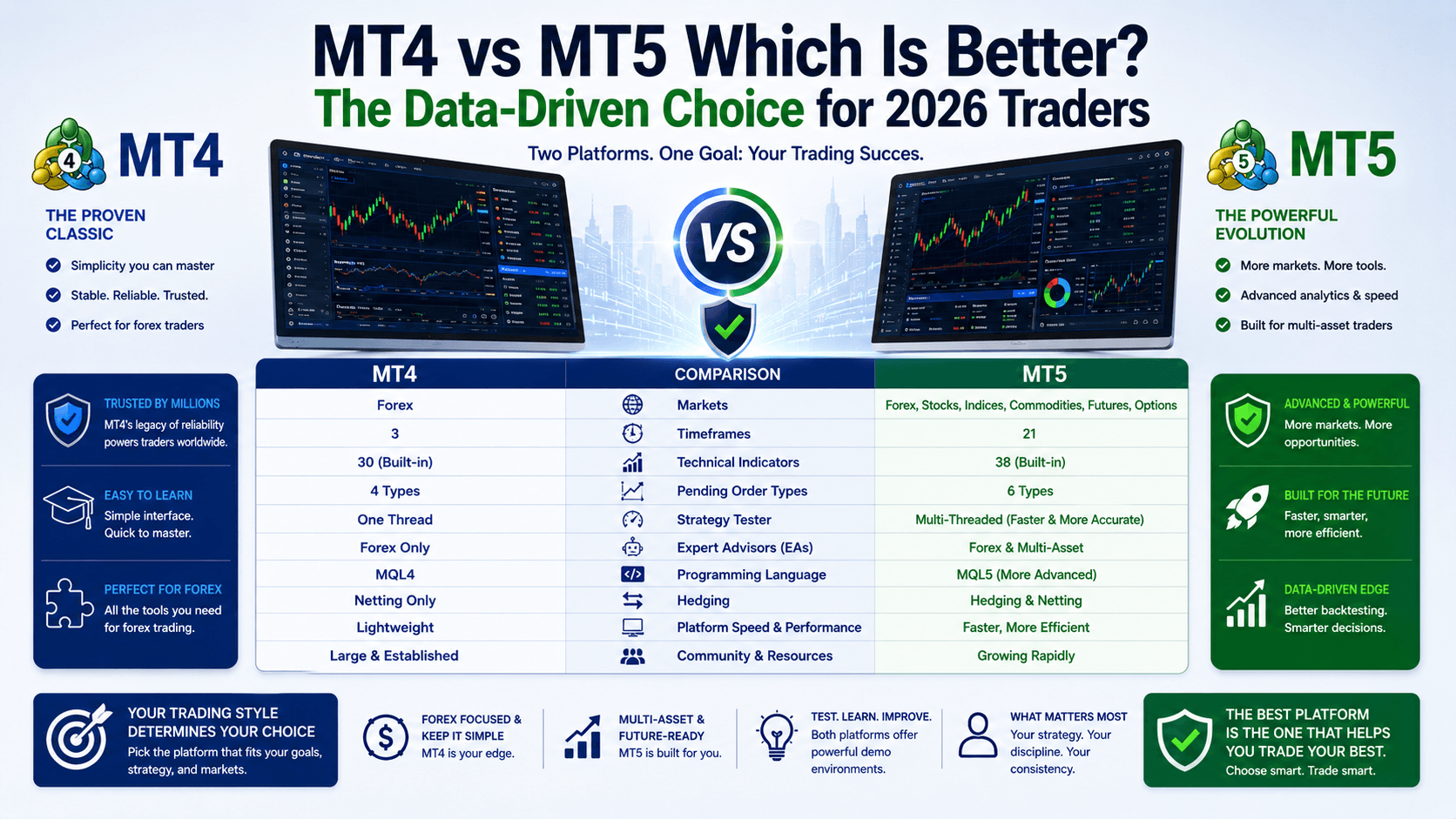
Let's go beyond the marketing claims and look at the measurable differences. This comparison table covers the essential parameters every trader should evaluate.

| Feature | MetaTrader 4 (MT4) | MetaTrader 5 (MT5) |
|---|---|---|
| Primary Market Focus | Forex, CFDs | Forex, CFDs, Stocks, Futures, Indices, Commodities, Crypto |
| Built-in Technical Indicators | 30 | 38 |
| Timeframes | 9 | 21 |
| Pending Order Types | 4 | 6 |
| Order Execution Policies | Fill or Kill | Fill or Kill, Immediate or Cancel, Return |
| Partial Order Fill | No | Yes |
| Depth of Market (DOM) | No | Yes |
| Economic Calendar | Not built-in | Built-in |
| Programming Language | MQL4 | MQL5 (object-oriented) |
| Strategy Tester | Single-threaded | Multi-threaded, multi-currency |
| Funds Transfer Between Accounts | No | Yes |
| System Requirements | Low | Higher |
| Community & EA Library | Vast, mature | Growing, but smaller |
Notice the pattern: MT5 offers more of everything — more timeframes, more indicators, more order types, more markets. But "more" isn't always "better." It depends on what you need.
Why Choose MT4? The Case for Proven Reliability
If your primary focus is forex trading, MT4 remains a powerful and practical choice. Here's why experienced traders still prefer it.
Simplicity and speed. MT4's interface is intuitive. A beginner can open a chart, apply a moving average, and place a trade within minutes. The learning curve is shallow. The platform runs smoothly on older computers and slower internet connections, which matters if you're trading from a less-than-ideal setup.
Massive community and EA library. MT4 has been the dominant platform for nearly two decades. The result? Thousands of free and paid Expert Advisors (EAs), custom indicators, and scripts. If you want to automate a strategy, the odds are high that someone has already built it for MT4. This is not true for MT5.
Proven stability. During high-volatility events like Non-Farm Payrolls or central bank announcements, MT4 holds up. Its simpler architecture means fewer potential points of failure. For a pure forex trader, this reliability is worth more than extra timeframes.
The trade-off: You are limited to forex and CFDs. You cannot trade stocks, futures, or indices directly from MT4 without using a CFD wrapper. You have fewer analytical tools. And you cannot access Depth of Market data.
Why Choose MT5? The Case for Modern Trading
If you trade multiple asset classes or need advanced analytical capabilities, MT5 is the superior platform. The data supports this.
Broader market access. MT5 was built for multi-asset trading. You can trade forex, stocks, indices, commodities, futures, and cryptocurrencies from a single platform. This eliminates the need to juggle multiple applications.
Advanced technical analysis. With 21 timeframes (vs. 9 on MT4) and 38 built-in indicators, MT5 allows for more granular chart analysis. The additional graphical objects — 44 in total — include advanced drawing tools for Gann, Fibonacci, and Elliott Wave analysis.
Superior backtesting. MT5's strategy tester is multi-threaded and supports multi-currency testing. This means you can test a strategy across multiple symbols simultaneously, using real tick data. The results are more accurate and the process is faster. For any trader serious about algorithmic trading, this is a decisive advantage.
Modern features. The built-in economic calendar, Depth of Market, and partial order fill policies give MT5 capabilities that MT4 simply cannot match. The netting system, which allows only one position per instrument, is preferred by many professional traders.
The trade-off: MT5 has a steeper learning curve. Its EA library is smaller. It requires more system resources. And some brokers still prioritize MT4 support, though this is changing rapidly.
Wrong Way vs. Right Way: A Real Trading Scenario
Let's make this concrete. Imagine you are a trader who wants to automate a simple moving average crossover strategy on EUR/USD.
The Wrong Way: You choose MT5 because it's "newer." You spend two weeks learning MQL5, a more complex programming language. You find that the EA you wanted to use was built for MQL4 and doesn't work on MT5. You either rebuild it from scratch or settle for a less tested alternative. Your strategy goes live later than planned, and you miss a profitable month.
The Right Way: You assess your needs first. You only trade forex. You want to use a proven EA. You choose MT4. You download the EA from the vast MQL4 community in minutes. You test it on a demo account within an hour. The platform runs perfectly on your laptop. You are live by the end of the week.
Now consider a different trader. You trade forex, stocks, and indices. You want to backtest a multi-asset strategy using tick data. You need Depth of Market to find the best entry prices. For you, MT5 is the obvious choice. MT4 simply cannot do what you need.
The lesson: Your platform choice must match your actual trading activity, not the hype.
FAQ
Is MT4 or MT5 better for beginners?
MT4 is generally better for beginners focused on forex. Its simpler interface, lower system requirements, and vast library of educational resources make it easier to learn. MT5 is suitable for beginners who plan to trade multiple asset classes from the start.

Can I use both MT4 and MT5 at the same time?
Yes, if your broker supports both platforms. However, you will need separate accounts for each. Many traders use MT4 for forex and MT5 for stocks or indices, but this requires managing multiple accounts and logins.
Is MetaTrader free to use?
Yes. Both MT4 and MT5 are completely free to download and use. You only need to open an account with a broker that supports the platform. The broker may charge spreads or commissions on trades, but the platform itself has no cost.
Which platform has more Expert Advisors (EAs)?
MT4 has a significantly larger library of EAs, custom indicators, and scripts due to its longer market presence and larger user base. MT5's library is growing but remains smaller. If you rely on automated trading, MT4 is the safer choice.
Quick Recap
- MT4 is the best choice for forex-focused traders who value simplicity, stability, and access to a vast EA library.
- MT5 is the superior platform for multi-asset traders who need advanced analysis, faster backtesting, and modern features like Depth of Market.
- The decision is not about which platform is "better" in absolute terms. It's about which platform aligns with your trading strategy, asset preferences, and technical comfort level.
- Always test both platforms on a demo account before committing real capital.
Quick Win: Test Both Platforms Today
Open a demo account with a broker that offers both MT4 and MT5. Download both platforms. Spend 15 minutes on each. Try to do the same three things: open a EUR/USD chart, apply a 50-period moving average, and place a market order. The platform that feels more natural to you is likely the right starting point. Your trading journey begins with the right tools — and now you have the data to choose wisely.