
I Blew $1,200 in Two Weeks. Here's What I Learned About the Mindset of Successful Traders
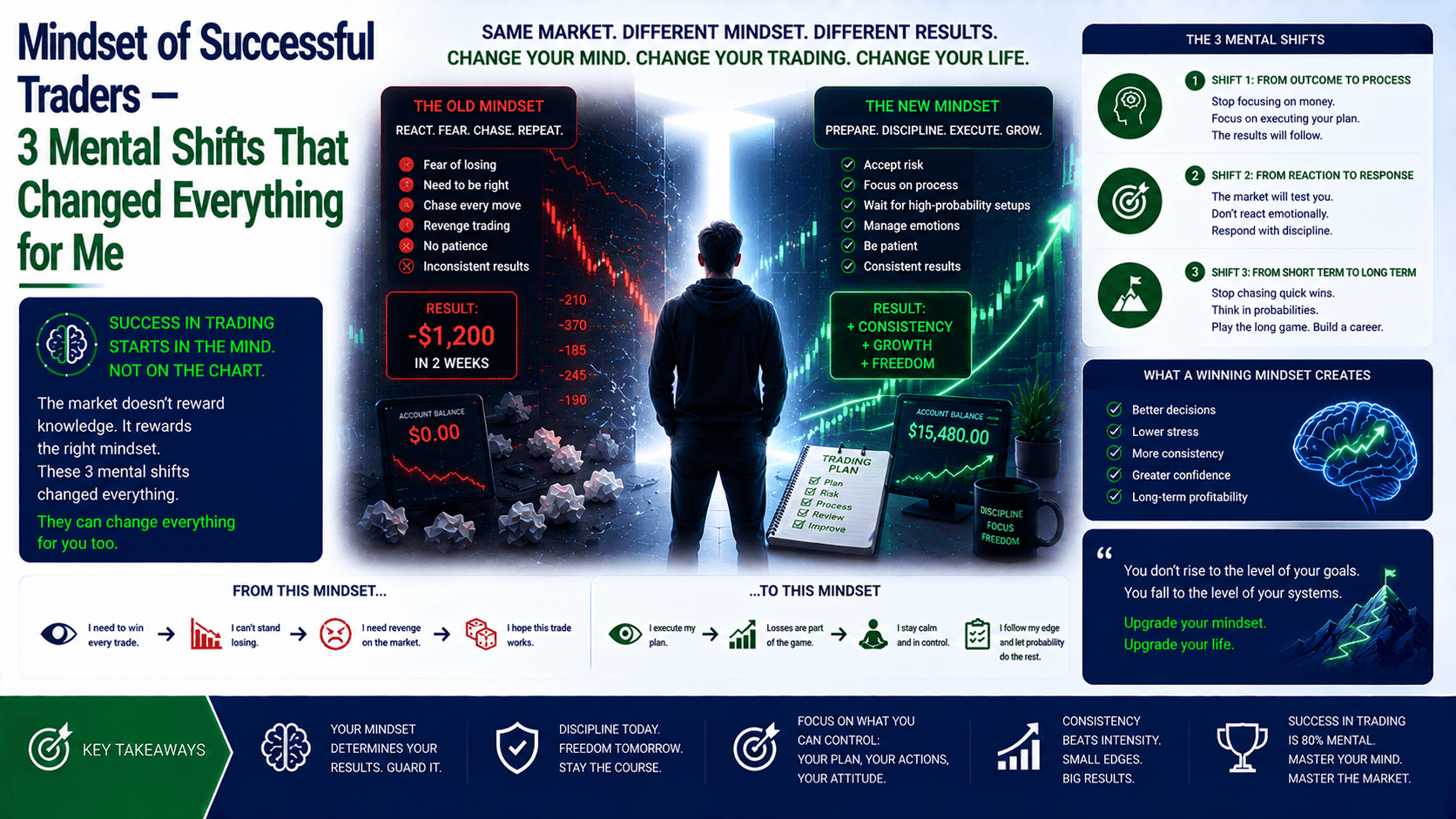
I still remember staring at my account balance. $1,200 gone. In 14 days.
I had the best strategy. I'd read every book, watched every video. My charts were perfect. My entries were solid.
But my mind? A complete disaster.
I'd enter a trade, see a 10-pip loss, and panic-close. Then watch it hit my target 30 minutes later. I'd skip my stop-loss on the next trade because "this one's different." It wasn't. I'd double down after a loss, trying to win it all back — and lose even more.
Here's the thing nobody tells you about the mindset of successful traders: it's not something you're born with. It's something you build. One painful lesson at a time.
Let me share the three mental shifts that finally turned things around for me.
Mental Shift #1: Stop Trying to Be Right — Start Trying to Protect Your Capital
Most beginners walk into trading thinking it's about being right. They want to predict where price will go. They want to feel smart.
I was the same. I'd hold a losing trade for hours because admitting I was wrong felt worse than losing money.
Wrong approach: EUR/USD at 1.0850. I go long. Price drops to 1.0840. I hold. It drops to 1.0830. I hold. It drops to 1.0810. I finally close — losing $40 on 0.1 lots. That's 4% of my $1,000 account in one trade.
Right approach: Same setup. I set my stop-loss at 1.0830 — 20 pips away. Price hits my stop, I lose $20 on 0.1 lots. That's 2%. I walk away. I live to trade another day.
The mindset of successful traders isn't about being right 80% of the time. It's about keeping your losses small so your wins actually matter.
| Trader Type | Win Rate | Avg Win | Avg Loss | Net Result (10 trades) |
|---|---|---|---|---|
| Beginner (chasing wins) | 70% | $10 | $40 | 7×$10 - 3×$40 = -$50 |
| Pro (managing risk) | 40% | $40 | $10 | 4×$40 - 6×$10 = +$100 |
See that? The pro wins less but makes more. That's the math of survival.
Mental Shift #2: Your Emotions Are Lying to You — Here's How to Catch Them
Trading is the only profession where your brain actively works against you.

When you're in a trade, your amygdala — the fear center — takes over. It screams at you to close when price moves against you by 2 pips. It whispers "just hold a little longer" when you're up 50 pips and should take profit.
Here are the three emotional traps I fell into — and how I fixed them:
1. Fear of Missing Out (FOMO)
You see a breakout. Price is surging. You jump in without checking support or resistance. Price reverses immediately. You lose $30.
The fix: Wait for a pullback. If you miss the trade, you miss it. There's always another one.
2. Revenge Trading
You lose $50 on a bad trade. You feel angry. You open another trade immediately — bigger size, no plan. You lose another $80.
The fix: After any loss, walk away for 30 minutes. Seriously. Go make tea. Stretch. Come back when your heart rate is normal.
3. Hope Holding
Your trade is down 30 pips. Your stop-loss is at 35 pips. You tell yourself "it'll bounce." It doesn't. You lose $70 instead of $20.
The fix: Set your stop-loss before you enter. Don't move it. Ever. Treat it like a contract with yourself.
Mental Shift #3: Consistency Beats Genius Every Time
I used to think the best traders were the ones who found the perfect indicator or the secret pattern nobody else knew.
Then I met a trader who'd been profitable for 12 years. He used one moving average and a support/resistance line. That's it.
He wasn't a genius. He was consistent.
He risked 1% per trade. He never deviated from his plan. He took the same setups day after day, month after month.
Here's what consistency looks like in practice:
- You have a trading plan with specific entry, stop-loss, and target rules
- You follow it even when you're bored, tired, or frustrated
- You trade the same size on every trade — no doubling up after wins or losses
- You journal every trade: what you did, why, how you felt
Let me give you a real example. Say you have a $2,000 account. You risk 1% per trade = $20. You take 3 trades per week. Your win rate is 45%, and your average win is 2.5x your average loss.
After 100 trades (about 8 months):
- 45 wins × $50 = $2,250
- 55 losses × $20 = $1,100
- Net profit: $1,150 (57.5% return)
That's not flashy. But it's real. And it's sustainable.
Comparison: The Mindset of Successful Traders vs. The Rest
| What They Do | The Rest | Successful Traders |
|---|---|---|
| After a loss | Revenge trade, double down | Step away, review journal, come back fresh |
| After a win | Get overconfident, increase size | Stick to the plan, same size next trade |
| When unsure | Take a random trade | Stay out, wait for clear setup |
| Risk per trade | 5-20% of account | 1-2% of account |
| Focus | Being right | Protecting capital |
FAQ
What is the most important trait for a successful trader?
Discipline. You can have the best strategy in the world, but if you can't follow it, it's useless. Discipline means sticking to your plan even when your emotions scream otherwise.

How do I control my emotions when trading?
Start with a trading journal. Write down how you felt before, during, and after each trade. Over time, you'll see patterns. Also, set strict risk limits and never trade when you're angry, tired, or stressed.
Can anyone develop the mindset of a successful trader?
Yes. It's not a personality trait — it's a skill. Like any skill, it takes practice. Start small, journal everything, and focus on process over profit. The results will follow.
How long does it take to develop a winning trading mindset?
Most traders need 6-12 months of consistent practice to build the right mental habits. The key is surviving long enough to learn. Keep your risk small, and give yourself time to grow.
Quick Recap
- Successful traders focus on capital preservation, not being right
- Your emotions will lie to you — catch them with rules and routines
- Consistency beats genius. Follow your plan, every single time
- Risk 1-2% per trade. Use stop-losses. Journal everything
Your Quick Win Today
Open your trading platform right now. Look at your last 5 trades. Write down one thing you did well and one thing you could improve. That's it. One minute. Start building awareness today.