
Why Most Traders Lose Money Before They Even Enter a Trade
Here's something nobody tells you about forex trading: how you manage your position size matters more than whether you're right or wrong.
Two traders can have the exact same strategy. One blows up their account in a week. The other grows steadily. The difference? Money management.
And there are two opposing approaches to position sizing that traders argue about constantly: Martingale vs Anti-Martingale forex strategies.
One doubles down after losses. The other doubles down after wins. Which one actually works? Let's break it down with real numbers — and show you why one of these will likely destroy your account.
What Is the Martingale Strategy in Forex?
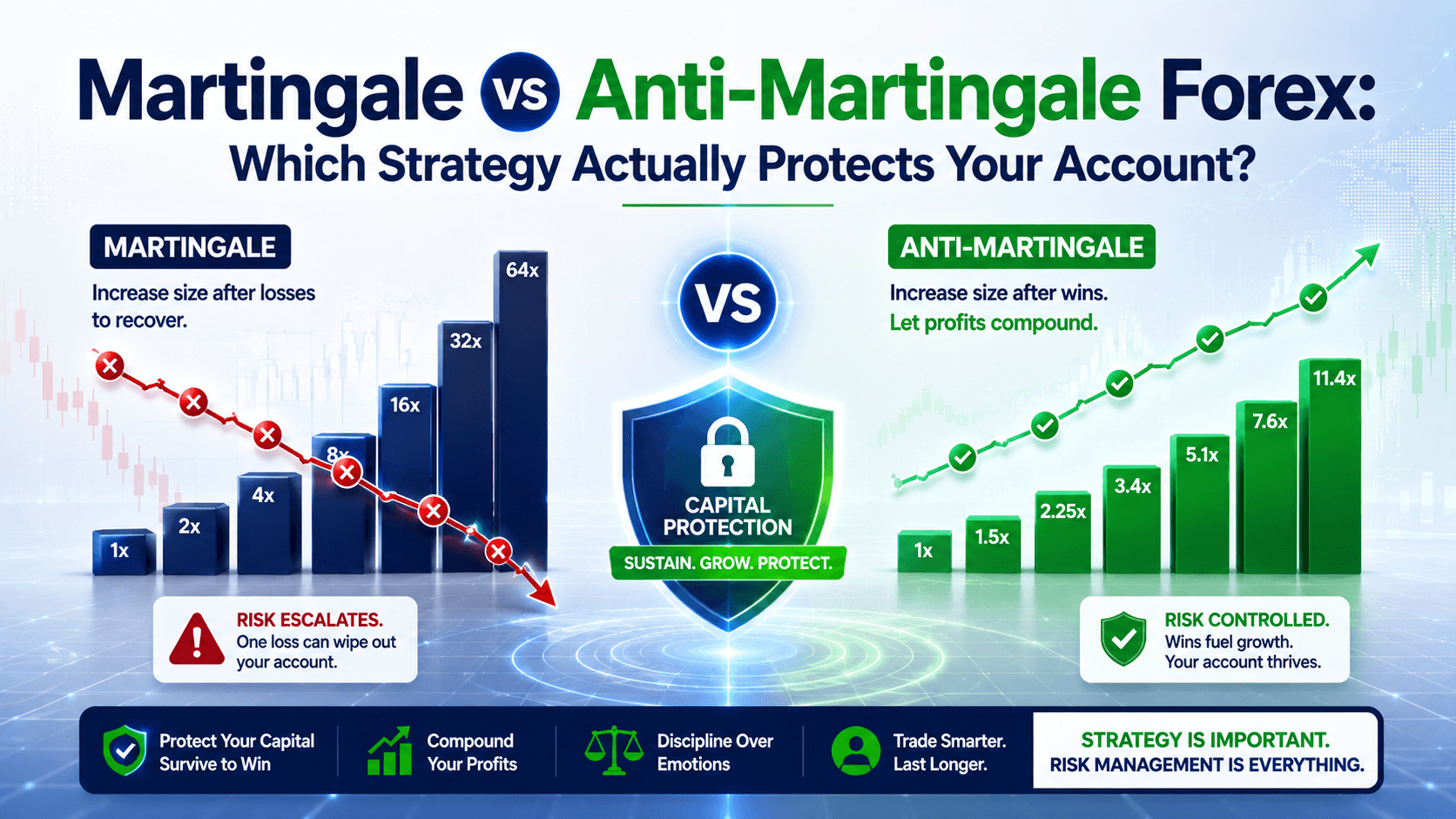
The Martingale strategy comes from 18th-century gambling. In forex, it means doubling your position size after every losing trade.
The logic? One winning trade will recover all your previous losses and give you a small profit.
Sounds simple. But here's where it gets dangerous.
How Martingale Works — The Math
Let's say you're trading EUR/USD with a $1,000 account. You risk $10 per trade on 0.01 lots.
- Trade 1: $10 risk → Loss → Account: $990
- Trade 2: Double to $20 risk → Loss → Account: $970
- Trade 3: Double to $40 risk → Loss → Account: $930
- Trade 4: Double to $80 risk → Win → Profit: $80
Total loss from trades 1-3: $70. Profit from trade 4: $80. Net: +$10.
See the appeal? One win erased three losses. But what happens when the losing streak extends?
The Martingale Trap — When Losses Snowball
Let's extend that same example:
| Trade | Position Size | Result | Account Balance |
|---|---|---|---|
| 1 | $10 | -$10 | $990 |
| 2 | $20 | -$20 | $970 |
| 3 | $40 | -$40 | $930 |
| 4 | $80 | -$80 | $850 |
| 5 | $160 | -$160 | $690 |
| 6 | $320 | -$320 | $370 |
| 7 | $640 | Need $640 — but you only have $370 | MARGIN CALL |
Seven consecutive losses. That's it. Just seven trades and your $1,000 account is gone.
And in forex, seven consecutive losses is completely normal — especially if you're trading against the trend.
What Is the Anti-Martingale Strategy in Forex?
The Anti-Martingale strategy flips the concept. You increase position size after wins and decrease after losses.
Instead of chasing losses, you let your winners run bigger while protecting your account during losing streaks.
How Anti-Martingale Works — The Math
Same setup: $1,000 account, starting with $10 risk on EUR/USD.
- Trade 1: $10 risk → Win → Account: $1,010
- Trade 2: Double to $20 → Win → Account: $1,030
- Trade 3: Double to $40 → Loss → Account: $990
- Trade 4: Halve to $20 → Loss → Account: $970
- Trade 5: Halve to $10 → Win → Account: $980
After 5 trades with 2 wins and 3 losses, you're down $20. Not great — but your account is still alive.
Now compare that to Martingale. After 5 trades with 2 wins and 3 losses under Martingale, you'd be down far more because you doubled after each loss.
Martingale vs Anti-Martingale Forex: The Key Differences
| Factor | Martingale | Anti-Martingale |
|---|---|---|
| After a loss | Double position size | Halve position size |
| After a win | Reset to base size | Double position size |
| Risk profile | High — losses compound fast | Lower — losses shrink |
| Capital needed | Very large account | Moderate account |
| Best market | Range-bound, low volatility | Trending markets |
| Psychological load | Extreme — doubling after losses is stressful | Manageable |
| Account survival | Low — one bad streak wipes you out | High — losses shrink automatically |
The Wrong Way First — Then the Right Way
Wrong way: A beginner hears about Martingale and thinks "I'll just double down until I win. The market has to reverse eventually, right?"

So they start with 0.01 lots on EUR/USD. After 5 losses, they're at 0.32 lots. The next trade needs 0.64 lots — but their account can't handle it. One more loss and they're done.
Right way: Use Anti-Martingale principles. Start small. After a win, add a little more. After a loss, step back. Let the market prove it's on your side before you increase exposure.
Here's the reality: Professional traders use Anti-Martingale thinking. They scale into winning positions and cut losing ones fast. They don't double down on losers — that's gambling, not trading.
Why Martingale Almost Always Fails in Forex
Three reasons:
1. Markets aren't fair coin flips. Roulette has fixed odds. Forex has trends, gaps, and black swan events. A losing streak can last 15-20 trades easily.
2. You have finite capital. Martingale assumes unlimited funds. After 10 consecutive losses, your position size has grown 1,024 times your starting size. A $10 start becomes a $10,240 requirement.
3. Spreads and commissions eat you alive. Every time you double your position, you're paying more in spread. On EUR/USD with a 1-pip spread, that's $1 on 0.01 lots but $100+ on 1.0 lots.
When Anti-Martingale Makes Sense
Anti-Martingale works best when you have a high-probability strategy in a trending market.
Example: You're trading XAU/USD (Gold) during a strong uptrend. Your strategy wins 65% of the time. After a win, you add 0.01 lots. After a loss, you cut back.
Over 20 trades with 13 wins and 7 losses, your winning trades are bigger and your losing trades are smaller. That's how accounts grow.
FAQ
Is Martingale or Anti-Martingale better for forex?
Anti-Martingale is safer for most traders. It protects your account during losing streaks and lets profits compound during winning streaks. Martingale requires a very large account and high risk tolerance.

Can Martingale work in forex?
It can work temporarily in low-volatility, range-bound markets. But one extended losing streak will wipe out months of gains. Most professional traders avoid it.
What position sizing strategy do professional traders use?
Most professionals use a fixed percentage risk model (1-2% per trade) with elements of Anti-Martingale — scaling into winning positions and cutting losing ones quickly.
How much capital do you need for Martingale?
You need enough to survive at least 10-15 consecutive losses. For a $10 starting position, that means $10,000-$20,000 minimum. Most retail traders don't have this.
📝 Quick Recap
- Martingale doubles after losses — high risk, high capital needed, often leads to blown accounts
- Anti-Martingale doubles after wins — safer, protects capital, works in trends
- Real example: $1,000 account with Martingale can blow up in 7 trades. Same account with Anti-Martingale survives 15+ trades easily
- Bottom line: Anti-Martingale is the smarter choice for most forex traders
Your Quick Win — Do This in 5 Minutes
Open your trading platform. Look at your last 10 trades. Write down the position size you used for each one.
Did you increase size after losses (Martingale)? Or after wins (Anti-Martingale)?
If you've been doubling down on losers, stop. Today. Switch to a fixed 1% risk per trade or use Anti-Martingale principles. Your account will thank you.