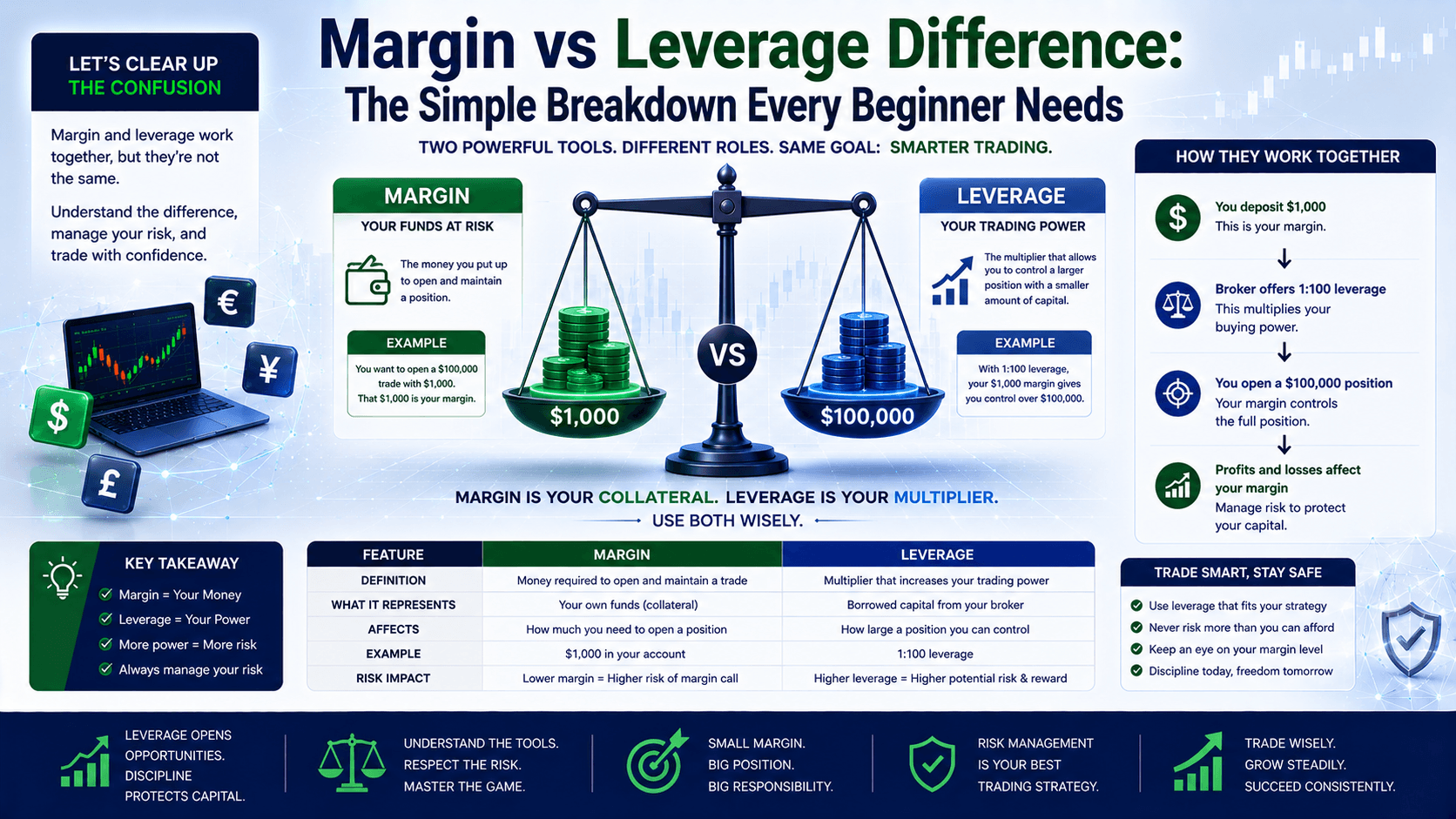

Let's Clear Up the Confusion Right Now
Ever stared at your trading platform and wondered what the difference between margin and leverage actually is? You're not alone. Most beginners mix them up — and honestly, most forex sites make it way more complicated than it needs to be.
Here's the simple truth: margin is the deposit you put up. Leverage is the multiplier that lets you control a bigger position with that deposit. They're two sides of the same coin.
Think of it like renting an apartment. Margin is the security deposit you leave with the landlord. Leverage is the fact that you get to live in a $500,000 apartment with just a $5,000 deposit. Pretty cool, right?
But here's where it gets dangerous — and where most beginners get burned.
The Wrong Way: Treating Leverage Like Free Money
I've seen this happen a hundred times. A new trader opens an account with $500, sees they can get 100:1 leverage, and thinks: "Awesome, I can trade like I have $50,000!"
So they open a 0.5 lot position on EUR/USD. That's $50,000 notional value. Their margin requirement at 1% is $500 — their entire account.
EUR/USD moves 20 pips against them. That's a $100 loss. Their account drops to $400. Suddenly, they're below the margin requirement. The broker closes the trade automatically.
Account blown. In one trade. With a 20-pip move.
Sound familiar? Yeah, I've been there too. It's a painful lesson that most people learn the hard way.
The Right Way: Understanding Margin vs Leverage Difference
Let's break down the margin vs leverage difference properly — with real numbers you can actually use.

What is Leverage?
Leverage is the ratio between the money you have and the position size you can control. It's expressed as X:1.
- 50:1 leverage means you control $50 for every $1 of your own money
- 100:1 leverage means you control $100 for every $1
- 500:1 leverage? You control $500 for every $1
Sounds amazing, right? But remember — it works both ways. If the trade goes against you, you lose $500 for every $1 too.
What is Margin?
Margin is the amount of money you need to put up as a "good faith deposit" to open a trade. It's NOT borrowed money — it's collateral.
When you open a position, the broker sets aside a portion of your account balance as margin. That money isn't available for other trades until you close the position.
The Magic Formula
Here's the simple relationship you need to remember:
Leverage = 1 ÷ Margin Requirement
So if your broker requires 2% margin:
Leverage = 1 ÷ 0.02 = 50:1
And if you want to know the margin requirement from leverage:
Margin Requirement = 1 ÷ Leverage Ratio
So 100:1 leverage means:
Margin Requirement = 1 ÷ 100 = 0.01 = 1%
Real Example: Let's Math It Out
Let's say you want to trade 1 standard lot (100,000 units) of EUR/USD. EUR/USD is at 1.0850.
Without leverage: You'd need $108,500 in your account. Not realistic for most of us.
With 50:1 leverage (2% margin):
- Notional position value: $108,500
- Margin required: 2% × $108,500 = $2,170
- Your actual capital at risk: The full $108,500 if the trade goes bad
See the difference? You only need $2,170 to open the trade, but you're exposed to a $108,500 position. That's the margin vs leverage difference in action.
Comparison Table: Margin vs Leverage at a Glance
| Feature | Margin | Leverage |
|---|---|---|
| What it is | Deposit/collateral required | Multiplier that increases buying power |
| How it's expressed | Percentage (e.g., 2%) | Ratio (e.g., 50:1) |
| What it does | Locks up part of your account balance | Allows you to control larger positions |
| Risk | You can lose your margin deposit | You can lose MORE than your deposit |
| Example | 2% of $100,000 = $2,000 required | 2% margin = 50:1 leverage |
The Trap Nobody Warns You About
Here's the thing most forex sites won't tell you: margin and leverage work together, but they're not the same thing.
When you see "100:1 leverage," your brain thinks "I can trade big!" But what actually matters is the margin requirement. That's the number that determines whether your trade stays open or gets closed.
⚠️ Common Mistake: Beginners think margin is the maximum they can lose. Wrong. Margin is just the deposit. If the trade goes against you, you can lose your ENTIRE account — not just the margin.
Let me give you a real scenario:
You have $1,000. You open a trade with 50:1 leverage. Margin required is $200. Price moves against you by 80 pips on a 0.1 lot trade. That's $80 loss. Your account is now $920. Still above the margin requirement. Trade stays open.
But if price moves 200 pips? That's $200 loss. Your account drops to $800. Margin requirement is still $200. You have $800 equity. You're fine — for now.
If price moves 500 pips? That's $500 loss. Your account is $500. Margin requirement is $200. Your equity ($500) is above margin ($200). Still okay. But barely.
The point: margin determines whether you can open a trade. Leverage determines how fast you can lose money.
FAQ
Is margin the same as leverage?
No. Margin is the deposit you need to open a position. Leverage is the multiplier that allows you to control a larger position with that deposit. They're related but different concepts.

What's a safe leverage for beginners?
Start with 10:1 or 20:1 leverage max. Even 50:1 can be dangerous for new traders. Focus on small position sizes and proper risk management first.
Can I lose more money than my margin deposit?
Yes. If your trade goes against you significantly, you can lose your entire account balance — not just the margin amount. This is why stop losses are crucial.
How do I calculate margin for a trade?
Margin = Position Size ÷ Leverage. For example, a $50,000 position with 50:1 leverage requires $1,000 margin (50,000 ÷ 50 = 1,000).
Quick Recap
- Margin = the deposit you put up (like a security deposit)
- Leverage = the multiplier that increases your buying power
- They're inversely related: higher leverage = lower margin requirement
- Margin is NOT borrowed money in forex — it's collateral
- You can lose more than your margin deposit if you don't manage risk
Your Quick Win Today
Open your trading platform right now. Find the margin requirement for EUR/USD. It's usually displayed somewhere in your account settings or trade ticket. Write it down. Then calculate what leverage that gives you: 1 ÷ margin requirement = leverage ratio.
Now look at your account balance. Calculate the maximum position size you can open with that margin. Then cut it in half. That's a safer starting point.
Knowing the margin vs leverage difference is the first step to trading smarter. Now go apply it.