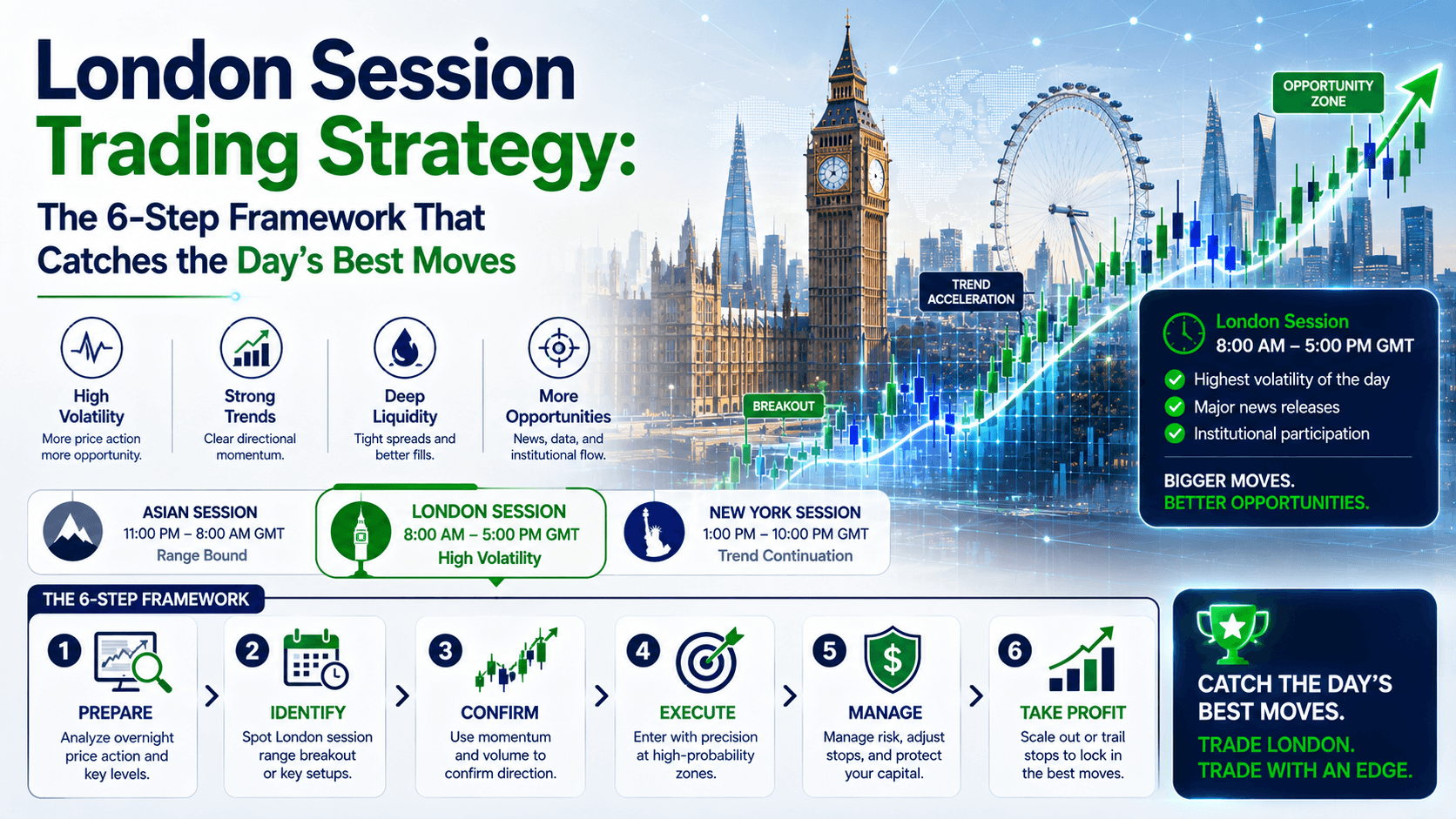

Why Most Traders Miss the London Session's Best Moves
You wake up, check your charts, and see EUR/USD has been drifting sideways for hours. The Asian session is quiet — typical. Then 8:00 AM London time hits. Suddenly, price explodes. You watch it move 40 pips in 15 minutes. But you're not in the trade.
Sound familiar?
The London session handles about 43% of all forex transactions daily. That's trillions of dollars moving through the market while you're sipping your morning coffee. And most traders miss it — not because they're not watching, but because they don't have a plan for when the action starts.
Here's the thing: the London session is predictable. Not in the "price will go up" sense. But in the sense that the market follows patterns every single day. Once you know what to look for, you can catch those moves consistently.
Let me show you exactly how.
What Makes the London Session Different?
The London session isn't just another trading window. It's the most liquid, most volatile, and most active period in the forex market. Here's why it matters:
| Feature | Asian Session | London Session |
|---|---|---|
| Average pip movement (EUR/USD per hour) | 5-8 pips | 10-15 pips |
| Spread costs | Wider (1.5-2 pips) | Tighter (0.5-1 pip) |
| Breakout frequency | Low | High |
| Institutional participation | Moderate | Very high |
The numbers tell the story. During London hours, you get double the volatility of the Asian session with half the spread costs. That's the sweet spot for day traders.
The 6-Step London Session Trading Strategy
Here's the framework I've used for years. Follow these steps, and you'll have a clear plan every morning.

Step 1: Identify the Asian Session Range
Open your chart at 7:00 AM London time (2:00 AM ET). Look at the last 4-6 hours of price action from the Asian session.
What you're looking for: A tight range. Ideally 15-30 pips for EUR/USD or GBP/USD. The tighter the range, the more explosive the breakout.
Mark two lines:
- The Asian session high — resistance
- The Asian session low — support
These are your trigger levels.
Step 2: Check the Higher Timeframe Trend
Before you even think about entering, zoom out. Look at the 1-hour or 4-hour chart.
Ask yourself: Is the overall trend up, down, or sideways?
- Uptrend on HTF → Only take long breakouts above Asian high
- Downtrend on HTF → Only take short breakouts below Asian low
- Sideways → Take breakouts in either direction
This simple filter keeps you from trading against the bigger move.
Step 3: Wait for the Breakout — With Confirmation
Here's where most beginners mess up. They see price touch the Asian high and jump in. Then price reverses 10 pips and takes their stop.
Don't do that.
Wait for one of these confirmations:
- A candle closes outside the Asian range (not just a wick)
- Volume spikes (if your platform shows it)
- RSI moves above 50 (for longs) or below 50 (for shorts)
Let's use a real example:
EUR/USD Asian range is 1.0850 to 1.0870 (20 pips). At 8:15 AM London time, price breaks above 1.0870. A 15-minute candle closes at 1.0875. That's your confirmation.
Step 4: Enter the Trade
You have three entry options. Choose based on your risk tolerance:
| Entry Style | When to Enter | Pros | Cons |
|---|---|---|---|
| Aggressive | On first touch of breakout level | Best price | High false breakout risk |
| Conservative | After candle close outside range | Fewer false breakouts | Misses some moves |
| Retest | After breakout, wait for pullback to broken level | Best risk:reward | May not retest |
I prefer the conservative entry for beginners. It filters out most false breakouts while still catching the bulk of the move.
Step 5: Set Your Stop Loss and Take Profit
Stop loss placement:
- For long trades: Place stop 5-10 pips below the Asian low
- For short trades: Place stop 5-10 pips above the Asian high
Take profit targets:
- Target 1: 1x ATR (Average True Range) of the Asian session
- Target 2: Previous day's high/low
- Target 3: Use a trailing stop after price moves 1.5x your risk
Let's calculate with real numbers:
You're long EUR/USD. Entry at 1.0875. Asian low was 1.0850. Your stop is at 1.0840 (10 pips below Asian low). That's 35 pips risk. On 0.1 lots, that's $35 risk.
ATR of Asian session was 15 pips. So target 1 is 1.0875 + 15 = 1.0890 (15 pips gain). Target 2 is previous day's high at 1.0900 (25 pips gain).
Risk:reward = 35 pips risk : 25 pips gain = 1:0.7. Not great. So you skip this trade and wait for a better setup.
Pro tip: Only take trades with at least 1:1.5 risk:reward. Ideally 1:2 or better.
Step 6: Manage the Trade
Once you're in, don't just stare at the chart. Here's how to manage actively:
- First 30 minutes: Watch for false breakouts. If price reverses and closes back inside the range, exit immediately.
- After 1 hour: Move your stop to breakeven if price has moved 1.5x your initial risk.
- Before New York open (1:00 PM London / 8:00 AM ET): Consider closing 50% of your position. The London-NY overlap can cause sharp reversals.
Best Currency Pairs for the London Session
Not all pairs behave the same during London hours. Here are the ones that perform best:
| Pair | Average Pip Movement (per hour) | Best For |
|---|---|---|
| EUR/USD | 10 pips | Beginners, tight spreads |
| GBP/USD | 13 pips | Volatility, news trading |
| USD/JPY | 19 pips | Trend followers |
| GBP/JPY | 22 pips | Experienced traders only (wild moves) |
| EUR/JPY | 22 pips | Breakout traders |
Stick with EUR/USD and GBP/USD when you're starting out. They have the tightest spreads and most predictable patterns.
Common Mistakes to Avoid
I've made every mistake on this list. Learn from my pain:
- Entering before London opens: The Asian session can fake you out. Wait for the London candle to close.
- Chasing the move: If price has already moved 30 pips, you're late. Wait for the next setup.
- Ignoring the higher timeframe: A breakout against the daily trend is more likely to fail. Check the bigger picture.
- Not checking news: Major economic releases (BOE, ECB, US data) can cause unpredictable moves. Check the economic calendar before trading.
- Overtrading: The London session gives you 2-3 good setups per day. Don't force trades.
FAQ
What time does the London session start?
The London forex session opens at 8:00 AM London time (3:00 AM ET / 7:00 AM UTC) and closes at 5:00 PM London time (12:00 PM ET / 4:00 PM UTC).

Can I trade the London session with a small account?
Yes. Use micro lots (0.01 lots) to keep risk manageable. A $500 account can trade London breakouts with 0.01 lots and 20-pip stops, risking only $2 per trade (0.4% of account).
What's the best timeframe for the London breakout strategy?
The 15-minute chart is the sweet spot. It filters noise from 1-minute charts while giving you enough time to react. Use the 1-hour chart to confirm the trend.
How many trades should I take during the London session?
2-3 trades maximum. The London session has the best setups in the first 2 hours. After that, volatility drops until the New York overlap. Quality over quantity.
Quick Recap
- The London session offers the highest liquidity and volatility in forex — use it
- Mark the Asian session range and wait for a confirmed breakout
- Only trade in the direction of the higher timeframe trend
- Use 1:1.5 minimum risk:reward — skip trades that don't meet this
- Manage actively: move stops to breakeven after 1 hour, close before NY open
Your Quick Win
Open your chart right now. Set the time to 7:00 AM London time (2:00 AM ET). Find EUR/USD on the 15-minute chart. Mark the high and low of the Asian session (midnight to 7:00 AM London time). Now you have your trigger levels for tomorrow morning.
Do this today. Tomorrow, you'll be ready to catch the breakout.