
Here's the Problem Most Traders Face
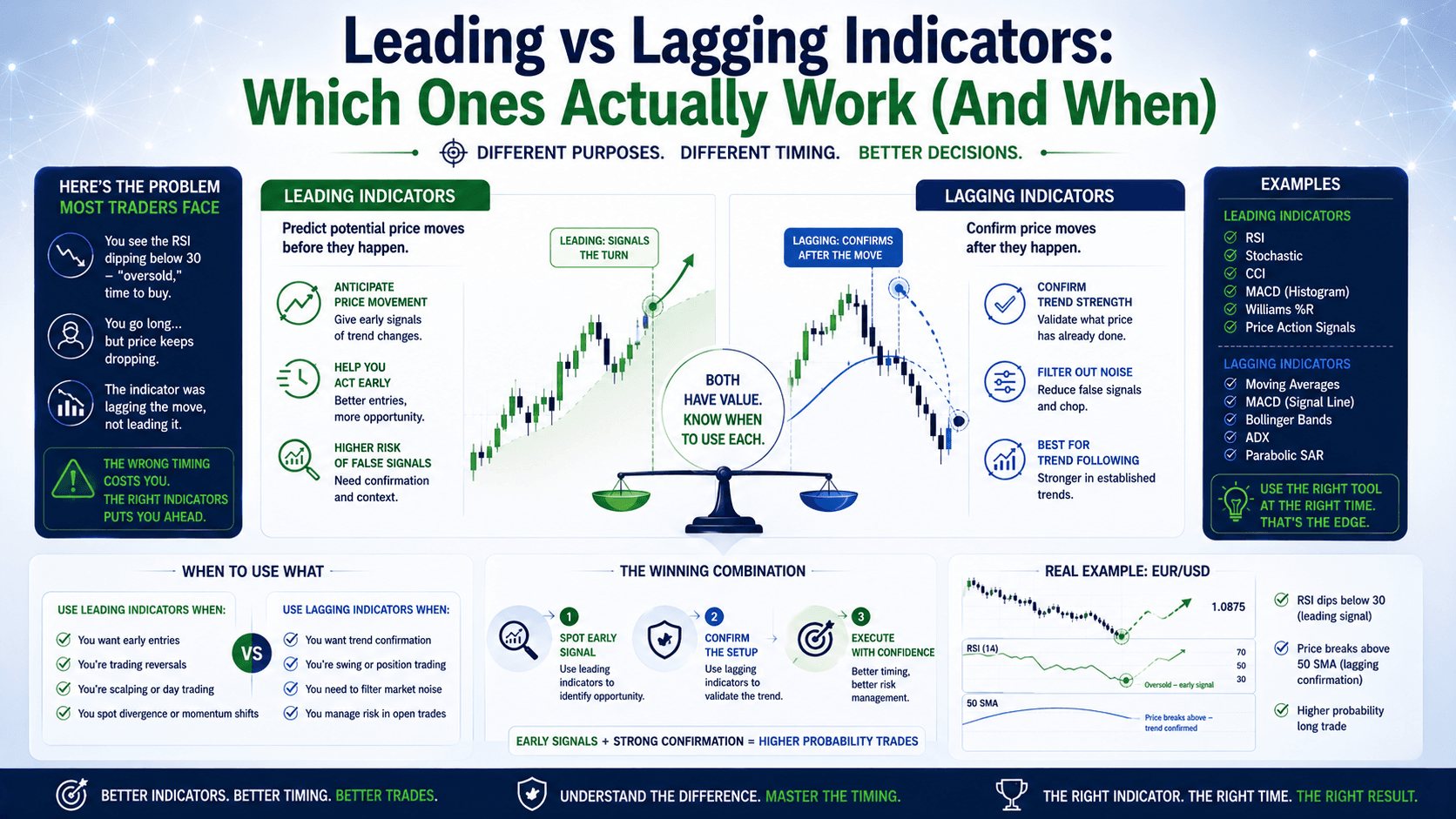
You've got your chart open. EUR/USD at 1.0875. You see the RSI dipping below 30 — "oversold," time to buy. You go long with 0.1 lots. Price drops another 20 pips. Your stop gets hit. Then it reverses and goes up 50 pips.
Sound familiar?
You just experienced the leading vs lagging indicators dilemma. The RSI gave you a leading signal — a prediction that price would reverse. It was wrong. A lagging indicator like a moving average would have waited, confirmed the trend, and kept you out of that fakeout.
But here's the thing: lagging indicators make you late. By the time they signal, the trend's already moved 30 pips. You're buying at the top.
So which one do you use? The answer isn't "one is better." The answer is when to use each one.
What Are Leading Indicators? (The Speedsters)
Leading indicators try to predict what price will do before it happens. They measure things like momentum, overbought/oversold conditions, and potential reversals.
How They Work — The Math
Take the Relative Strength Index (RSI). It's a momentum oscillator that ranges from 0 to 100. When it drops below 30, the asset is considered "oversold" — meaning price might bounce. When it goes above 70, it's "overbought" — price might drop.
Here's the trap: In a strong downtrend, RSI can stay below 30 for days. You buy at 29, it drops to 25, then 20. You're catching a falling knife.
Common Leading Indicators
| Indicator | What It Does | Best Market | Weakness |
|---|---|---|---|
| RSI | Measures overbought/oversold | Ranging (sideways) | Many false signals in trends |
| Stochastic Oscillator | Compares close to price range | Ranging | Can stay overbought/oversold |
| Support & Resistance | Identifies key price levels | Both | Subjective, can be broken |
| Pivot Points | Calculates support/resistance from prior data | Ranging | Less effective in strong trends |
What Are Lagging Indicators? (The Confirmers)
Lagging indicators wait for price to move first, then confirm the trend. They're slower, but they keep you on the right side of the market.

How They Work — The Math
Take the 50-period Simple Moving Average (SMA). It averages the last 50 closing prices. When price crosses above the SMA, it confirms an uptrend. When it crosses below, it confirms a downtrend.
The catch: By the time the cross happens, price has already moved. On EUR/USD, that could be 20-40 pips. You're entering late, but you're entering with the trend.
Common Lagging Indicators
| Indicator | What It Does | Best Market | Weakness |
|---|---|---|---|
| Moving Averages (SMA/EMA) | Smooths price to show trend | Trending | Late signals, whipsaws in ranges |
| MACD | Shows trend direction & momentum | Trending | Lagging, crossovers come late |
| Bollinger Bands | Measures volatility | Trending | Reacts after volatility changes |
| ADX | Measures trend strength | Trending | Doesn't show direction |
The Wrong Way vs The Right Way
The Wrong Way (What Most Beginners Do)
You apply RSI and a 50-SMA to your chart. EUR/USD is at 1.0850. RSI drops to 28 — oversold. You buy 0.1 lots. Price drops to 1.0830. RSI goes to 22. You buy another 0.1 lots averaging down. Price drops to 1.0810. You're down $40 on 0.2 lots with no stop.
Result: You're holding a losing position because a leading indicator told you to buy into a downtrend.
The Right Way (What Professionals Do)
First, identify the market condition. Is EUR/USD trending or ranging?
- If trending: Use lagging indicators. Wait for the 50-SMA to slope up. Enter on pullbacks to the SMA. Target the next resistance.
- If ranging: Use leading indicators. Buy when RSI hits 30 near support. Sell when RSI hits 70 near resistance.
Let's run the numbers on a ranging market:
EUR/USD at 1.0850. Range is 1.0800-1.0900. RSI drops to 28 near 1.0810 (support). You buy 0.1 lots. Stop at 1.0790 (20 pips = $20 risk). Target 1.0880 (70 pips = $70 profit). Risk:reward = 1:3.5.
Result: Price bounces. You hit target. You're up $70. The leading indicator worked because you used it in the right market.
Leading vs Lagging: The Data Comparison
| Factor | Leading Indicators | Lagging Indicators |
|---|---|---|
| Signal timing | Before the move | After the move |
| False signals | High (30-50% of signals) | Low (10-20% of signals) |
| Best market | Ranging (sideways) | Trending |
| Worst market | Strong trends | Sideways ranges |
| Profit potential | Higher (catch the whole move) | Lower (enter late) |
| Risk level | Higher (fakeouts) | Lower (confirmed trends) |
How to Combine Them (The Smart Strategy)
You don't have to pick one. The best traders use both — but in the right order.
Here's a simple framework:
- Use ADX (lagging) to determine if the market is trending or ranging. ADX above 25 = trending. Below 25 = ranging.
- If trending: Use moving averages (lagging) for trend direction. Enter on pullbacks.
- If ranging: Use RSI (leading) at support/resistance. Buy oversold, sell overbought.
Let's see it in action with Gold (XAU/USD):
Gold at $2,350. ADX is 18 (ranging). Range is $2,320-$2,380. RSI drops to 28 near $2,330. You buy 0.1 lots ($10 per pip). Stop at $2,315 (15 pips = $150 risk). Target $2,370 (40 pips = $400 profit). Risk:reward = 1:2.7.
Price bounces off support. RSI rises. You hit target. $400 profit.
Now compare: If you had used only a lagging indicator (like a moving average cross), you would have entered at $2,350 after the bounce — 20 pips later. Your profit would be $200 instead of $400.
FAQ
Are leading indicators better than lagging indicators?
No. Each works best in different market conditions. Leading indicators excel in ranging markets. Lagging indicators work better in trending markets. The key is knowing which market you're in.

Can I use leading and lagging indicators together?
Yes. Use ADX to identify market condition, then apply the appropriate indicator. This prevents conflicting signals and keeps you on the right side of the market.
Why do leading indicators give so many false signals?
Because they attempt to predict future price moves. In strong trends, they can stay overbought or oversold for extended periods. This leads to fakeouts that cost traders money.
What's the best leading indicator for beginners?
RSI is the most straightforward. Use it at support/resistance levels in ranging markets. Avoid using it in strong trends until you have more experience.
📝 Quick Recap
- Leading indicators predict price moves — best in ranging markets, prone to false signals
- Lagging indicators confirm price moves — best in trending markets, enter late but safe
- Use ADX to determine market condition first, then choose your indicator
- Combine them wisely: leading in ranges, lagging in trends
- Always use a stop loss — false signals happen to everyone
⚡ Quick Win
Open your chart right now. Pull up EUR/USD on the 1-hour timeframe. Add ADX (14) and RSI (14). Look at the last 10 candles. Is ADX above or below 25? If below, the market is ranging. Find the nearest support and resistance. Now check RSI — is it near 30 at support or 70 at resistance? That's your potential trade setup. Practice identifying market conditions first. The indicator choice becomes obvious after that.