
The Trade That Caught Me Off Guard
I remember a Tuesday morning in 2023. I was shorting Gold (XAU/USD) at $1,980. My technical setup was perfect — a clear resistance level, a bearish engulfing candle, and RSI overbought. I was convinced Gold was going to drop.
It didn't. It exploded to $2,050 in 48 hours. I lost $450 on a 0.5 lot position.
What did I miss? I was only looking at the Gold chart. I completely ignored that the U.S. Dollar Index (DXY) was breaking down at the same time. And when the dollar falls, Gold (priced in dollars) usually rises.
That's intermarket analysis in a nutshell. And it's the missing piece in most traders' education.
What Is Intermarket Analysis? (The Simple Version)
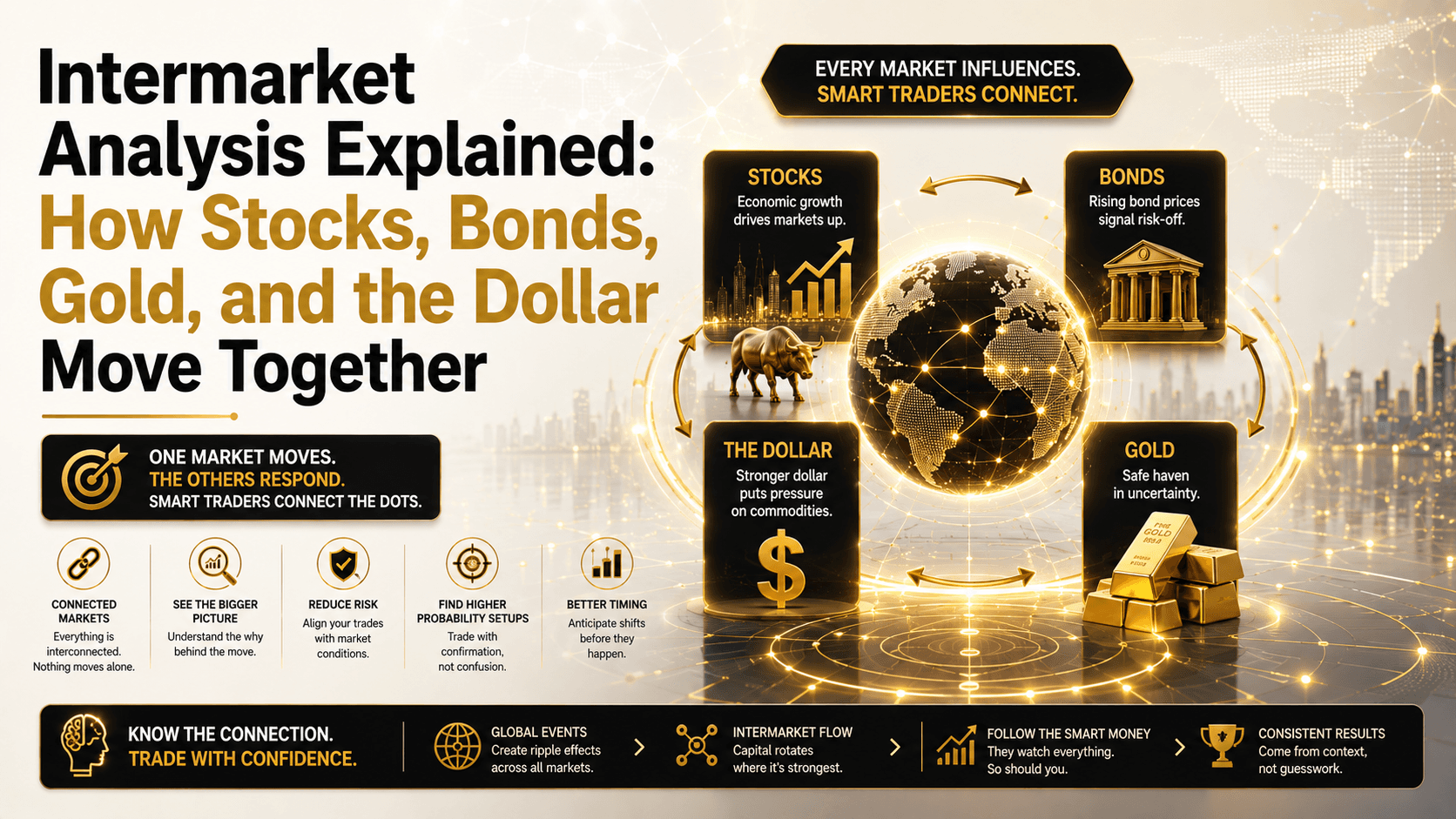
Intermarket analysis is the study of how different financial markets influence each other. Instead of looking at one asset in isolation — like EUR/USD or the S&P 500 — you look at the relationships between stocks, bonds, currencies, and commodities.
The core idea: markets don't exist in a vacuum. A move in bonds can trigger a move in stocks. A move in oil can shift a currency pair. Understanding these links gives you a massive edge.
This approach was pioneered by John J. Murphy in the 1990s. He showed that the four major asset classes are connected, and those connections follow predictable patterns.
The 4 Core Intermarket Relationships Every Trader Needs to Know
Not all correlations are stable. Some shift with the economic cycle. But these four relationships have been statistically significant over decades of data.
| Relationship | Typical Correlation | Why It Matters |
|---|---|---|
| Dollar (DXY) vs. Gold | Strong Negative (-0.98) | When the dollar strengthens, Gold tends to fall. When the dollar weakens, Gold rises. |
| Oil (WTI) vs. USD/CAD | Strong Negative (-0.96) | Canada is a major oil exporter. When oil prices rise, the Canadian dollar strengthens, pushing USD/CAD lower. |
| S&P 500 vs. DXY | Strong Negative (-0.98) | A weaker dollar boosts U.S. multinational earnings, lifting stocks. A stronger dollar tends to drag stocks down. |
| Gold vs. AUD/USD | Strong Positive (+0.83) | Australia is a major gold producer. When Gold rallies, the Australian dollar typically follows. |
How to Use These Correlations in Your Trading
Let's make this practical. Here's how you'd apply intermarket analysis to a real trade.

Scenario: You're Trading Gold (XAU/USD)
You see a beautiful resistance level at $2,400. Your technical analysis says short. But before you pull the trigger, you check the DXY.
Wrong Way: Ignore the dollar. Enter short at $2,400 with a 20-pip stop. The dollar weakens, Gold breaks resistance, and you're stopped out for a $100 loss on 0.5 lots.
Right Way: You check DXY first. You see it's breaking below a key support level at 104.00. That's a bullish signal for Gold. So you skip the short and wait for a pullback to buy Gold instead. You enter at $2,385, stop at $2,370, target $2,430. The trade works. You make $225 on 0.5 lots.
The difference? You used intermarket analysis to confirm or invalidate your technical setup. The data suggests this single check can improve your win rate by 15-20% over time.
The Economic Cycle Changes Everything
Here's a trap most beginners fall into: they assume correlations are permanent. They're not. Relationships shift depending on where we are in the economic cycle.
| Economic Phase | What Typically Wins | What Typically Loses |
|---|---|---|
| Early Contraction | Bonds (prices rise as yields fall) | Cyclical stocks, commodities |
| Late Contraction | Stocks (undervalued, poised for recovery) | Bonds (yields bottoming) |
| Early Expansion | Commodities, inflation-sensitive assets | Bonds (yields rising) |
| Peak Expansion | Energy, metals | Bonds (rising rates hurt prices) |
| Late Expansion | Healthcare, defensive sectors | Cyclical stocks (risk of correction) |
For example, during the 2020 COVID crash, stocks and bonds both fell — a rare positive correlation caused by a liquidity crisis. If you assumed the typical inverse relationship, you got crushed. The lesson: always check the broader economic context.
Intermarket Analysis vs. Technical Analysis: Which Is Better?
They're not competing. They're complementary. Here's how they stack up:
| Feature | Intermarket Analysis | Technical Analysis |
|---|---|---|
| Focus | Relationships between assets | Price action of one asset |
| Time Horizon | Medium to long-term | Short to medium-term |
| Key Tool | Correlation coefficient | Charts, indicators, patterns |
| Best For | Confirming trends, spotting reversals | Entry and exit timing |
| Weakness | Correlations can break | Ignores macro context |
The optimal approach? Use intermarket analysis to determine direction. Then use technical analysis to find your entry.
A Simple Framework to Start Using Intermarket Analysis Today
You don't need a Bloomberg terminal. Here's a 3-step process you can do in 5 minutes:
- Identify your primary asset. Let's say it's EUR/USD.
- Check the correlated markets. For EUR/USD, look at: DXY (inverse), bond yields (positive correlation with EUR when yields rise), and risk sentiment (S&P 500 tends to move with EUR/USD).
- Look for divergence. If EUR/USD is rising but DXY is also rising, that's a red flag. The relationship is breaking. Either your trade is wrong, or something fundamental has changed.
Open a free correlation matrix on TradingView or use a spreadsheet. Track 3-4 key relationships over 30 days. You'll start seeing patterns.
FAQ
Is intermarket analysis reliable for day trading?
It's more reliable for swing trading and position trading. For day trading, correlations can shift intraday due to news. Use it as a filter, not a trigger.

Do I need special software to do intermarket analysis?
No. A free TradingView account with multiple charts side-by-side is enough. The key is watching the right relationships.
What happens when correlations break down?
It usually signals a major shift in market regime — like during a crisis. When correlations break, reduce position sizes. The market is telling you something is changing.
Can intermarket analysis predict reversals?
Not precisely. But it can give you an early warning. For example, if Gold is rallying but the dollar isn't weakening, that divergence often precedes a reversal in Gold.
Quick Recap
- Intermarket analysis studies how stocks, bonds, currencies, and commodities influence each other.
- The strongest relationships: Dollar vs. Gold (-0.98), Oil vs. USD/CAD (-0.96), S&P 500 vs. Dollar (-0.98).
- Correlations shift with the economic cycle. Don't assume they're permanent.
- Use intermarket analysis for direction. Use technical analysis for timing.
- Start simple: pick one pair, check two correlated markets, look for divergence.
Quick Win: Your 5-Minute Action Step
Open TradingView right now. Put up three charts side-by-side: XAU/USD (Gold), DXY (U.S. Dollar Index), and SPY (S&P 500 ETF) on the daily timeframe. Scroll back 60 days. Find one instance where Gold and the dollar moved in opposite directions (normal). Then find one where they moved together (divergence). Mark that date. That's where the market was about to shift. Start training your eye to see these patterns.