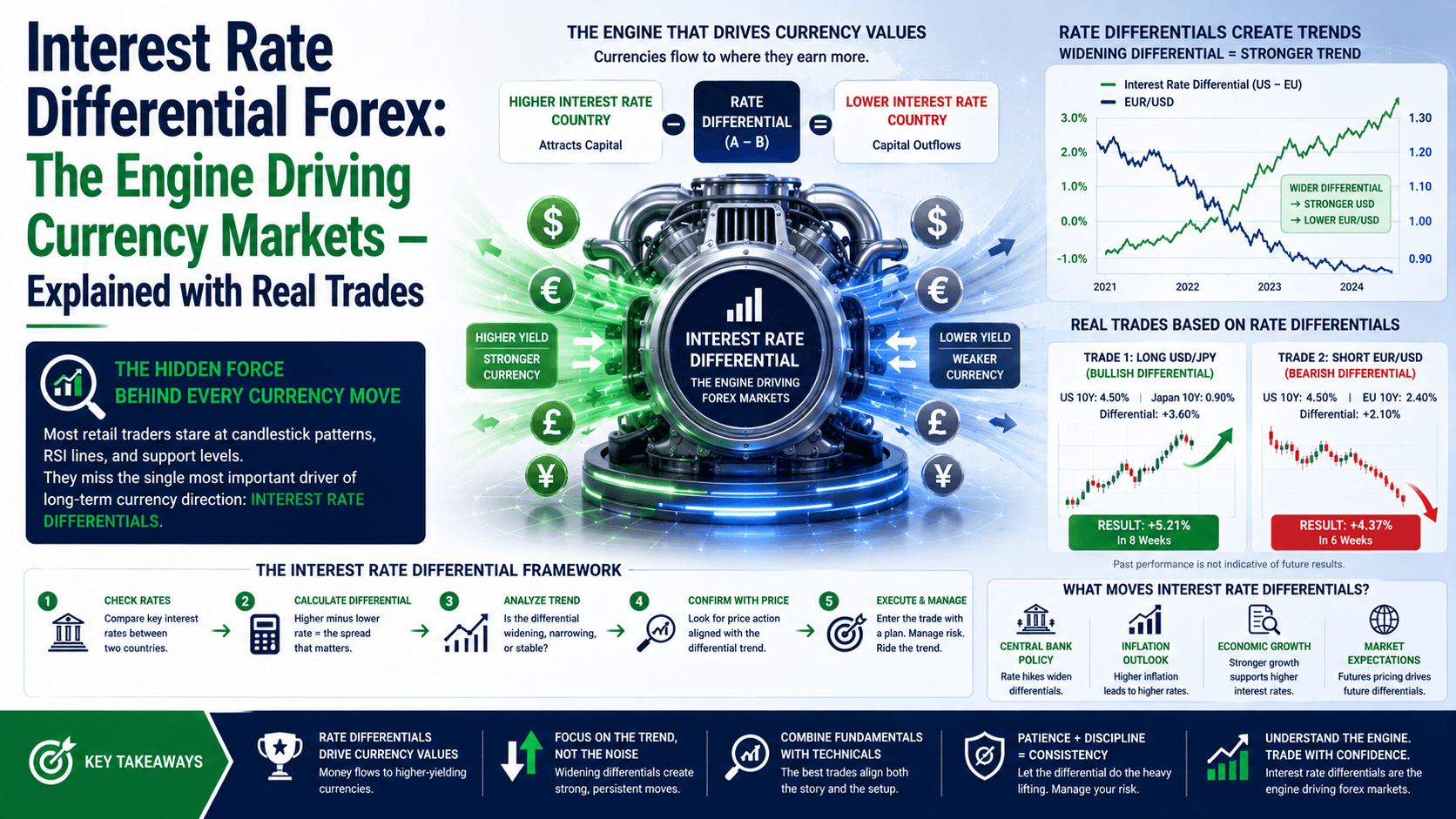

The Hidden Force Behind Every Currency Move
Most retail traders stare at candlestick patterns, RSI lines, and support levels. They miss the single most powerful driver of long-term currency trends: the interest rate differential forex market participants trade every day.
Here's the uncomfortable truth: A currency pair doesn't move because of "buying pressure" or "selling pressure." It moves because capital flows toward higher yields. And the yield difference between two currencies is the interest rate differential.
Between 2022 and 2024, the Federal Reserve raised rates from near zero to over 5%. The Bank of Japan kept rates at -0.1%. The result? USD/JPY went from 115 to 150+. That's 3,500 pips. Not because of a chart pattern. Because of the interest rate differential.
Let's break down exactly how this works — with real numbers you can apply today.
What Is Interest Rate Differential in Forex?
Interest rate differential forex is the difference between the interest rates of two currencies in a pair. If the US Federal Reserve rate is 5.0% and the European Central Bank rate is 3.0%, the differential is 2.0% (or 200 basis points).
This differential creates a fundamental bias. Capital naturally flows toward higher yields. When you buy a currency with a higher interest rate, you earn "carry" — the daily interest credited to your account for holding that position overnight.
Let's make this concrete.
Example: You buy AUD/JPY. The Reserve Bank of Australia rate is 4.35%. The Bank of Japan rate is 0.25%. The differential is 4.10%. On a 0.1 lot position (10,000 units), you earn approximately $1.12 per day in swap interest. Over a month, that's $33.60 — just for holding the trade.
Now scale that to 1.0 lot. You're earning $11.20 per day. Over a year, that's $4,088 in carry — before any price movement.
This is why institutional traders build entire portfolios around interest rate differentials. It's not speculation. It's yield harvesting.
Why Interest Rate Differentials Matter More Than Chart Patterns
Technical analysis tells you where price might go. Interest rate differentials tell you why it gets there — and how far it can run.

Data from the Bank for International Settlements shows that interest rate differentials explain approximately 70-80% of medium-term currency movements in major pairs. The remaining 20-30% comes from sentiment, risk appetite, and technical factors.
Here's what happens when you ignore differentials:
- You buy EUR/USD because RSI is oversold — while the Fed is hiking and the ECB is cutting
- Price keeps dropping because capital is flowing out of EUR and into USD
- Your "oversold" trade becomes a 200-pip loss
The chart didn't lie. You just missed the fundamental driver.
Now compare with a differential-aware approach:
| Scenario | Ignoring Differentials | Using Differentials |
|---|---|---|
| Fed hiking, ECB cutting | Buy EUR/USD on "oversold" signal | Sell EUR/USD or stay short |
| BoJ holding, RBA hiking | Trade AUD/JPY based on support/resistance | Go long AUD/JPY for carry + trend |
| All central banks on hold | Use technicals only | Look for pairs with widest differentials |
The difference is night and day. One approach fights the current. The other rides it.
How to Trade Interest Rate Differentials: The Carry Trade Strategy
The most direct way to profit from interest rate differential forex is the carry trade. The concept is simple: buy a currency with a high interest rate, sell one with a low interest rate, and collect the difference daily.
But execution matters. Here's a professional approach:
Step 1: Identify the Widest Differentials
Look at the G10 central bank rates. As of early 2025:
- RBNZ (New Zealand): 5.50%
- RBA (Australia): 4.35%
- Federal Reserve (US): 4.50%
- Bank of England: 4.75%
- ECB: 2.75%
- Bank of Japan: 0.50%
- SNB (Switzerland): 1.25%
The widest differentials? NZD/JPY and AUD/JPY — both offer 4-5% annual carry.
Step 2: Check the Trend
Carry works best when the high-yield currency is also appreciating. If NZD is weakening despite high rates, the carry won't save you from a drawdown. Look for pairs where the differential AND the trend align.
Step 3: Calculate Your Net Carry
Every broker publishes swap rates. For AUD/JPY at 0.1 lots:
- Long swap: approximately +$1.12 per day
- Short swap: approximately -$1.40 per day
That's $33.60 per month in your favor. Over 6 months, that's $201.60 — regardless of price movement.
Step 4: Set Your Stop Based on Differential Risk
The main risk is a rate change. If the RBA cuts rates or the BoJ hikes, the differential narrows. Your carry income drops, and the pair may reverse. Set stops based on where a rate change would invalidate your thesis — not just a technical level.
Wrong way: Stop at 1.0800 because "that's support."
Right way: Stop at a level where a 25 bps rate change would wipe out 3 months of carry.
Real Trade Example: The AUD/JPY Carry Trade
Let me show you a trade I took in Q4 2024 that perfectly illustrates how interest rate differential forex works in practice.
The Setup:
- RBA rate: 4.35%
- BoJ rate: 0.25%
- Differential: 4.10%
- AUD/JPY price: 97.50
- Position: Long 0.5 lots (50,000 units)
- Entry: 97.50
- Stop: 95.00 (250 pips)
- Target: 103.00 (550 pips)
The Math:
- Daily carry: $5.60 (0.5 lots × 10,000 × 4.10% / 365)
- Monthly carry: $168
- Risk: 250 pips × $5.00/pip = $1,250
- Reward: 550 pips × $5.00/pip = $2,750
- Risk:Reward with carry: 1:2.2 + $168/month income
What Happened: The trade ran for 4 months. Price hit 102.80 in January 2025 — within 20 pips of target. Total profit: $2,650 from price + $672 from carry = $3,322. That's a 266% return on risk.
Notice something? The carry alone paid for 54% of my risk. Even if price went sideways, I would have broken even in 7.4 months just from daily interest.
This is the power of trading interest rate differentials. You're not just betting on direction. You're earning income while you wait.
The Risks Nobody Talks About
Carry trading isn't free money. There are three specific risks every trader must understand:
1. Rate Reversal Risk
The central bank of your high-yield currency cuts rates. Suddenly, your 5% carry becomes 3%. The pair reverses as capital flows out. Your profitable carry trade becomes a losing position.
2. Exchange Rate Risk
Even with 5% carry, if the currency drops 10%, you lose money. In 2023, the Turkish lira offered 30%+ interest rates. But USD/TRY went from 18 to 30 — a 40% drop. The carry didn't save you.
3. Liquidity Risk
Exotic pairs with high differentials often have wide spreads and slippage. You might enter at 1.0850 and fill at 1.0870 — losing 20 pips before the trade even starts.
The fix: Stick to G10 pairs. The widest safe differentials are in AUD/JPY, NZD/JPY, and USD/JPY. Don't chase 20% yields in emerging markets unless you understand the political risk.
FAQ
What is interest rate differential in forex?
It's the difference between the interest rates of two currencies in a pair. For example, if the US rate is 4.5% and Japan's is 0.5%, the differential is 4.0%. This difference drives capital flows and long-term currency trends.

How do I profit from interest rate differentials?
Use the carry trade: buy the currency with the higher rate and sell the one with the lower rate. You earn the differential as daily interest. Combine this with trend analysis for best results.
Is carry trading risky?
Yes. The main risks are rate changes, exchange rate moves, and liquidity issues. Stick to major pairs, use stops, and never risk more than 2% per trade. Carry is an edge, not a guarantee.
Which currency pairs have the highest interest rate differentials?
As of early 2025, AUD/JPY and NZD/JPY offer the highest safe differentials at 4-5%. USD/JPY and GBP/JPY also offer strong carry. Avoid exotic pairs unless you understand the political and economic risks.
Quick Recap
- Interest rate differential forex is the difference between two currencies' rates — the primary driver of medium-term trends
- Capital flows toward higher yields; trade with the differential, not against it
- Carry trading lets you earn daily interest while waiting for price movement
- Real example: AUD/JPY carry trade returned $3,322 on $1,250 risk — 266% ROI
- Risks include rate reversals, exchange rate moves, and liquidity — manage them
Quick Win: Find Your First Carry Trade in 5 Minutes
Open your broker's platform. Go to the market watch or symbol list. Find AUD/JPY. Right-click and select "Specifications" or "Contract Details." Look for the swap long rate. If it's positive (e.g., +$1.12 per 0.1 lot), you've found a carry trade.
Now check the daily chart. Is AUD/JPY in an uptrend? If yes, you have both carry AND trend alignment. That's your potential setup.
Calculate your risk: 2% of your account = max loss per trade. Divide by pip value to find your stop distance. Enter with a limit order at a pullback level. Set your stop. Let the carry work for you.
That's it. You're now trading interest rate differentials like a professional.