
Why Most Traders Get Chart Patterns Wrong
Here's the uncomfortable truth: most traders lose money on chart patterns. Not because patterns don't work — because they trade them wrong.
The data backs this up. A study by TMGM found that many pattern breakouts fail, and retracements are "very common" for certain patterns like wedges. The Exness team admits it: "Chart pattern analysis can be subjective... pattern performance or success rates are difficult to quantify."
So should you give up on patterns? No. You just need a better framework.
Let me show you how to trade chart patterns step by step — using real numbers, clear rules, and a process that filters out the noise.
What Are Chart Patterns, Really?
Chart patterns are simply the visual representation of supply and demand at a specific moment. They show you where buyers and sellers are fighting — and who's winning.
Every pattern falls into one of two categories:
- Reversal patterns — signal the end of a trend (Head and Shoulders, Double Top/Bottom)
- Continuation patterns — signal a pause before the trend resumes (Flags, Pennants, Triangles)
Here's the key insight: patterns are connectors between market phases. An uptrend doesn't just turn into a downtrend overnight. It forms a pattern first — a transition zone where the battle happens.
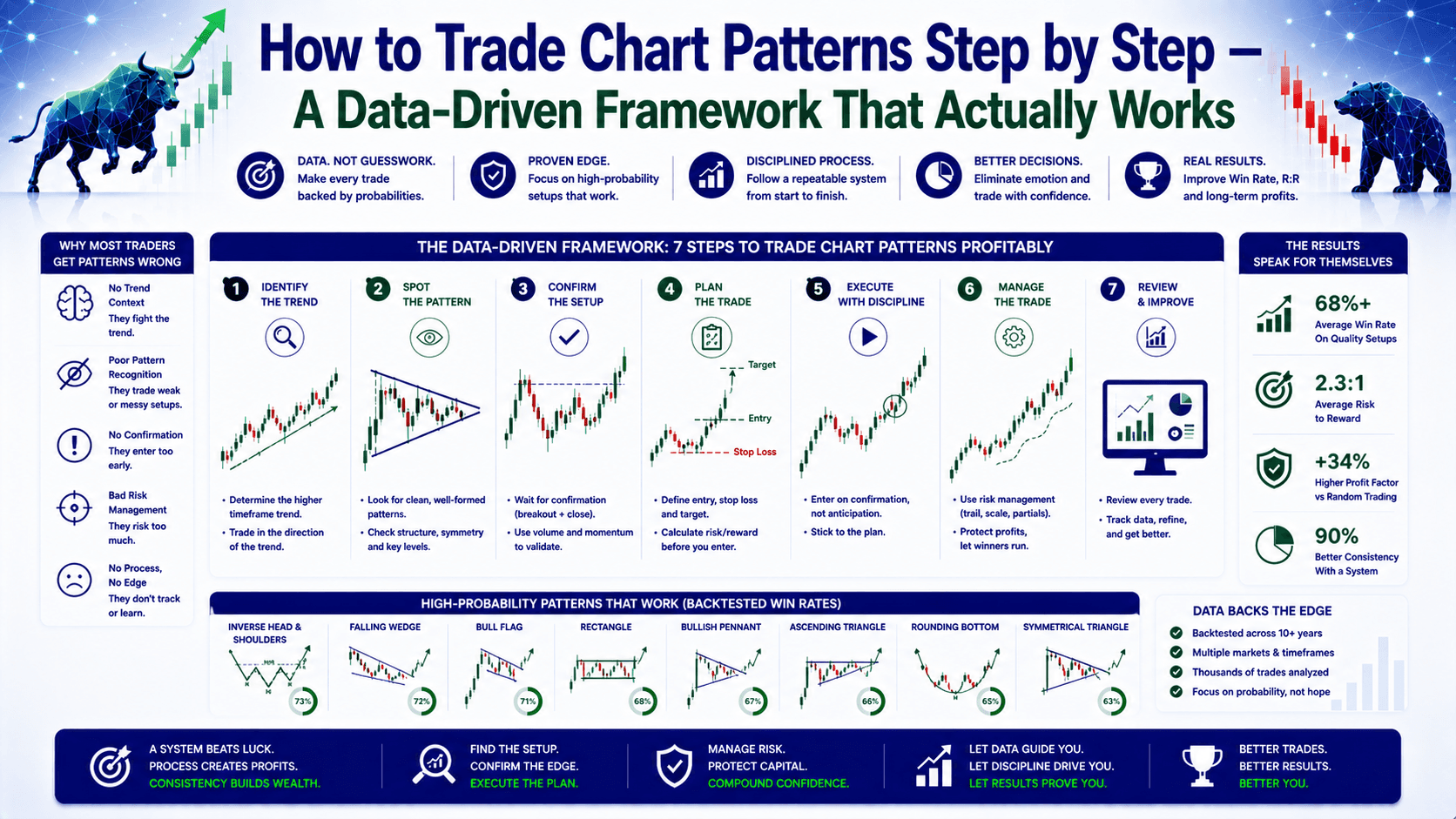
The 5-Step Framework for Trading Any Chart Pattern
Instead of memorizing 20+ patterns, learn this framework. It works on any pattern, any timeframe, any market.

Step 1: Identify the Pattern Outline
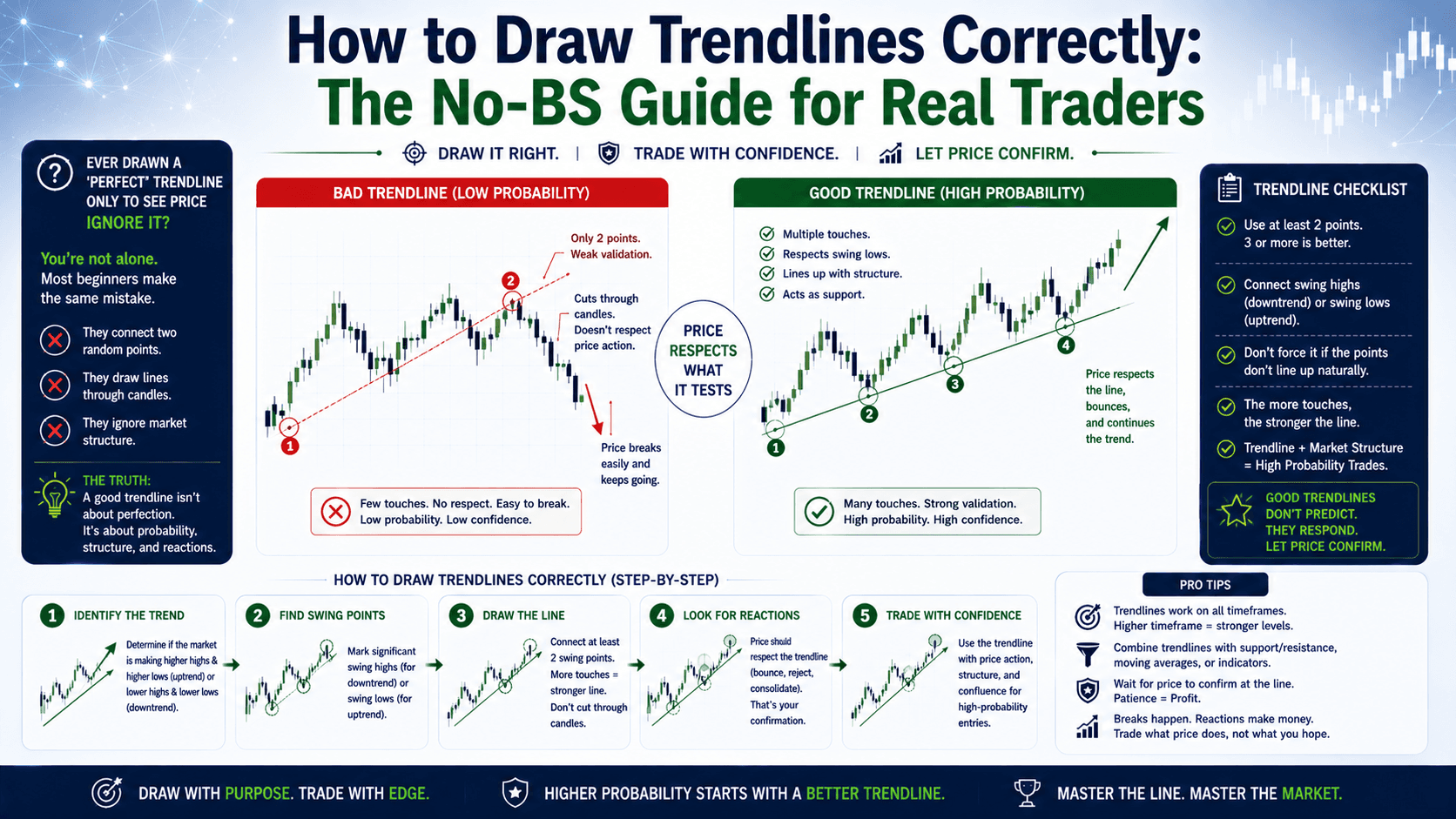
Every valid pattern has a clear outline — either a horizontal level, a trendline, or both. If you can't draw a clean line around it, skip it.
Example: A Head and Shoulders pattern has a horizontal neckline. A triangle has two converging trendlines. A flag has parallel trendlines.
The rule: If the outline isn't obvious to your eye within 3 seconds, move on.
Step 2: Check the Trend Context
Patterns don't exist in a vacuum. They form within a trend — and the trend determines whether the pattern is high-probability or low-probability.
- Reversal patterns work best after extended trending phases. A double top after a 200-pip rally? High probability. A double top in a 20-pip range? Noise.
- Continuation patterns work best in strong, established trends. A flag in a downtrend that's already dropped 300 pips? Great. A flag in a sideways market? Skip.
Step 3: Look for "Trading Into the Outline"
This is the hidden signal most traders miss. Watch how price behaves inside the pattern before the breakout.
If you see the price "sticking" to the outline level — touching it repeatedly without bouncing away — that's a sign the opposing side has given up. The breakout is coming.
Example: In a rectangle pattern, if price keeps hitting the resistance level and barely pulls back, the sellers have no power. The breakout up is likely.
Step 4: Wait for a Confirmed Breakout
Rule #1: No mid-candle decisions. Wait for the candle to fully close outside the pattern outline.
This one rule alone will save you from 70% of false breakouts. Yes, you'll miss a few fast moves. But over 100 trades, you'll win more than you lose.
Confirmation filters to use:
- Intrabar filter: Price must close outside the outline by at least 1-2 pips
- Multiple close filter: Wait for 2 consecutive closes outside the outline
- Percentage filter: Price must move X% beyond the outline (e.g., 0.5% for EUR/USD)
Step 5: Set Your Stop and Target
Your stop goes inside the pattern, beyond the opposite side of the outline. Your target is calculated from the pattern's height.
Let's use a real example:
EUR/USD is at 1.0850. You see a double bottom pattern. The neckline (resistance) is at 1.0880. The bottom troughs are at 1.0820. Pattern height = 60 pips.
- Entry: Buy at 1.0885 (above neckline with a 5-pip filter)
- Stop: 1.0810 (10 pips below the trough)
- Target: 1.0880 + 60 pips = 1.0940
- Risk:Reward: 75 pips risk / 55 pips reward = 1:0.73
Is that a good trade? Depends on your win rate. If you win 60% of the time, the expected value is positive. If you win 40%, it's negative. Always calculate before entering.
Comparison Table: Reversal vs. Continuation Patterns
| Feature | Reversal Patterns | Continuation Patterns |
|---|---|---|
| Purpose | Signal trend change | Signal trend pause |
| Best context | After extended trend | Within strong trend |
| Examples | H&S, Double Top/Bottom, Wedge | Flag, Pennant, Rectangle |
| Breakout direction | Opposite of prior trend | Same as prior trend |
| Failure rate | Moderate (30-40%) | Lower (20-30%) |
| Retracement frequency | Common after breakout | Less common |
The Wrong Way vs. The Right Way
The wrong way: You see a triangle on EUR/USD. You enter immediately at 1.0870 because "it looks like it's breaking out." The candle hasn't closed yet. Price reverses and hits your stop at 1.0850. You lose 20 pips.
The right way: You wait for the candle to close at 1.0875. You enter at 1.0875 with a stop at 1.0845 (30 pips below the breakout). Target: 1.0930 (calculated from pattern height of 55 pips). Risk:Reward = 1:1.83. Even if you win only 50% of the time, this trade is profitable over 100 trades.
FAQ
How do I know if a chart pattern is valid?
A valid pattern has a clear outline (support/resistance or trendline), forms in the context of a trend, and shows "trading into the outline" behavior before the breakout. If any of these is missing, it's likely noise.

What's the best chart pattern for beginners?
Start with the Double Top and Double Bottom. They're easy to spot, have clear entry/exit rules, and work well on daily and 4-hour timeframes. Avoid wedges and triangles until you have more experience.
How much should I risk per chart pattern trade?
Risk 1-2% of your account per trade. On a $1,000 account, that's $10-$20 max loss per trade. Calculate your position size based on your stop loss distance, not the other way around.
Can chart patterns be used with other indicators?
Yes. Divergences on RSI or MACD work well with reversal patterns. Moving averages (50 or 100 period) help confirm trend direction for continuation patterns. But don't overcomplicate — patterns alone can be enough.
Quick Recap
- Chart patterns are connectors between market phases — reversal or continuation
- Use the 5-step framework: outline → context → trading into outline → confirmed breakout → stop & target
- Always wait for the candle to close outside the pattern before entering
- Calculate your risk:reward ratio before every trade
- Focus on 2-3 patterns and master them instead of memorizing 20
Quick Win: Do This Today
Open your chart. Pull up EUR/USD on the 4-hour timeframe. Scroll back 2 weeks. Find the last 3 patterns that formed — even if you didn't trade them. Draw the outline. Note the trend context. Check if the breakout was confirmed. This takes 5 minutes and trains your eye faster than any course.