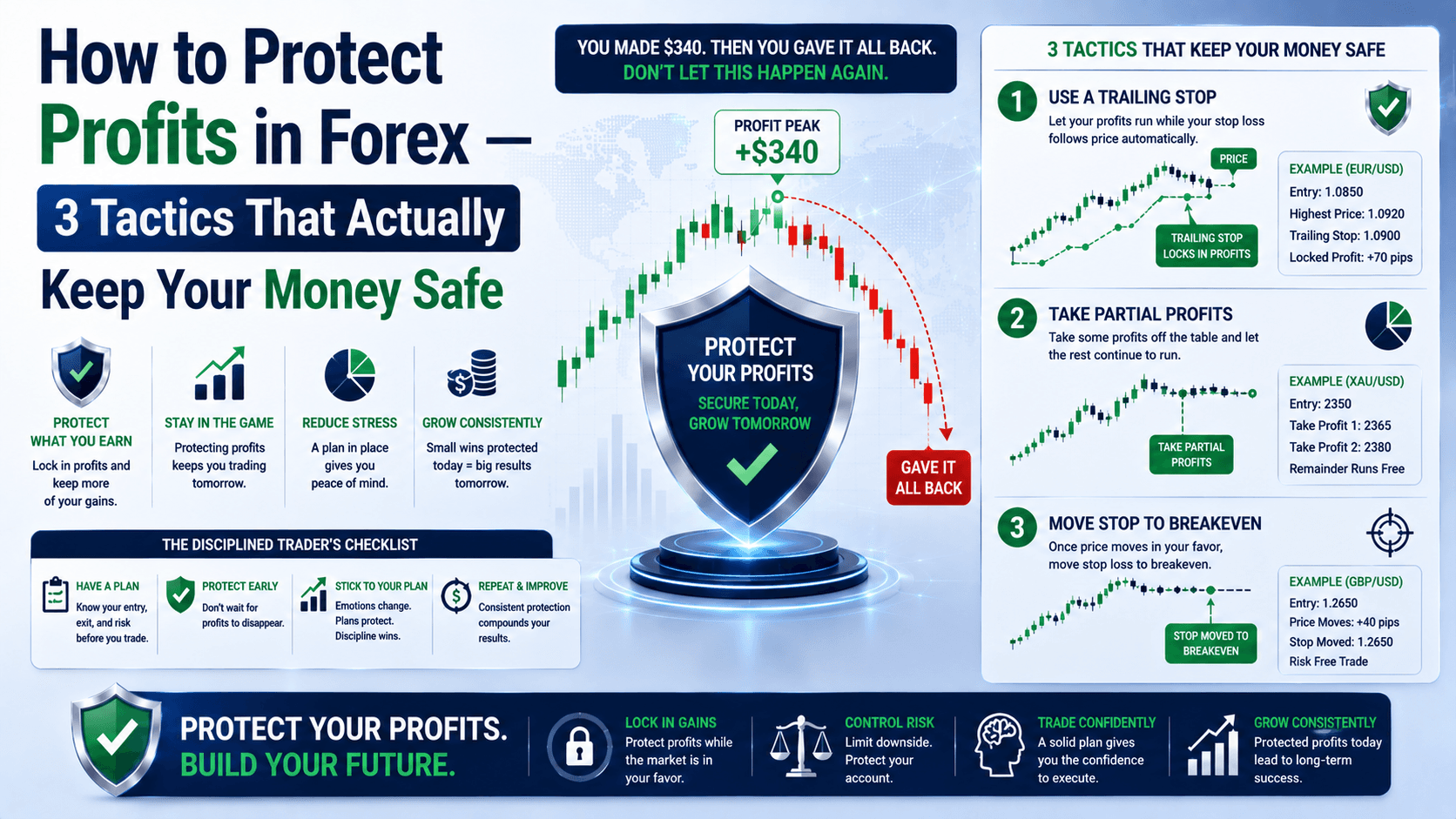

You Made $340. Then You Gave It All Back. Sound Familiar?
You had a good week. Three winning trades in a row on EUR/USD. You were up $340 on a $2,000 account. Feeling like a pro.
Then Thursday happened. You took one trade without a stop loss. Price reversed 50 pips. Your $340 profit turned into a $120 loss.
And by Friday? You were chasing losses, revenge trading, and down $280 total.
I've been there. I blew my first account doing exactly this — making money, then giving it all back because I had no clue how to protect profits in forex.
Here's the hard truth: Making money is the easy part. Keeping it is the skill.
Let me show you 3 specific tactics that changed everything for me. Real numbers. Real examples. No fluff.
Tactic #1: The Trailing Stop — Let Your Winners Run Without Letting Them Escape
Most beginners set a fixed take-profit and walk away. The trade hits their target, they're happy. But what if price would have run another 80 pips?
That's the problem with fixed targets — you're capping your upside.
A trailing stop solves this. It follows price as it moves in your favor. If price reverses, the stop locks in your profit at the best level.
How to Set It Up (Step by Step)
Step 1: Enter your trade. Let's say you buy EUR/USD at 1.0850 with a 20-pip initial stop at 1.0830.
Step 2: Set a trailing stop of 15 pips. This means the stop will always stay 15 pips below the current price.
Step 3: Price moves to 1.0880 (+30 pips). Your trailing stop automatically moves to 1.0865 (15 pips below). You've now locked in a 15-pip profit minimum.
Step 4: Price continues to 1.0920 (+70 pips). Your stop is now at 1.0905. If price reverses here, you walk away with a 55-pip profit — not the full 70, but far better than a fixed target of 30 pips.
| Scenario | Fixed TP (30 pips) | Trailing Stop (15 pips) |
|---|---|---|
| Price hits +30 pips, then reverses | +30 pips ✅ | +15 pips ✅ |
| Price runs to +70 pips, then reverses | +30 pips | +55 pips 🏆 |
| Price runs to +120 pips, then reverses | +30 pips | +105 pips 🏆 |
On a 0.1 lot position, that's the difference between $30 and $105 on one trade.
Pro tip: Set your trailing stop distance based on market volatility. For EUR/USD in normal conditions, 15-20 pips works well. For Gold (XAU/USD), use 300-500 pips because it moves faster.
Tactic #2: The 1:2 Risk-Reward Rule — Stop Trading Hopium
Here's the math that protects your profits: Never take a trade where your potential loss is bigger than half your potential gain.

That means a minimum 1:2 risk-reward ratio. Risk $50 to make $100. Risk $20 to make $40.
Why This Works (The Numbers Don't Lie)
Let's say you take 10 trades with a 1:2 risk-reward ratio. You risk $50 per trade to make $100.
- You win 4 trades: 4 × $100 = +$400
- You lose 6 trades: 6 × $50 = -$300
- Net result: +$100 — even though you were wrong 60% of the time
Now compare that to a beginner who takes trades with a 1:1 ratio (risk $50, aim for $50):
- Win 4 trades: 4 × $50 = +$200
- Lose 6 trades: 6 × $50 = -$300
- Net result: -$100 — losing money despite the same win rate
| Win Rate | 1:1 Ratio | 1:2 Ratio | 1:3 Ratio |
|---|---|---|---|
| 30% | -$400 | -$100 | +$200 ✅ |
| 40% | -$200 | +$100 ✅ | +$400 |
| 50% | $0 | +$300 | +$600 |
| 60% | +$200 | +$500 | +$800 |
The lesson: You don't need to be right most of the time. You just need your winners to be bigger than your losers.
Your action item: Before every trade, write down your stop loss distance and your target distance. If the ratio is less than 1:2, don't take the trade. Period.
Tactic #3: The 1% Rule — Never Risk More Than You Can Lose Twice
This is the single most important rule I teach. Risk no more than 1% of your account on any single trade.
Why 1%? Because it keeps you in the game. Even if you lose 10 trades in a row, you've only lost 10% of your account. You can recover from that.
How to Calculate Your Position Size
Let's use a real example with a $3,000 account:
- 1% of $3,000 = $30 — this is your max risk per trade
- You want to trade EUR/USD at 1.0850 with a 20-pip stop loss
- On a mini lot (0.1), 1 pip = $1. A 20-pip stop = $20 risk
- $20 is under $30, so you can trade 0.1 lots ✅
- If your stop was 40 pips: 40 × $1 = $40 risk — too much. Drop to 0.05 lots: 40 × $0.50 = $20 risk ✅
Common mistake at this step: Beginners set their stop loss after choosing their lot size. Wrong. Choose your stop loss based on the chart (support/resistance), then calculate the lot size that keeps risk at 1%.
The Wrong Way vs. The Right Way
Wrong way: "I'll risk $100 on this Gold trade. If it works, I make $300. If it doesn't, I'll just trade more tomorrow."
Right way: "I have a $5,000 account. 1% = $50 max risk. Gold is at $2,350. My stop loss is 500 pips away. On 0.1 lots, 500 pips × $1 = $500 risk — way too much. I drop to 0.01 lots: 500 × $0.10 = $50 risk. Perfect."
FAQ
How do I protect profits in forex without limiting my upside?
Use a trailing stop. It locks in profits as price moves in your favor without capping your maximum gain. Set it 15-20 pips below current price for EUR/USD, wider for volatile pairs like Gold.

What's the best risk-reward ratio for forex?
Minimum 1:2. That means risking $1 to make $2. This allows you to be wrong 60% of the time and still be profitable. Higher ratios like 1:3 are even better.
How much should I risk per forex trade?
Risk 1% of your account per trade. On a $2,000 account, that's $20 max. This ensures you can survive losing streaks without blowing your account.
Should I use a fixed take-profit or a trailing stop?
Use a trailing stop for trending markets — it lets profits run. Use a fixed take-profit for range-bound markets where price reverses at clear levels. Know which market you're in.
📝 Quick Recap
- Trailing stops lock in profits while letting winners run — set them 15-20 pips away for EUR/USD
- 1:2 risk-reward minimum — you can be wrong 60% of the time and still make money
- 1% risk per trade — calculate lot size AFTER setting your stop loss, not before
Your Quick Win (Do This in 5 Minutes)
Open your trading platform right now. Look at your last 5 trades. For each one, calculate:
- What was your risk-reward ratio?
- Did you use a trailing stop or fixed take-profit?
- What percentage of your account did you risk?
If any trade had a ratio below 1:2 or risked more than 1%, that's your first fix. Write it down. Next trade, you do it right.
That's how you protect profits in forex. Not with fancy indicators. With simple rules you actually follow.