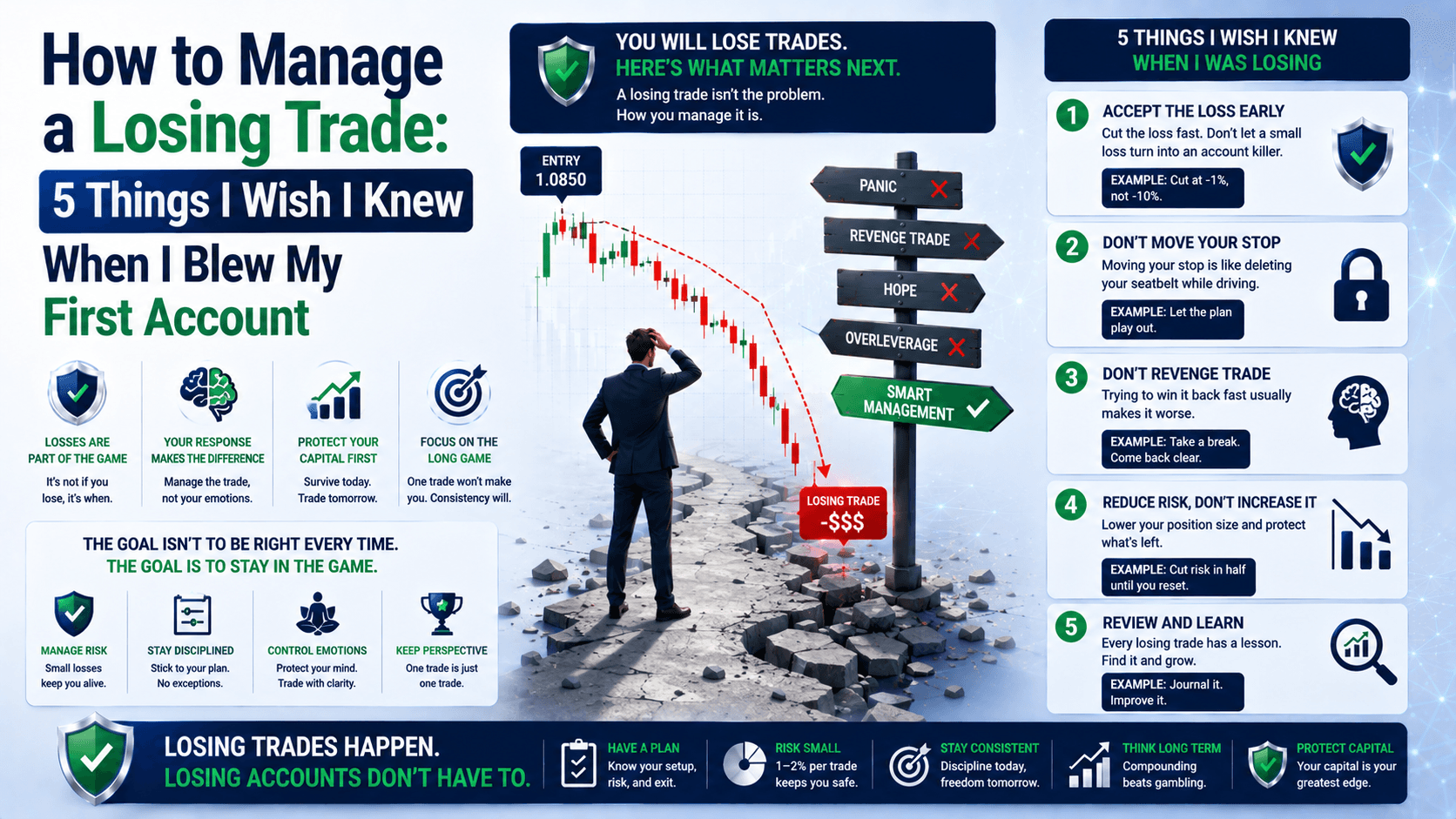

You Will Lose Trades. Here's What Matters Next.
Let me save you a few thousand dollars and a lot of heartache: you will lose trades. I don't care if you have a 90% win rate — that 10% will hit you, and it will hit you hard if you don't know how to manage a losing trade.
When I started trading Gold (XAU/USD) over a decade ago, I thought I was invincible. My first 10 trades? Winners. I was on top of the world. Then trade #11 happened. EUR/USD was at 1.0820, I went long, and it dropped 150 pips in 3 hours. I didn't have a stop loss. My $2,000 account became $800 overnight.
That's the day I learned the difference between a trader and a gambler. A gambler hopes. A trader manages.
Here's the truth: how you manage a losing trade determines whether you trade next week or sit on the sidelines for months. Let me show you exactly what I do now — with real numbers, real trades, and zero fluff.
What Most Traders Get Wrong About Losing Trades
The biggest mistake? They treat a losing trade like a problem to be fixed — not a cost of doing business.
Let me paint you a picture. You're in a EUR/USD trade. You bought at 1.0850. Price drops to 1.0830. Your heart starts racing. You think, "It'll bounce, I'll just hold a little longer." Price hits 1.0810. Now you're down 40 pips. On 0.1 lots, that's $40. On 1.0 lots? $400. You're frozen. You can't cut the loss because "it's too much to lose." So you hold. Price hits 1.0780. Now you're down 70 pips — $700 on 1.0 lots.
Sound familiar?
That's not managing a losing trade. That's hoping. And hope is not a strategy.
The correct approach is brutally simple: accept the loss the moment it violates your trade plan. Not when it hurts. Not when it's too big to ignore. The moment.
Step 1: The 1% Rule — Your Account's Seatbelt
Before you even enter a trade, you need to know one number: how much are you willing to lose?

Professional traders risk 1% of their account per trade. Max. Some stretch to 2%. Never more.
| Account Size | 1% Risk ($) | 2% Risk ($) |
|---|---|---|
| $500 | $5 | $10 |
| $1,000 | $10 | $20 |
| $5,000 | $50 | $100 |
| $10,000 | $100 | $200 |
| $50,000 | $500 | $1,000 |
Let's math it out. You have a $2,000 account. You risk 1% per trade = $20 max loss. You're trading EUR/USD at 1.0850. Your stop loss is 20 pips away. On 0.1 lots, 1 pip = $1. So 20 pips = $20 risk. Perfect. That's your trade size.
Now, what happens when that trade loses? You lose $20. Your account drops to $1,980. You trade again. Next trade, you risk 1% of $1,980 = $19.80. Your risk shrinks with your account. That's how you survive losing streaks.
⚠️ Common mistake: Traders risk the same dollar amount every trade. If you risk $20 on trade #1 and lose, then risk $20 again on trade #2, you're actually risking 1.01% of your new $1,980 balance. It's small, but over 10 losses, it adds up. Always recalculate based on your current balance.
Step 2: Set Your Stop Loss Before You Enter — No Exceptions
This is non-negotiable. Your stop loss is your line in the sand. It says, "If price goes here, I was wrong, and I'm out."
Here's how to set it:
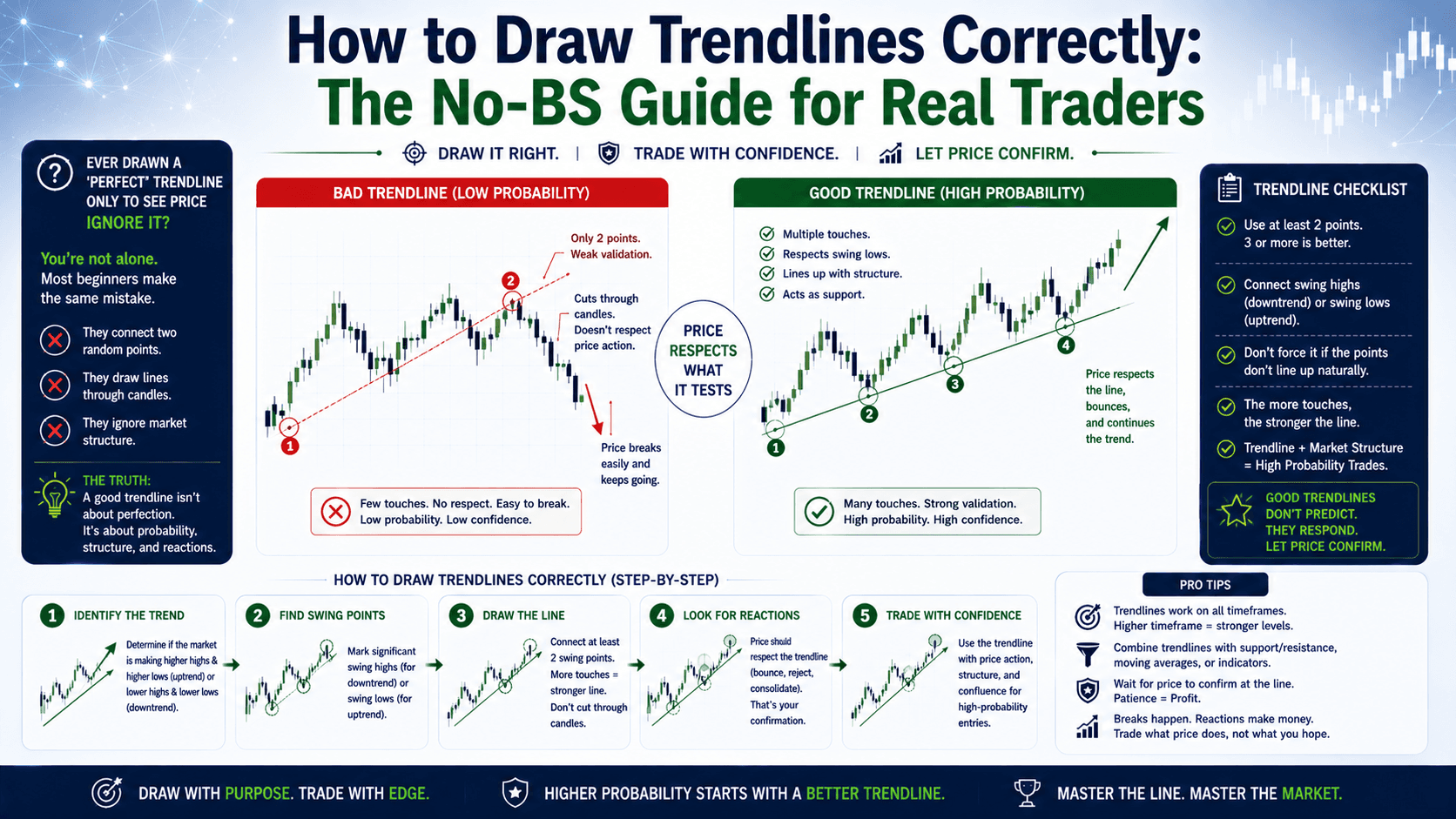
- Technical stop: Place it below a recent swing low (for long trades) or above a recent swing high (for short trades). Give it 5-10 pips of breathing room so you don't get stopped out by noise.
- Dollar stop: Calculate the pip distance from entry to stop. Multiply by your lot size. That's your dollar risk. It must be within your 1% limit.
- Time stop: If the trade hasn't moved in your direction within X hours (e.g., 4 hours for a day trade), close it. Time is money.
Wrong way: "I'll set a stop loss after I enter the trade." No. You set it before you click "Buy" or "Sell." Every time.
Right way: You see a setup on GBP/USD. Entry at 1.2650. Stop at 1.2620 (30 pips). On 0.1 lots, that's $30 risk. Your $3,000 account can handle that (1%). You enter. Done.
Step 3: The 3 Things You Do When a Trade Goes Against You
You're in the trade. Price is moving against you. Here's your checklist — follow it in order:
- Check your stop. Is it still in place? Yes? Good. Don't move it. Don't widen it. Let it do its job.
- Ask yourself: "Is my analysis still valid?" If the reason you entered the trade is still there (e.g., support level held, trend is intact), hold. If not, close the trade early. Don't wait for the stop to get hit.
- If price hits your stop, you're done. Close the chart. Walk away for 30 minutes. No revenge trading. No "I'll get it back on the next trade."
💡 Pro tip: I keep a post-it note on my monitor: "The market doesn't care about your opinion. Cut the loss. Live to trade tomorrow."
Step 4: The Recovery Plan — How to Bounce Back
You just lost 3 trades in a row. Your $2,000 account is now $1,940. You're frustrated. Your confidence is shaken. What now?
Step 4a: Stop Trading
Seriously. Close the platform. Go for a walk. Play with your dog. Watch a movie. Do not trade until you're calm. Emotional trading is how you turn a $60 loss into a $600 loss.
Step 4b: Analyze the Losses
Open your trading journal (you have one, right?). Answer these questions:
- Did I follow my plan? (If yes, the loss was part of the game. Move on.)
- Did I break my rules? (If yes, identify the trigger — was it boredom? Fear of missing out?)
- Was the market condition unusual? (News event? High volatility? Adjust your strategy.)
Example: You lost on a EUR/USD trade during the US Non-Farm Payrolls release. That's a high-volatility event. Your strategy might not work during those 30 minutes. Solution: avoid trading during news releases.
Step 4c: Reduce Your Risk
After a losing streak, drop your risk to 0.5% per trade for the next 10 trades. This rebuilds your confidence and protects your account. You're not trying to "get it all back" — you're trying to survive.
FAQ
How do I mentally handle a losing trade?
Accept that losses are part of the business. No strategy wins 100% of the time. Focus on the process, not the outcome. If you followed your plan, the loss was correct. Move to the next trade.

Should I ever average down on a losing trade?
No. Averaging down (adding to a losing position) is a gamble, not a strategy. It increases your risk and can blow your account. Cut the loss and look for a better entry later.
What's the best risk-reward ratio for managing losing trades?
Aim for at least 1:2 (risk $10 to make $20). With a 1:2 ratio, you only need to win 34% of your trades to be profitable. That gives you plenty of room for losing trades.
How many losing trades in a row should I tolerate?
It depends on your strategy, but a good rule is: after 3 consecutive losses, stop trading for the day. After 7 consecutive losses in a week, stop trading for the week. Review your strategy and market conditions.
Quick Recap
- Risk 1% per trade. Never more. Your account survives losing streaks.
- Set your stop loss before you enter. No exceptions. It's your safety net.
- When a trade goes against you, check your stop, check your analysis, and if it hits, you're done. No revenge trading.
- After a losing streak, stop, analyze, and reduce your risk. Survival comes first.
- Losses are tuition. Learn from them, don't let them destroy you.
Your Quick Win
Open your trading platform right now. Look at your last 3 losing trades. For each one, write down:
- The entry price
- The stop loss you used (or didn't use)
- How much you lost in dollars
- Whether you followed your plan
If you didn't have a stop loss on any of them, that's your #1 priority to fix. If you did, but you moved it wider, that's your #1 priority. One change: commit to setting your stop loss before every trade this week. That's it. One rule. See how it changes everything.