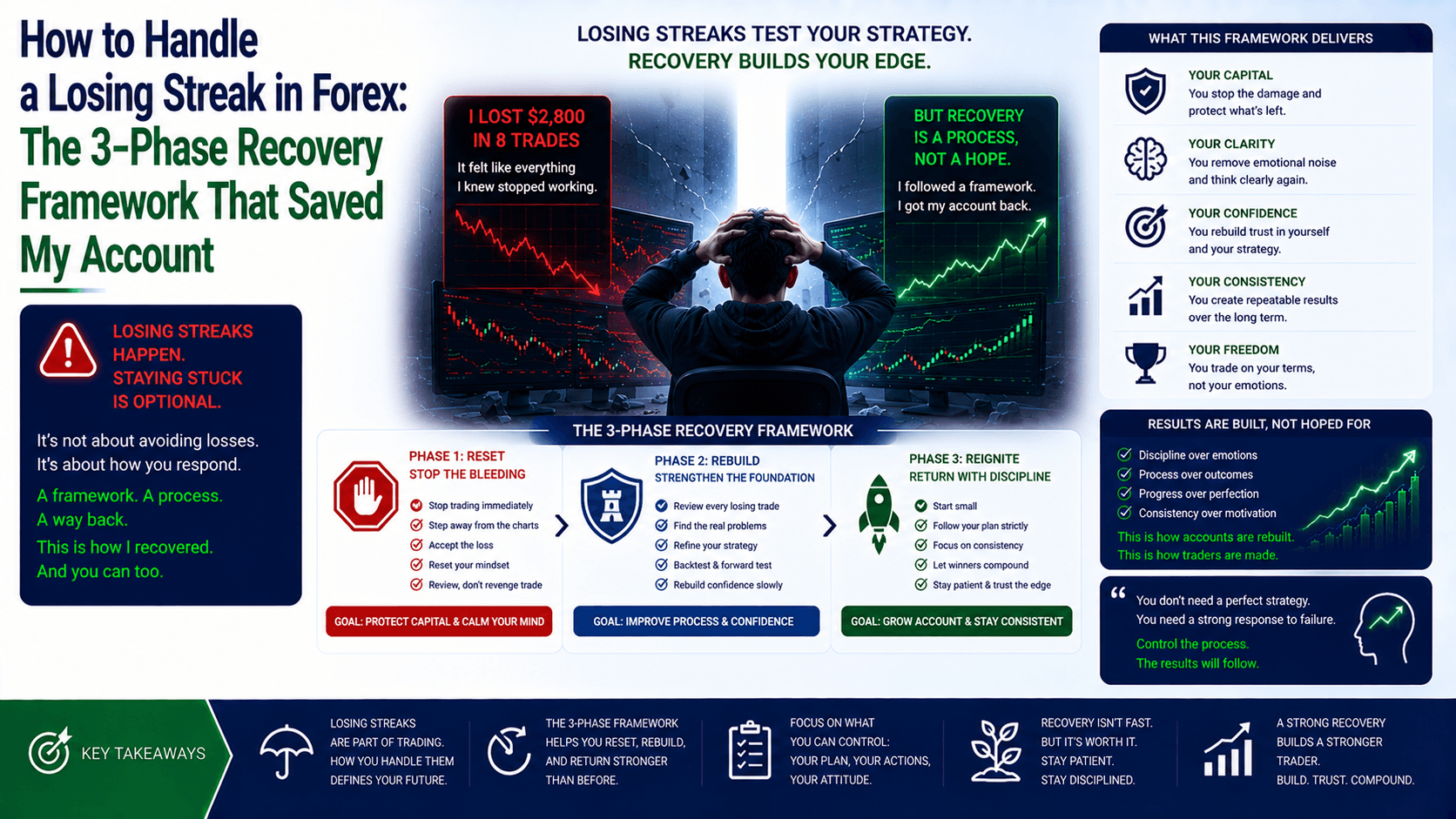

I Still Remember the Week I Lost $2,800 in 8 Trades
It was a Tuesday. I was trading Gold (XAU/USD), my specialty. I had a solid setup, a clear entry at $2,350, and a stop loss 15 pips away. Standard stuff.
Then price spiked 8 pips past my stop, hit it, and reversed. Classic.
I was down $120 on 0.8 lots.
What did I do? I took the next trade immediately. Then another. And another. By Friday, I had taken 8 trades. All losers. My account was down $2,800.
That's when I realized: the losing streak wasn't the problem. My reaction to it was.
Here's the thing nobody tells you about how to handle a losing streak — it's not about willpower. It's about having a system. A structured recovery framework that turns a losing streak from an emotional crisis into a diagnostic opportunity.
Let me walk you through the exact 3-phase framework I use now. And still use, 10 years later.
Phase 1: Diagnose the Streak (Before You Do Anything Else)
Most traders skip this step. They see a few red numbers and immediately assume their strategy is broken. So they change it. Which usually makes things worse.
Here's what I do instead. I pull up my last 20 trades and run through a diagnostic checklist. I'm looking for one of three root causes:
- Strategy problem: Your setup stopped working because market conditions shifted. A breakout strategy that crushed it in a trending market will bleed in choppy, range-bound conditions.
- Execution problem: Your strategy is fine, but you're not following it. You're entering early, moving stops, or revenge trading.
- Market condition problem: The market itself changed. Low volatility, news-driven chop, holiday volume. No strategy thrives in every environment.
Here's the key question to ask: Are your "rules followed" trades still profitable? If yes, it's an execution problem. If no, it's a strategy or market problem.
Let me give you a real example. Remember that $2,800 losing streak I mentioned? When I filtered my trades by time of day, I discovered something painful: 6 of those 8 trades happened after 1:00 PM. My morning trades were still profitable. I was trading outside my best window.
The diagnosis changed everything. I didn't need a new strategy. I needed to stop trading after lunch.
Phase 2: Stabilize the Bleeding (The Hard Part)
Once you know the cause, the goal shifts. You're not trying to make money. You're trying to stop the bleeding and rebuild confidence through controlled, disciplined trading.

Here's the protocol I use. It's based on the number of consecutive losses and account impact. Let's assume a $10,000 account with $100 risk per trade (1% of capital).
| Level | Consecutive Losses | Account Impact | What You Do |
|---|---|---|---|
| Normal Variance | 2-3 | -$200 to -$300 | Review trades. If rules followed, continue at full size. |
| Caution | 4-5 | -$400 to -$500 | Cut position size by 50%. Trade only your top 2 setups. |
| Warning | 6-7 | -$600 to -$700 | Stop trading for the session. Full journal review. |
| Critical | 8-10 | -$800 to -$1,000 | Take 1-3 days off. Backtest your strategy on recent data. |
| Emergency | 10+ | -$1,000+ | Paper trade 1-2 weeks. Re-enter at 25% size. |
The most important rule? Cut your position size by 50% at the first sign of a losing streak. If you normally risk $100 per trade, drop to $50. This isn't about limiting losses — it's about reducing emotional pressure. A $50 loss feels very different from a $100 loss when you're already down $400.
And here's the trap most traders fall into: they take one winning trade at reduced size, think "I'm back," and immediately return to full size. Then they take another loss and spiral again.
Don't do that. Stabilization takes time.
Phase 3: Rebuild with the 10-Trade Rule
How do you know you're ready to size back up? Not by your P&L. By your process.
I use what I call the 10-Trade Rule: you're ready to increase size only after you've completed 10 consecutive rule-following trades. Not 10 consecutive wins. 10 trades where you followed every rule — correct entry, correct stop, correct exit, correct position size.
Here's the graduated recovery I use:
- During the streak: 50% of normal risk ($50 on a $10,000 account)
- Stage 1 (first 3-5 rule-following trades): Stay at 50% risk
- Stage 2 (next 3-5 rule-following trades): Move to 75% risk ($75)
- Stage 3 (net positive for the week): Return to 100% risk ($100)
This approach protects you from the "double dip" — where a premature return to full size turns a recovering week into another losing week. It also rebuilds confidence gradually, which matters more than most traders admit.
The Math: Why Losing Streaks Are Inevitable (And Why You Need a System)
Let me show you the numbers that changed my perspective forever.
If your win rate is 55%, the probability of any single sequence of 5 trades all being losers is 0.45 to the fifth power — about 1.8%. That sounds rare. But over 250 trades in a year, you have roughly 246 possible starting points for a 5-trade sequence. The probability of experiencing at least one 5-trade losing streak? Over 98%.
Here's what that looks like at different win rates:
- 40% win rate: Multiple 5-trade losing streaks per year. Guaranteed.
- 50% win rate: Expect 2 to 3 per year.
- 55% win rate: Expect 1 to 2 per year.
- 60% win rate: Still happens. Variance is real.
The takeaway? If you're a profitable trader and you experience a 5-trade losing streak, the most likely explanation is math, not a broken strategy. Your trading expectancy hasn't changed. The variance within that expectancy just showed up in a cluster.
The problem isn't the losing streak. It's what you do next.
FAQ
Is a losing streak a sign that my strategy is broken?
Not necessarily. Even profitable strategies with a 55% win rate will experience 5-trade losing streaks 1-2 times per year. The key is to diagnose whether the streak is variance or a real strategy failure by checking if your "rules followed" trades are still profitable.

Should I stop trading during a losing streak?
Yes, but only after a specific threshold. For most traders, 4-5 consecutive losses is the warning level where you should cut position size by 50%. At 6-7 losses, stop trading for the session. At 8-10 losses, take 1-3 full days off.
How do I know when to size back up after a losing streak?
Use the 10-Trade Rule: only increase size after 10 consecutive rule-following trades (not 10 wins). Then use a graduated recovery: 50% risk first, then 75%, then full size only after a net positive week.
What's the most common cause of a losing streak?
Execution problems — not following your rules. Most traders change their strategy during a losing streak when the real issue is emotional discipline. Always diagnose first by checking if your "rules followed" trades are still profitable.
📝 Quick Recap
- Diagnose first: Is it a strategy problem, execution problem, or market condition problem? Check your "rules followed" trades.
- Cut size immediately: At 4-5 consecutive losses, drop to 50% position size. This reduces emotional pressure.
- Use the 10-Trade Rule: Only size back up after 10 consecutive rule-following trades. Process over P&L.
- Losing streaks are math: Even a 55% win rate strategy will hit a 5-trade losing streak 1-2 times per year. It's normal.
Your Quick Win
Open your trading journal right now. Filter your last 20 trades. Tag each one as "rules followed" or "rules broken." If more than 40% are "rules broken," you've found your problem. Fix your execution before you touch your strategy.
Trust me on this one. I learned it the hard way — $2,800 worth.