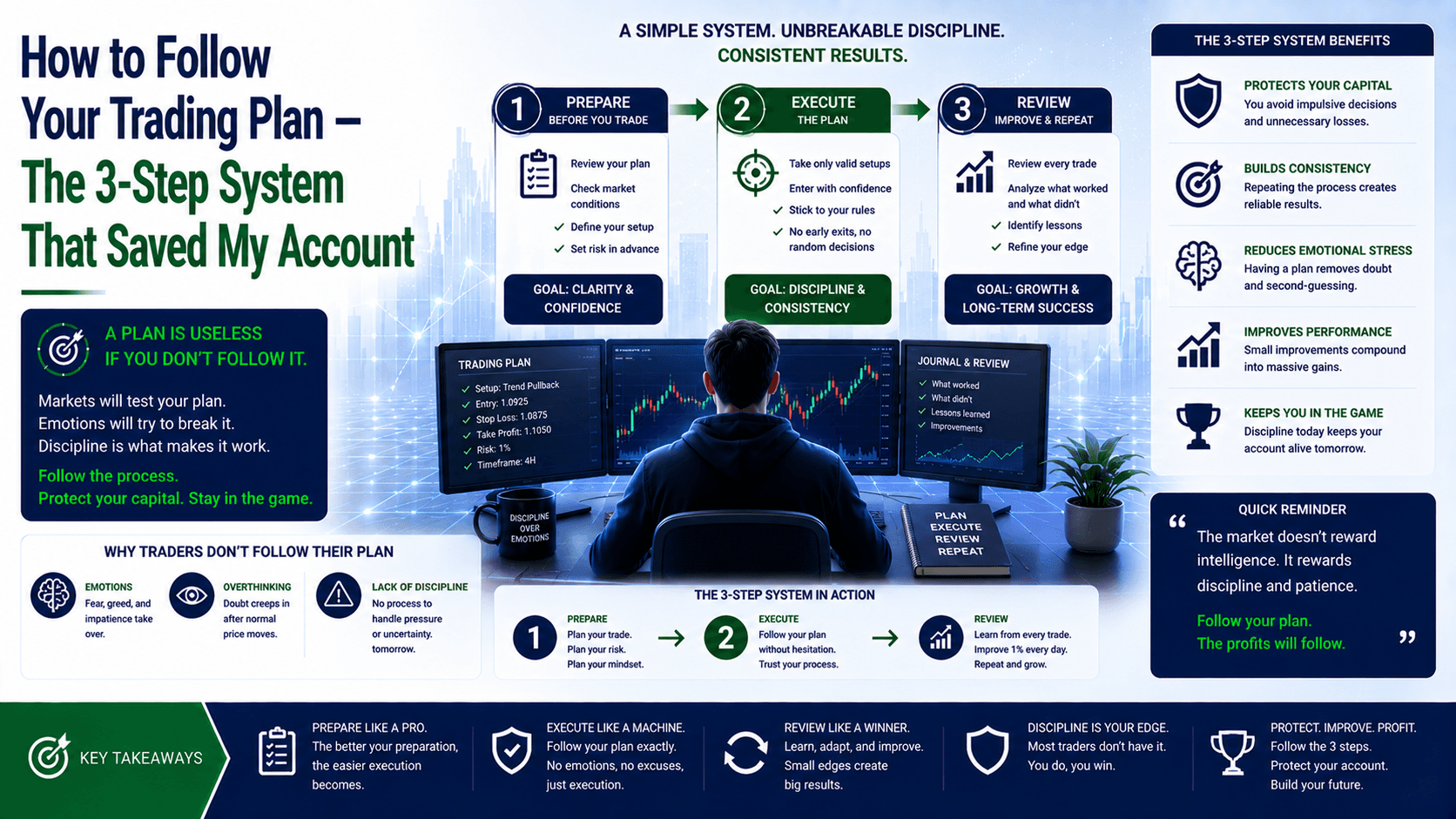

Let's get something straight. You have a trading plan. You spent hours building it. Maybe you even backtested it. But when the trade goes against you by 15 pips, your hand hovers over the mouse, and suddenly the plan goes out the window.
I've been there. More times than I'd like to admit.
The difference between winning traders and everyone else isn't a better strategy. It's the ability to follow your trading plan when everything in your body screams to do the opposite.
Here's the truth: you don't need a better plan. You need a system to actually follow the one you have.
Why 90% of Traders Can't Follow Their Own Plan
You know the feeling. EUR/USD is at 1.0850. Your plan says: "Enter long on a bullish engulfing candle at support, stop at 1.0830, target 1.0900." The candle forms. You enter. Price drops 5 pips. Your stomach drops with it.
Then price bounces and hits your target. You made $50 on 0.1 lots. But in that moment of panic, you almost closed the trade early.
That's the problem. Your trading plan is logical. Your brain is emotional. And when the two clash, emotion wins almost every time.
The math is brutal: if you can't follow your rules, your strategy doesn't matter. A 60% win-rate strategy followed 50% of the time is worse than a 40% win-rate strategy followed 90% of the time.
The 3-Step System to Actually Follow Your Trading Plan
After blowing my first account (yes, really), I developed a simple system. Three steps. No fluff. Here it is:
Step 1: Shrink Your Rules to One Page
Most traders have a 10-page trading plan. Entry rules, exit rules, 15 indicators, 3 timeframes, and a partridge in a pear tree. Good luck remembering all that when price is moving fast.
Here's what I did: I condensed my entire plan onto one page. Literally. Print it out. Tape it to your monitor.
Your one-page plan should have:
- Entry criteria — 1-2 specific setups (e.g., "Buy when price touches 50 EMA and RSI is above 30")
- Stop loss — Fixed level, not a percentage of your account
- Take profit — Fixed level or trailing stop rule
- Max risk per trade — A dollar amount, not a percentage
- Daily loss limit — When you stop trading for the day
Example: My own plan for EUR/USD says: "Enter long when price touches 1.0830 support with a bullish pin bar. Stop at 1.0810. Target 1.0870. Max risk $20 per trade. If I lose 3 trades in a row, stop for the day."
That's it. Five lines. I can read it in 10 seconds while a trade is open.
Step 2: Set Up Your Trade Before You Enter
Here's the mistake most beginners make: they see a setup, enter the trade, and then figure out their stop and target. By the time they set their stop, price has already moved 5 pips against them.
Do it in reverse. Before you click "buy" or "sell":
- Decide your entry price
- Set your stop loss
- Set your take profit
- Calculate your position size
- Then enter the trade
This forces you to think about the downside before the upside. It also means your stop and target are already in the market before emotions kick in.
Real example: You want to trade Gold (XAU/USD) at $2,350. Your plan says: "Enter long on a bounce from $2,340 support. Stop at $2,330. Target $2,360. Risk 2% of $5,000 account = $100."
Before you enter, calculate: $2,340 entry, $2,330 stop = 10 pip risk. On 1.0 lots, that's $100 risk. Perfect. Now enter.
If price hits $2,330, you lose $100. That's fine — it's within your plan. You don't panic. You don't move the stop. You just take the loss and move on.
Step 3: Create a "No-Trade" Checklist
This is the step nobody talks about. Most traders focus on when to trade. The pros focus on when not to trade.
Before every trade, run through this checklist:
- Am I trading outside my scheduled hours? (No trading after 5 PM my time)
- Have I already hit my daily loss limit? (If yes, stop immediately)
- Is there a major news event in the next 2 hours? (If yes, skip the trade)
- Am I trying to "get back" losses from a previous trade? (If yes, step away)
- Does this setup match exactly one of my 1-2 criteria? (If no, don't enter)
If you answer "yes" to any of the first four, or "no" to the last one, you don't take the trade. Period.
This checklist alone saved me from at least 50 bad trades in my first year. It's boring. It's mechanical. And it works.
Comparison: Following Your Plan vs. Trading on Emotion
| Situation | Following Your Plan | Trading on Emotion |
|---|---|---|
| Trade goes against you by 10 pips | You hold, stop is at 20 pips | You panic-close at -8 pips |
| Trade hits your stop | You take the loss, move on | You revenge-trade double size |
| Trade hits your target | You take profit, feel good | You hold for "more," watch it reverse |
| Losing streak of 3 trades | You stop for the day | You keep trading to "win back" losses |
| Result after 100 trades | Consistent, small gains | Blown account or breakeven |
The Before/After: How I Learned to Follow My Plan
Before: I had a 20-page trading plan I never looked at. I'd enter trades on "gut feel," set random stop losses, and hold losing positions for hours hoping they'd turn around. My account dropped from $3,000 to $800 in 3 months.

After: I printed my one-page plan and taped it to my monitor. I set up my stop and target before entering. I ran my "no-trade" checklist before every trade. My account grew from $800 to $1,400 in 6 months. Not sexy. But consistent.
The difference wasn't a better strategy. It was following the one I already had.
FAQ
How do I stop myself from moving my stop loss?
Treat your stop loss as a contract with yourself. Once set, it's non-negotiable. If you can't trust yourself, use a broker's guaranteed stop-loss order (if available) or set alerts at your stop level.

What if my trading plan stops working?
Review your trading journal after 20-30 trades. If your win rate drops significantly or your drawdown exceeds 20%, tweak your plan. But don't change it after one or two losing trades — that's just emotion.
How long should I follow a plan before judging it?
At least 50-100 trades. A sample size smaller than that doesn't tell you if the plan works — it tells you if you were lucky or unlucky. Test on a demo account first if you're unsure.
Can I trade without a plan if I'm experienced?
No. Even professional traders with 20 years of experience have plans. The market is too chaotic for intuition alone. Your plan is your anchor when the storm hits.
Quick Recap
- Shrink your trading plan to one page — print it and tape it to your monitor
- Set your stop and target before you enter every trade
- Create a "no-trade" checklist and run it before every entry
- Follow your plan for at least 50 trades before judging it
Your Quick Win Today
Open your current trading plan. Cut it down to one page. Print it. Tape it to your monitor. Then, before your next trade, read it out loud. Yes, out loud. It sounds silly, but it forces your brain to process the rules before your emotions take over.
Do this for 10 trades. See what happens.
Now it's your turn. You have a plan. You know it works. The only thing standing between you and consistent profits is your ability to follow it.
Start today.