
I Lost $400 in 12 Minutes. Here's What I Learned About Emotional Trading
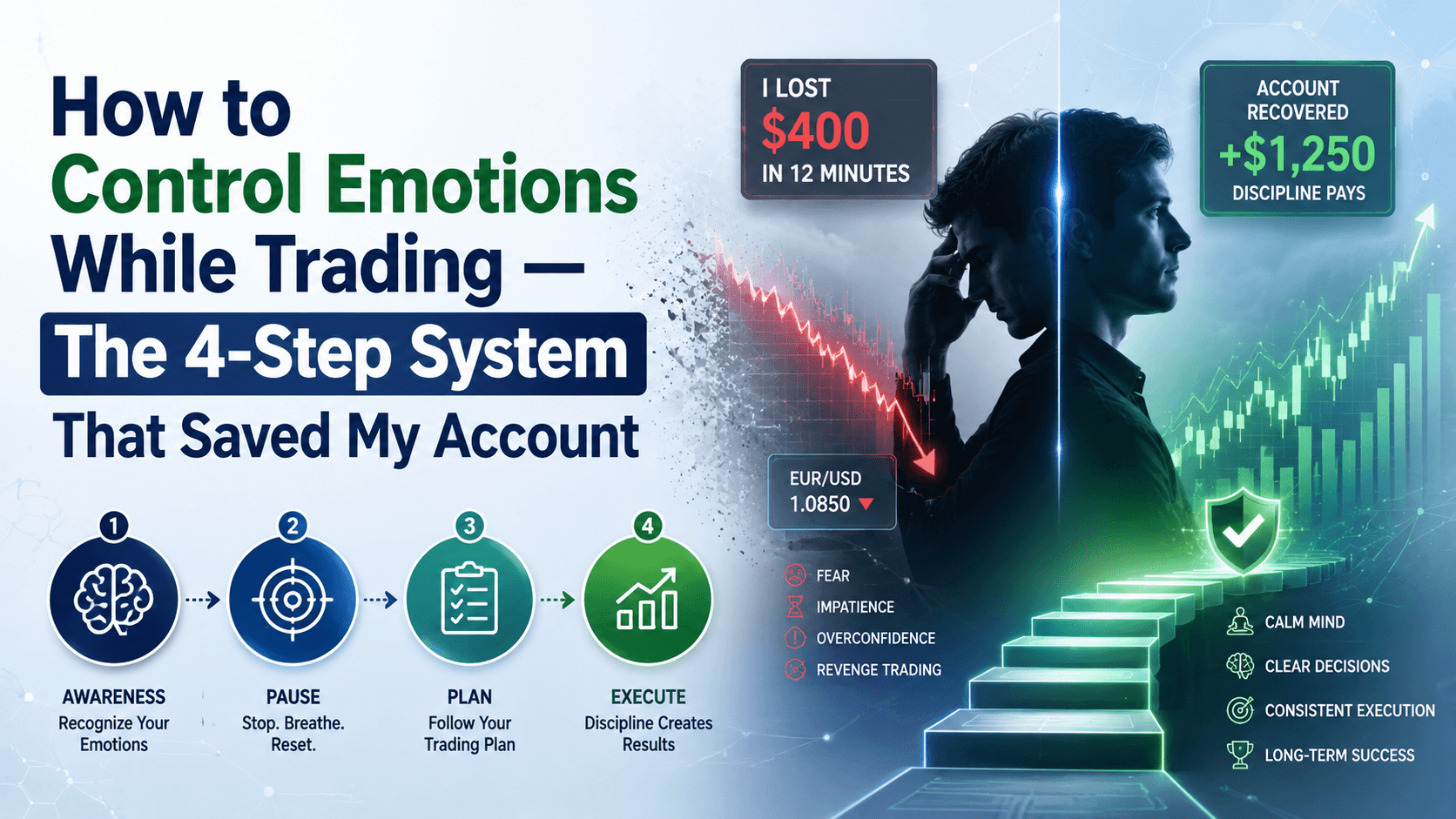
I'll never forget that Tuesday morning. EUR/USD was at 1.0850, and I saw what I thought was a perfect setup. I went long with 0.5 lots, no stop loss, convinced I was right.
Twelve minutes later, I was down $400. Price dropped 80 pips in a straight line. I didn't just lose money — I froze. I couldn't close the trade because "it had to come back."
Spoiler: it didn't.
That day, I learned the hard way that knowing how to control emotions while trading isn't a nice-to-have. It's the difference between building an account and blowing one.
Let me share what I wish someone had told me before I lost that $400.
Why Your Brain Is Working Against You (The Biology of Bad Trades)
Here's the thing nobody tells beginners: your brain is designed to keep you alive, not to make you money trading.
When you see red numbers on a losing trade, your amygdala — the part of your brain that handles fear — lights up. Your heart rate increases. Your palms sweat. And suddenly, you're not thinking about support levels or risk-reward ratios. You're thinking about survival.
This is called the fight or flight response. And it's the #1 reason why most traders lose money.
I've seen it happen a hundred times. A trader enters a position, price moves against them by 10 pips, and they panic-close for a loss. Ten minutes later, price reverses and hits their original target. That's not bad luck. That's biology.
The good news? You can train your brain to override this response. But first, you need to understand the specific emotions that hijack your decisions.
The 4 Emotions That Destroy Your Trading (With Real Numbers)
1. Fear — The Account Killer
Fear shows up in two ways. Either you don't enter a trade you should have taken, or you exit a winning trade way too early.

Let me give you a concrete example. You have a $2,000 account. You see GBP/USD at 1.2650 with a clear support level at 1.2620. Your stop loss would be 30 pips away. On 0.1 lots, that's $30 risk — 1.5% of your account. That's fine.
But fear whispers: "What if it breaks support? What if you lose more?" So you don't enter. Price hits 1.2710 the next day. You just missed 60 pips — $60 on 0.1 lots — because fear made you hesitate.
The fix: Calculate your risk BEFORE you enter. If it's within your 1-2% rule, trust the math, not the feeling.
2. Greed — The Overtrading Trap
Greed is the opposite of fear but equally dangerous. You have a winning trade, and instead of taking profit at your target, you think: "It's going higher. Let me move my take profit."
I did this with a Gold trade last year. I was long at $2,340 with a target at $2,360. Price hit $2,358, and I moved my target to $2,370. Price reversed at $2,362 and dropped to $2,330. I went from a $200 profit to a $100 loss on 0.1 lots.
That's greed costing you $300.
The fix: Set your take profit when you enter the trade. Don't move it. Ever. If you want to scale out, take partial profits at your first target and let the rest run with a trailing stop.
3. Hope — The Silent Account Drainer
Hope is the most insidious emotion because it feels positive. "Maybe it'll come back." "Just give it one more day."
Here's the math on hope. You're long USD/JPY at 150.50. Your stop loss should be at 150.10 (40 pips). But you don't set one because you're hopeful. Price drops to 150.00. Then 149.50. Then 149.00.
On 0.1 lots, that's 150 pips × $0.93/pip = $139.50 loss. But on 0.5 lots? That's $697.50. Hope just cost you a third of your $2,000 account.
The fix: Set a stop loss on EVERY trade before you click buy or sell. If you're hopeful without a stop, you're gambling, not trading.
4. Revenge — The Quickest Way to Blow Up
After a loss, your ego wants to "get it back." So you take a bigger position on the next trade. This is revenge trading, and it's a one-way ticket to a zero balance.
Let's say you lost $50 on a trade. Your account is $950. Instead of trading 0.05 lots (2% risk), you trade 0.2 lots because you want to make back that $50 fast.
Price moves against you by 20 pips. On 0.2 lots, that's $40 loss. Now your account is $910. You're down $90 total. You take another revenge trade with 0.3 lots. Price moves 15 pips against you. That's $45 more. Now you're at $865.
Three trades. One bad decision. $135 gone.
The fix: After any losing trade, walk away for at least 30 minutes. Better yet, stop trading for the day. The market will be there tomorrow.
How to Control Emotions While Trading — The 4-Step System
Here's the system I use now. It's simple, but it works because it removes the emotional decision-making from the equation.
Step 1: Pre-Trade Checklist (5 Minutes)
Before every trade, ask yourself three questions:
- Does this setup match my trading plan? (Yes/No)
- What's my exact stop loss and take profit? (Write them down)
- What's my risk in dollars? (Calculate it)
If you can't answer all three, don't take the trade. Simple as that.
Step 2: Position Sizing That Protects Your Sanity
This is the single most effective tool for emotional control. If your position size is too big, every pip feels like a heart attack. If it's right, you can think clearly.
Here's the formula I use:
- Account: $5,000
- Risk per trade: 1% = $50
- Stop loss: 25 pips on EUR/USD
- Position size: $50 ÷ (25 × $10 per pip for 1.0 lot) = 0.2 lots
On 0.2 lots, each pip is $2. A 25-pip loss is $50 — exactly 1% of your account. You can take 100 losing trades in a row before your account hits zero. That's not going to happen.
Trade at a size where a loss doesn't hurt. That's how you stay calm.
Step 3: The 10-Second Rule
When you feel the urge to do something emotional — close a trade early, move a stop, double down — stop. Take 10 seconds. Breathe. Ask yourself: "Is this decision based on my plan or my fear?"
If it's fear, don't do it. If it's your plan, execute it.
This 10-second pause is enough to let your rational brain catch up with your emotional brain.
Step 4: The Post-Trade Review
After every trade — win or lose — write down:
- What was my emotional state when I entered?
- Did I stick to my plan?
- What would I do differently?
This builds self-awareness. Over time, you'll start noticing patterns. "I always get greedy after two winning trades." Or "I always get fearful after lunch." Once you see the pattern, you can fix it.
Comparison Table: Emotional Trading vs. Controlled Trading
| Factor | Emotional Trader | Controlled Trader |
|---|---|---|
| Position size | Too big (0.5+ lots on $1k account) | Calculated (0.01-0.05 lots on $1k account) |
| Stop loss | Often no stop or moves it | Set before entry, never moved |
| After a loss | Revenge trades immediately | Walks away for 30+ minutes |
| After a win | Gets overconfident, sizes up | Sticks to the same plan |
| Decision-making | Based on feelings | Based on a written plan |
FAQ
How long does it take to control emotions while trading?
Most traders start seeing improvement after 3-6 months of consistent practice with a trading plan and journal. It's a skill, not a switch. Be patient with yourself.

Can I ever eliminate emotions from trading?
No, and you shouldn't try. The goal isn't to feel nothing — it's to recognize your emotions and make decisions despite them. Even professional traders feel fear and greed. They just don't act on them.
What's the most common emotional mistake beginners make?
Moving their stop loss wider on a losing trade because they "hope" it will come back. This turns a small, manageable loss into a catastrophic one. Set your stop and leave it.
Does demo trading help with emotional control?
Partially. Demo trading helps you learn the mechanics, but it won't replicate the fear of losing real money. Use demo to practice your plan, then start small with real money to train your emotions.
📝 Quick Recap
- Your brain's fight-or-flight response is the root cause of emotional trading
- The 4 emotions that destroy accounts: fear, greed, hope, and revenge
- Use the 4-step system: pre-trade checklist, correct position sizing, 10-second rule, post-trade review
- Set your stop loss before you enter. Never move it wider
- After a loss, walk away. The market will be there tomorrow
🚀 Your Quick Win Today
Open your trading journal (or a blank document). Write down the last 3 trades you took. For each one, answer: "What emotion was driving this decision?" Be brutally honest. Just this one exercise will show you exactly where you need to improve.
Controlling your emotions isn't about being a robot. It's about having a system that protects you from yourself. Start with the 4-step system above, and I promise you — your trading will change.
Now go set your stops.