
Why Choosing the Wrong Broker Costs More Than Money
You've learned about pips, lots, and leverage. You've practiced on a demo. Now you're ready to open a real account. Then you search "how to choose a forex broker" and find 50 articles listing 50 factors — spreads, platforms, customer support, account types, deposit methods, and on and on.
Overwhelming? Absolutely. But here's the truth: most of those factors matter less than you think. A 0.1 pip difference in spread won't make or break you. A fancy trading platform won't fix a losing strategy.
What will make or break you? A broker that isn't regulated. A broker that executes orders poorly. A broker that makes it hard to withdraw your money. These are the real risks — and most beginners don't check them until it's too late.
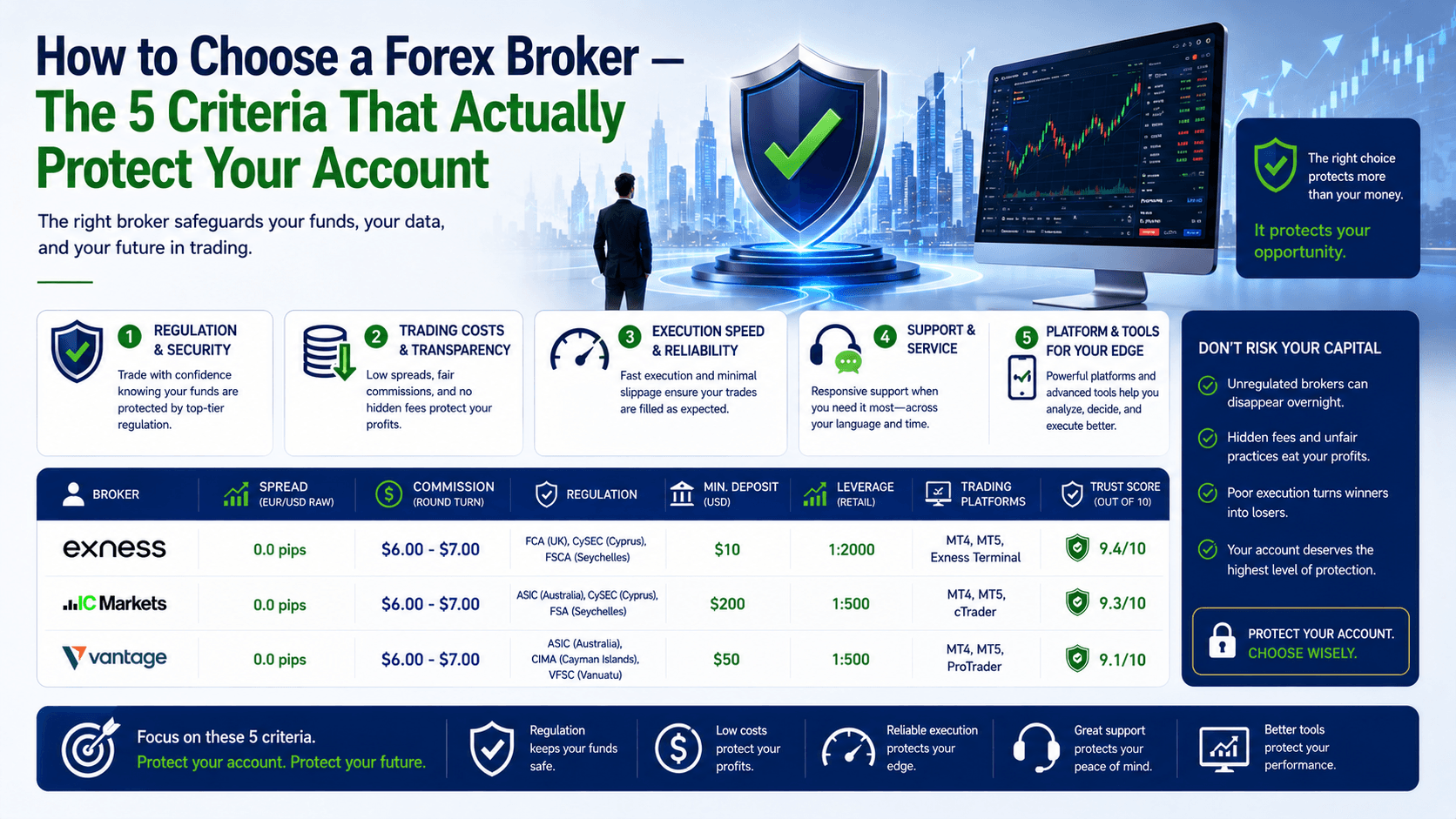
Let's cut through the noise. Here are the 5 criteria that actually matter when you choose a forex broker — and how to evaluate them properly.
1. Regulation: The Non-Negotiable
This is the single most important factor. A regulated broker answers to a financial authority. An unregulated broker answers to no one.
Major regulators include:
- FCA (UK) — Financial Conduct Authority
- ASIC (Australia) — Australian Securities and Investments Commission
- CySEC (Cyprus) — Cyprus Securities and Exchange Commission
- FINMA (Switzerland) — Swiss Financial Market Supervisory Authority
- NFA (US) — National Futures Association
How to verify: Every regulated broker displays its license number in the website footer. Go to the regulator's website and search that number. If it doesn't match, walk away.
⚠️ Common trap: Some brokers claim regulation in one jurisdiction but operate clients under a different, unregulated entity. Always check which entity your account falls under.
2. Execution Quality: What You Actually Get
Spread and commission are easy to compare. But execution quality — how fast and accurately your orders get filled — is harder to measure and more important.

Here's the scenario: You place a buy order on EUR/USD at 1.0850. The broker shows 1.0850 as the ask price. But your order fills at 1.0852. That's 2 pips of negative slippage. On a 0.1 lot position, that's $2. On a 1.0 lot position, that's $20 — gone before the trade even starts.
Execution quality depends on the broker's model:
| Broker Type | How It Works | Key Consideration |
|---|---|---|
| Market Maker | Broker takes the other side of your trade | Potential conflict of interest — broker profits when you lose |
| STP (Straight Through Processing) | Orders sent directly to liquidity providers | Generally better execution, but spreads can widen in volatile markets |
| ECN (Electronic Communication Network) | Orders matched directly between buyers and sellers | Usually lower spreads but commission-based pricing; best for active traders |
| DMA (Direct Market Access) | Orders sent directly to the interbank market | Highest transparency; typically for professional traders |
For most retail traders, an STP or ECN broker offers the best balance of cost and execution quality.
3. Trading Costs: The Math That Matters
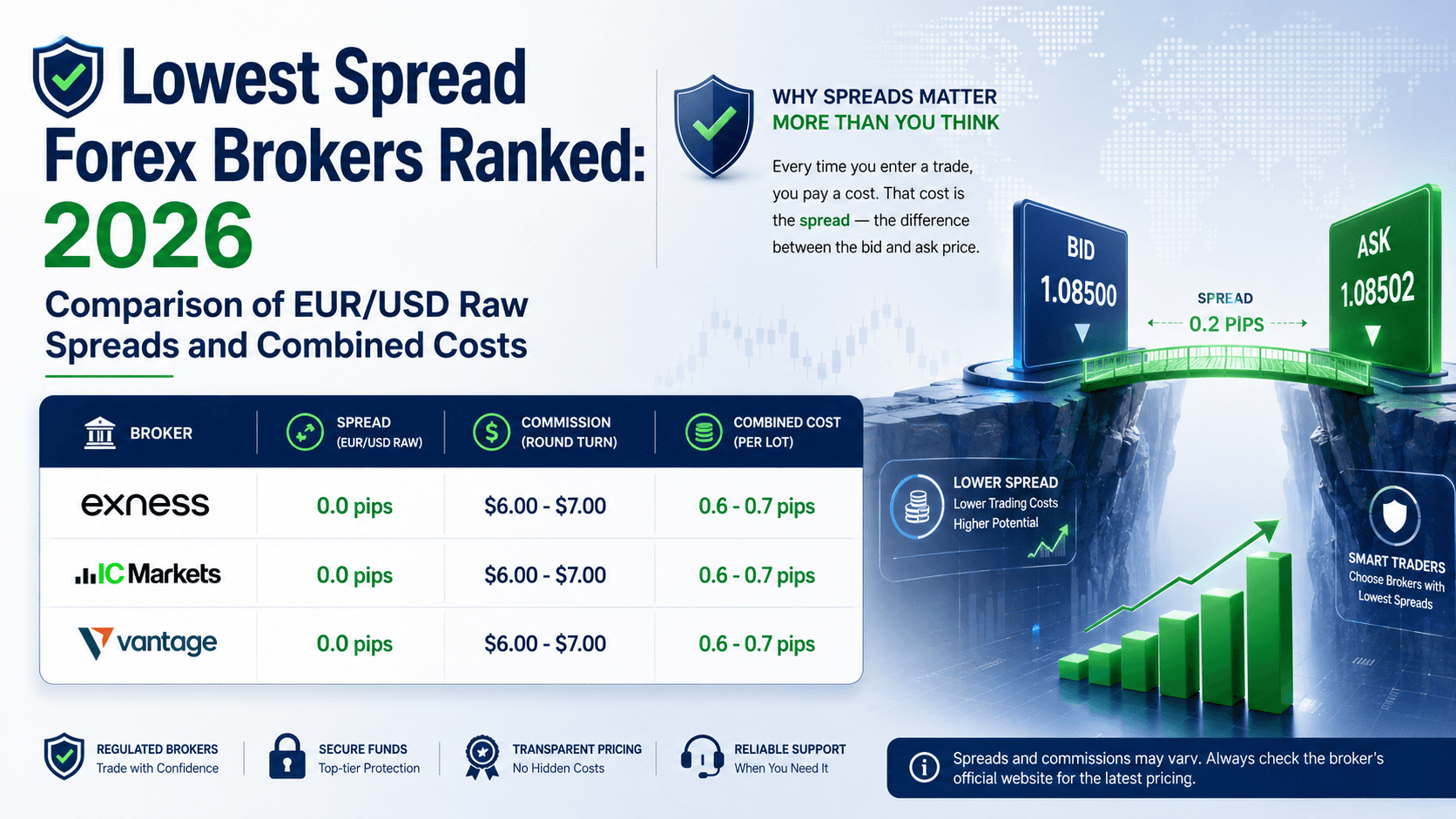
Let's calculate the real cost of a trade. Most beginners only look at the spread. But there are three components:
- Spread: The difference between bid and ask. EUR/USD at 1.0850/1.0851 = 1 pip spread. On 0.1 lots, that's $1.
- Commission: Some brokers charge a flat fee per trade. Example: $3.50 per side on a standard lot. That's $7 round trip.
- Swap (overnight funding): If you hold a position past 5 PM EST, you pay or receive interest. This can add up significantly on longer-term trades.
Real example: You trade 0.5 lots of EUR/USD, 10 times per week. Exness has a 1 pip spread, no commission. Broker B has a 0.2 pip spread but charges $3.50 per side.
- Exness cost per trade: 1 pip × $5 = $5. Weekly: $5 × 10 = $50.
- Broker B cost per trade: 0.2 pips × $5 = $1 + $7 commission = $8. Weekly: $8 × 10 = $80.
Exness is cheaper for this volume. But if you trade 50 times per week, Broker B becomes cheaper. The right choice depends on your trading frequency.
4. Platform and Tools: The User Experience
MetaTrader 4 (MT4) and MetaTrader 5 (MT5) are the industry standards. They're reliable, widely supported, and offer all the tools most traders need. Some brokers offer proprietary platforms with additional features.
What to check:
- Mobile app: Can you trade from your phone? Is it stable?
- Charting tools: Does it have the indicators you use?
- Automated trading: Do you need Expert Advisors (EAs)? If so, MT4/MT5 support is essential.
- Demo account: Can you test the platform with virtual funds before depositing real money?
⚠️ Common trap: A demo account often shows better execution and lower spreads than the live environment. Always expect some degradation when going live.
5. Withdrawal Process: The Test That Never Fails
This is the most overlooked factor. A broker can be great at everything else, but if you can't withdraw your money easily, nothing else matters.
Before depositing, check:
- Withdrawal methods: Bank transfer, credit card, e-wallet? Are they the same as deposit methods?
- Processing time: 1-3 business days is standard. Anything longer is a red flag.
- Fees: Does the broker charge for withdrawals? Most reputable brokers don't.
- Verification process: You'll need to submit ID and proof of address. This is normal. But if the process takes weeks, that's a problem.
Quick test: Search "[broker name] withdrawal problems" on any trading forum. If you see multiple complaints, move on.
FAQ
Is it safe to trade with an unregulated broker?
No. An unregulated broker has no obligation to follow financial standards. If they go bankrupt or disappear, you have no recourse. Always choose a broker regulated by a reputable authority.

How much money do I need to start trading forex?
Many brokers allow deposits as low as $50-$100. However, with a $100 account, your position size is very limited. A $500-$1,000 minimum is more realistic for meaningful trading with proper risk management.
What is the best trading platform for beginners?
MetaTrader 4 (MT4) is the most widely used and beginner-friendly platform. It's intuitive, has extensive educational resources, and is supported by most brokers. MetaTrader 5 (MT5) offers more features but has a steeper learning curve.
How do I know if a broker's spreads are competitive?
Compare live spreads during major trading sessions (London and New York open). Major pairs like EUR/USD typically have spreads of 0.5-1.5 pips from ECN brokers. If a broker consistently shows spreads above 2 pips on majors, look elsewhere.
Quick Recap
- Regulation first: Verify the broker's license with the regulator's database. No exceptions.
- Execution matters more than spread: An STP or ECN broker gives you fairer fills.
- Calculate total cost: Spread + commission + swap = your real trading cost.
- Test the platform: Use a demo account for at least a week before depositing.
- Check withdrawal process: Read reviews about withdrawal speed and ease.
Quick Win: Your 5-Minute Broker Check
Open the website of any broker you're considering. Find the "Regulation" or "About Us" page. Note their license number. Go to the regulator's website and search it. If it's not listed, cross that broker off your list. This takes 5 minutes and could save you thousands.